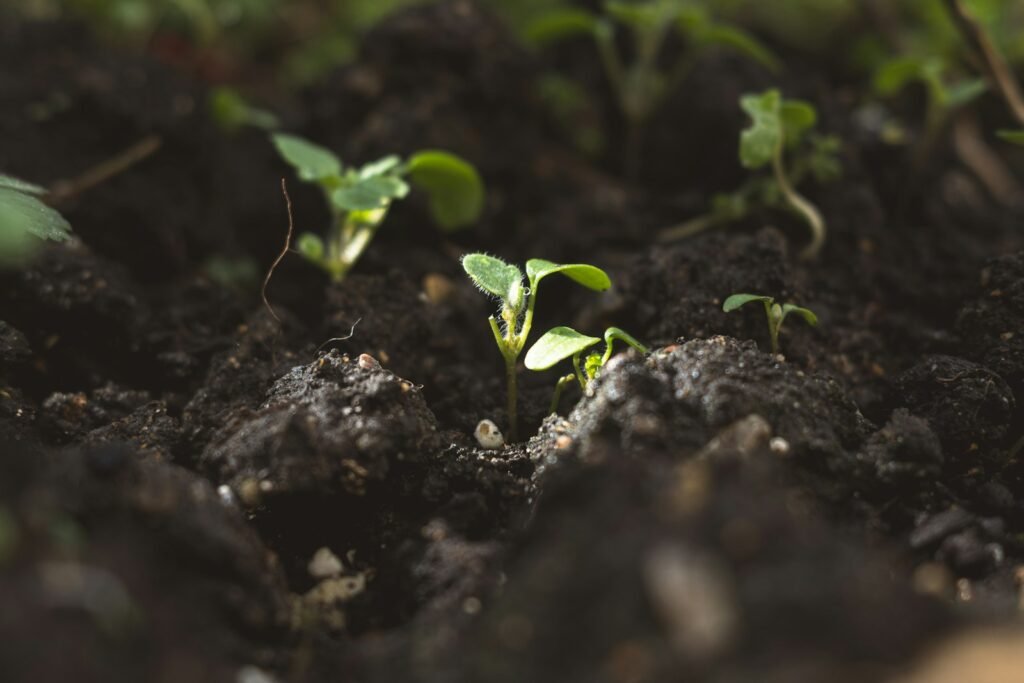
Before buying amendments or fertiliser, find out what your soil actually needs. Five simple tests, most needing nothing more than household items, tell you the texture, drainage, pH, moisture and biological health of your soil.
1. The jar test (texture)
Fill a straight-sided jar one-third with soil, top up with water and a teaspoon of dishwasher detergent, shake for three minutes and leave it. Sand settles in a minute, silt within a few hours and clay over a day or two. Measure each layer and enter the thicknesses in our soil texture calculator to get your soil class on the USDA triangle.
2. The percolation test (drainage)
Dig a hole about 30 cm (12 in) deep and wide, fill it with water and let it drain. Refill it and measure how far the level drops in an hour. The soil drainage calculator turns that into a drainage rate and tells you whether your soil drains well, slowly or too fast.
3. The pH test
A simple kit from a garden centre gives a good indication. For a quick check, mix soil with vinegar: fizzing means alkaline soil with free lime. Mix another sample with water and baking soda: fizzing suggests acid soil. If the pH is off, the soil pH calculator shows how much lime or sulfur to add.
4. The moisture test
Weigh a soil sample, dry it in a low oven until the weight stops changing and weigh it again. The soil moisture calculator converts that into water content and tells you how much water the root zone needs.
5. The worm count (soil life)
Dig out a spadeful of soil about 20 cm (8 in) cube in spring or autumn when the soil is moist, and count the worms. Ten or more means healthy, biologically active soil; fewer than three suggests the soil needs organic matter.
When to use a lab test
Home tests tell you about structure and approximate pH. A lab test adds accurate pH, a lime requirement, nutrient levels (phosphorus, potassium, magnesium) and organic matter. Get one when starting a new garden, every three to four years after, or when plants struggle despite good care. Our fertilizer requirement calculator turns lab recommendations into the amount of product to buy.
More guides
How Much Grass Seed Do I Need? Rates per 1,000 Sq Ft and per Acre by Grass Type
Seeding rates differ fivefold between grasses: bluegrass needs 2-3 lb per 1,000 sq ft, tall fescue 8-10 lb. Here are rates by…
Read guide
Growing Degree Days Explained: The Formula, Corn GDUs and How to Use Them
Growing degree days measure heat, not time, so they predict crop stages and pest timing better than the calendar. Here is the…
Read guide
How Much Is a Black Walnut Tree Worth? A Realistic Guide to Selling Walnut Timber
Most black walnut trees are worth hundreds, not thousands. Here is how buyers value walnut logs, why the Doyle rule matters and…
Read guide