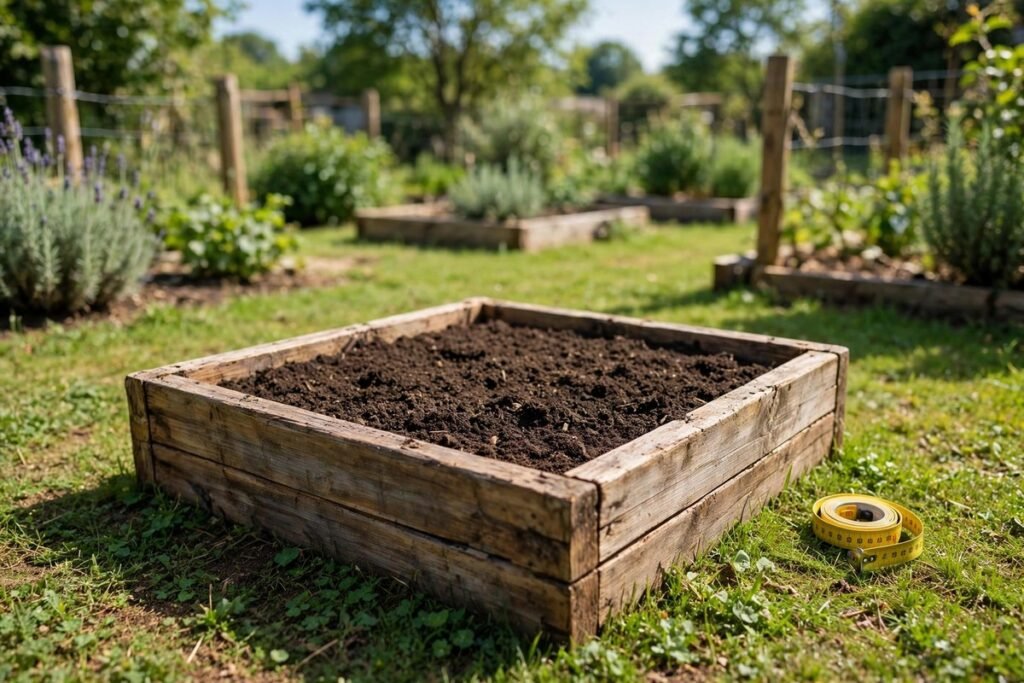
How Much Soil for a 4×4 Raised Bed?
A 4×4 raised bed 12 inches deep needs 16 cubic feet of soil, about 0.59 cubic yards or 11 bags of 1.5 cubic feet. At 6 inches deep it needs 8 cubic feet, at 18 inches it needs 24 cubic feet, and at 24 inches it needs 32 cubic feet. Add 10 percent for settling before you buy.
Below, see how that number changes with depth, how many bags it means, and how to split it into topsoil, compost and aeration. Use the Raised Bed Soil Calculator to run your exact size and mix.
How to work out soil for a 4×4 bed
Soil volume is length times width times depth. Measure inside the frame, not outside it.
For a rectangular bed, volume = inside length x width x depth. A 4×4 bed covers 16 square feet. At 12 inches deep, that is 16 x 1 = 16 cubic feet.
Divide by 27 for cubic yards: 16 / 27 = 0.59. Multiply by 28.32 for litres: 453 litres, or 0.45 cubic metres. Then add settling. Fresh mix sinks as air pockets close. The calculator uses 10 to 20 percent. Total = volume x beds x (1 + settling %). At 10 percent, 16 cubic feet becomes 17.6 cubic feet.
Soil volume for a 4×4 bed at every common depth
This table is for one square 4×4 foot bed, before settling.
| Fill depth | Cubic feet | Cubic yards | Litres | 1.5 cu ft bags | 2 cu ft bags |
|---|---|---|---|---|---|
| 6 inches | 8 | 0.30 | 227 | 6 | 4 |
| 12 inches | 16 | 0.59 | 453 | 11 | 8 |
| 18 inches | 24 | 0.89 | 680 | 16 | 12 |
| 24 inches | 32 | 1.19 | 906 | 22 | 16 |
With 10 percent for settling, the 12 inch bed rises to 17.6 cubic feet, or 12 bags of 1.5 cubic feet. The 18 inch bed rises to 26.4 cubic feet, or 18 bags, and the 24 inch bed to 35.2 cubic feet, or 24 bags.
In metric, a 4 foot bed is 1.22 metres on each side. At 30 cm deep it holds 453 litres, or 10 bags of 50 litres.
A 4×8 bed needs exactly double these figures. See the guide on how much soil for a 4×8 raised bed for that size.
Worked example: one 4×4 bed, 12 inches deep
Volume first: 4 x 4 x 1 foot = 16 cubic feet. Add 10 percent for settling: 16 x 1.10 = 17.6 cubic feet, or 0.65 cubic yards and 498 litres.
Split the settled total at the calculator default of 40 percent topsoil, 40 percent compost and 20 percent aeration. Each ingredient is total x its share. Topsoil is 17.6 x 0.40 = 7.04 cubic feet. Compost is also 7.04 cubic feet. Aeration is 17.6 x 0.20 = 3.52 cubic feet.
Bags are rounded up per ingredient: bags = ceil(ingredient volume / bag size). With 1.5 cubic foot bags, that is 5 of topsoil, 5 of compost and 3 of aeration, or 13 in total, one more than dividing the mixed total by 1.5. With 50 litre bags, it is 4, 4 and 2 bags.
In metric, the bed holds 453 litres, rising to 498 litres with settling: 199 litres of topsoil, 199 litres of compost and 100 litres of aeration. This matches the site example: a 2.4 x 1.2 metre bed at 30 cm deep holds 864 litres, or 950 litres with settling.
Two 4×4 beds at 12 inches deep need 32 cubic feet, or 35.2 cubic feet with settling.
How deep should a 4×4 raised bed be?
Depth is the biggest lever on cost. A 12 inch bed needs twice the soil of a 6 inch bed. Choose depth by crop and by what is under the bed.
Salad leaves, herbs, radishes and strawberries do well at 6 to 8 inches. Lettuce, beans, peas and dwarf bulbs suit 8 to 12 inches. Peppers, tomatoes, squash and carrots need 12 to 18 inches. Fruit bushes, shrubs and small trees need 18 inches or more.
The RHS notes that 30 cm (1 ft) suits dwarf bulbs, salad leaves and strawberries, but most plants, especially fruit bushes, shrubs and small trees, need 45 cm (18 in) or more. University of Maryland Extension gives a similar split for beds on hardscape: 8 inches for leafy greens, beans and cucumber, and 12 to 24 inches for pepper, tomato and squash.
On open soil, roots can grow past the frame, so a shallower fill still works. On paving, the bed is the whole root zone, so fill deeper. If you are not sure, 12 inches is a sound default.
Measure the depth you will actually fill, not the height of the lumber. A 12 inch frame filled to 10 inches needs 13.33 cubic feet, not 16.
What mix should you put in a 4×4 bed?
The calculator default is 40 percent topsoil, 40 percent compost and 20 percent aeration. Topsoil gives bulk and structure, compost adds nutrients, and aeration keeps the mix open so water drains.
There is no single best recipe. The RHS uses roughly seven parts topsoil, three parts organic matter and two parts sharp sand. University of Maryland Extension uses compost and topsoil in a 1:2 or 1:1 ratio. Mel’s Mix is one third compost, one third peat moss or coir, and one third vermiculite.
For a 4×4 bed at 12 inches deep with settling, the 40:40:20 split is 7.04 cubic feet of topsoil, 7.04 of compost and 3.52 of aeration. With 60 percent topsoil and 40 percent compost, the same 17.6 cubic feet splits as 10.56 of topsoil and 7.04 of compost.
Avoid one ingredient alone. Straight topsoil compacts and drains poorly. Straight compost shrinks fast. Straight potting soil dries out quickly and costs far more per cubic foot. For recipes, see the best soil mix for raised garden beds. For each part on its own, use the topsoil calculator and the compost calculator.
Bags or bulk for a 4×4 bed?
For one 4×4 bed at 12 inches deep, bags are usually simpler: 11 bags of 1.5 cubic feet before settling, or 12 with 10 percent settling.
Bulk becomes worth pricing once the total passes about 1 cubic yard. That happens with one bed at 24 inches deep, or two beds at 12 inches deep. Bulk needs somewhere to be tipped and time to move it the same day. Bags cost more per cubic foot, but you can buy exactly what you need.
Check the bag label before you count, as bag sizes are nominal and some are measured before compression. When you compare bulk quotes, confirm whether delivery is included. Mulch is separate, not part of the soil volume. Work it out with the mulch calculator after the bed is filled.
Measure inside the frame, then fill in layers
Measure inside the frame at two or three points, because timber can bow. Measure depth to the fill line you plan to use, not to the top of the board.
Fill in layers and water each layer lightly as you go, so air pockets settle early. Mix the ingredients before they go in, or layer them and mix in the bed with a fork. Leave the bed to settle for a few days, then top it up before planting. The plant spacing calculator shows how many plants fit a 4×4 bed once the fill is right.
Common mistakes with a 4×4 bed
Measuring outside the frame. For 2 inch boards, the inside can be 4 inches shorter each way, cutting volume by about 15 percent.
Using board height as fill depth. A 12 inch board filled to 10 inches needs 13.33 cubic feet, not 16. Decide the fill line first, then calculate.
Forgetting settling. Fresh mix can drop 1 to 2 inches in the first weeks. Without a 10 to 20 percent allowance, the bed ends up low and dries out faster.
Filling with topsoil alone. Topsoil alone compacts, drains slowly and gives plants little nutrition. Blend it with compost and aeration.
Filling a deep bed entirely with premium mix. Roots do most of their work in the top 8 to 12 inches. For a bed deeper than 18 inches, use coarser material below and good mix on top.
Buying bags by weight. A cubic foot of wet topsoil weighs far more than a cubic foot of dry compost. Buy by cubic feet or litres, and check the bag volume on the label.
Frequently asked questions
Q: How many bags of soil do I need for a 4×4 raised bed?
A: At 12 inches deep, 11 bags of 1.5 cubic feet, or 8 bags of 2 cubic feet, before settling. With 10 percent settling, buy 12 or 9 bags. Bought separately at 40:40:20, allow 5 of topsoil, 5 of compost and 3 of aeration.
Q: How much soil for a 4×4 raised bed 6 inches deep?
A: 8 cubic feet, about 0.30 cubic yards or 227 litres: 6 bags of 1.5 cubic feet, or 4 bags of 2 cubic feet. With 10 percent settling, the total is 8.8 cubic feet, which still rounds to 6 bags.
Q: How deep should a 4×4 raised bed be?
A: 12 inches suits most vegetables. Use 6 to 8 inches for salad leaves, herbs and strawberries, 12 to 18 inches for tomatoes, peppers and carrots, and 18 inches or more for fruit bushes. Go deeper on paving or compacted ground.
Q: Can I fill a raised bed with topsoil only?
A: You can, but the result is usually poor. Topsoil alone compacts, drains slowly and lacks organic matter. A blend of topsoil, compost and aeration holds structure, drains better and feeds plants.
Q: How much soil do I need after settling?
A: Add 10 to 20 percent. For a 4×4 bed at 12 inches deep, that takes 16 cubic feet to 17.6 cubic feet at 10 percent, or 19.2 at 20 percent. Top up with 1 to 2 inches of mix after the first few weeks, and again each spring.
Q: How much soil for a round 4 foot bed?
A: A round bed 4 feet across and 12 inches deep holds 12.57 cubic feet, about 0.47 cubic yards or 356 litres: 9 bags of 1.5 cubic feet before settling. Use pi x diameter squared / 4 x depth, then add settling.
A 4×4 bed is a good size to start with because the maths is simple. Work out the volume for your depth, add settling, split the mix, and check the bag count before you buy. Run your exact measurements through the Raised Bed Soil Calculator to confirm the total. For more guides, browse the garden guides.
More guides

How to Choose a Fertilizer Rate: Meet Nitrogen or Cap Every Nutrient
Learning how to choose a fertilizer rate starts with one choice. You either meet a chosen nutrient target, usually nitrogen, and accept…
Read guide
Too Much Phosphorus From Fertilizer: Surplus, Signs and Fixes
Too much phosphorus from fertilizer is a surplus that appears when a balanced blend meets nitrogen and supplies twice the phosphate the…
Read guide
Fertilizer NPK Numbers Explained: What N, P2O5 and K2O Mean
Fertilizer npk numbers are the three percentages on a fertilizer bag, listed in the order nitrogen, phosphate and potash. They tell you…
Read guide