How to Fill a Deep Raised Bed Cheaply
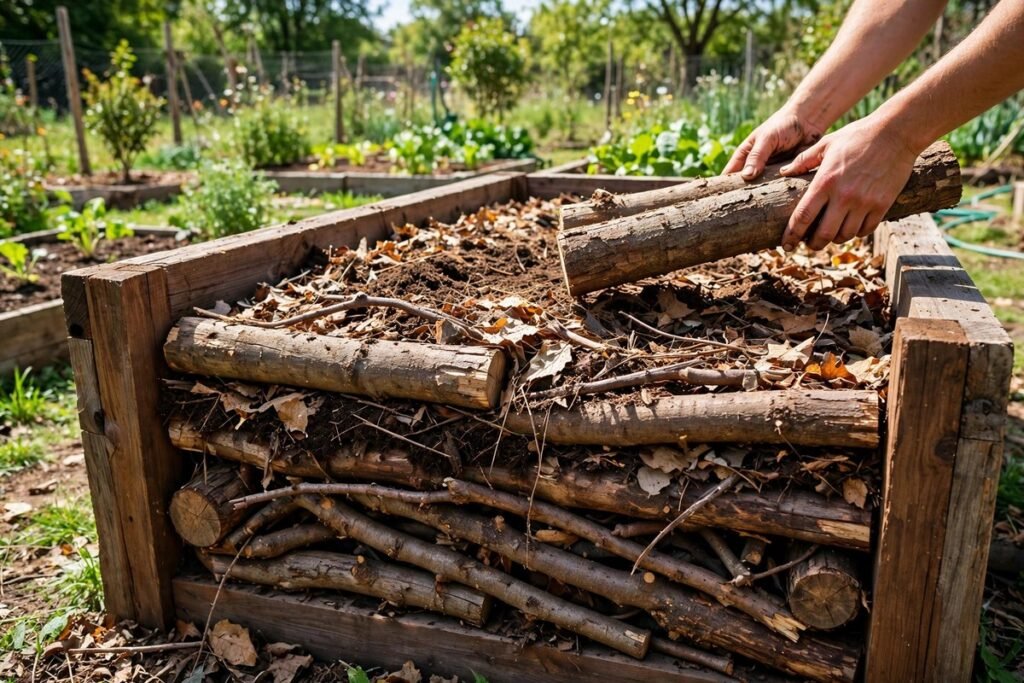
Fill a deep raised bed cheaply by putting bulky organic material in the bottom half and saving good soil mix for the top 12 inches where most roots grow. Logs, branches, leaves, straw and plain cardboard take up space for free, while the top layer gives plants the loose, fertile soil they need from day one.
Why a deep bed costs so much
Volume grows with every extra inch of height. A 4 by 8 foot bed 12 inches deep holds 32 cubic feet. At 24 inches deep, the same bed holds 64 cubic feet. Bagged mix is the most expensive way to buy that volume. Bulk soil is usually cheaper once you need a cubic yard or more. Most vegetables root mainly in the top 12 inches, so only that layer needs premium mix.
How much soil you save
Use inside measurements, because thick timber walls reduce the volume. The calculator uses this formula:
volume = inside length x width x depth
total = volume x beds x (1 + settling %)
each ingredient = total x its share
Settling is 10 to 20 percent for soil mix. Hugelkultur layers settle more, so top up after a few weeks.
A 4 by 8 foot bed 24 inches deep, filled fully, needs 4 x 8 x 2 feet, or 64 cubic feet. With 12 inches of logs, branches and leaves at the bottom and 12 inches of soil mix on top, you need 4 x 8 x 1 foot, or 32 cubic feet. That is about 1.2 cubic yards, since 32 divided by 27 is 1.19. Add 10 percent for settling and the order is about 35 cubic feet. You save 32 cubic feet, about half.
A 4 by 8 foot bed 18 inches deep, filled fully, needs 4 x 8 x 1.5 feet, or 48 cubic feet. With 6 inches of filler below and 12 inches of mix on top, you need 32 cubic feet again, or about 35 cubic feet with 10 percent for settling. The saving is 16 cubic feet, or one third.
Use the Raised Bed Soil Calculator for the top layer only. Enter the inside length and width, enter 12 inches as the depth, and set settling to 10 percent. With the common 40 percent topsoil, 40 percent compost and 20 percent aeration blend, 35 cubic feet splits to 14 cubic feet of topsoil, 14 cubic feet of compost and 7 cubic feet of aeration.
What goes where
Think coarse at the bottom and fine at the top, so water and roots can move down and air can reach the material breaking down.
| Layer, bottom to top | Depth in a 24 inch bed | Material | Purpose |
|---|---|---|---|
| Base | Thin sheet | Plain brown cardboard, overlapped, wetted | Smothers weeds, attracts worms |
| Coarse wood | 6 to 8 inches | Logs and thick branches, packed tightly | Takes up volume, holds moisture |
| Small wood and leaves | 4 to 6 inches | Twigs, shredded leaves, straw | Fills gaps, adds carbon |
| Green and compost | 2 to 4 inches | Grass clippings in thin layers, finished compost | Adds nitrogen and microbes |
| Top soil mix | 12 inches | Topsoil and compost blend, with aeration | Planting layer, loose and fertile |
For an 18 inch bed, shorten the wood and leaf layers and keep 12 inches of mix on top, with about 6 inches of filler below. For a 12 inch bed, use no large logs. Use twigs, leaves and compost, and keep at least 8 to 10 inches of mix on top. The RHS gives the same logic: for beds deeper than 50 cm, about 20 inches, replace the base with rubble or subsoil, then finish with good mix. Rubble is more stable; wood is cheaper but sinks more.
Hugelkultur, honestly
Hugelkultur means burying wood under soil. In a framed bed it is logs and branches at the bottom, smaller material above them, then soil. Clemson Cooperative Extension describes that order, starting with 3 to 4 inches of corrugated cardboard, then wood from largest to smallest, then plant material, then topsoil and compost on top. Wood soaks up water and releases it slowly once it softens. Fertility is slower, as wood breaks down over years.
Washington State University Extension, in a review by Linda Chalker Scott, notes there are no peer reviewed scientific studies on hugelkultur as a whole system. Treat the water and fertility claims as plausible and site dependent, not as a guarantee.
Three trade offs matter. First, settling. Logs compact, leaves collapse and wood loses volume as it decays, so expect the surface to fall by a few inches in the first weeks and months. Top up with compost and mix. Second, nitrogen. Fresh wood is high in carbon and low in nitrogen, so microbes breaking it down can draw nitrogen from the soil above in the first season. Partly rotted wood is better than fresh green wood. Add finished compost above the wood, and grow peas and beans in the first season. Do not mix fresh wood chips through the top 12 inches. Third, drainage. Fill gaps with twigs, leaves and straw, water each layer as you build it, and do not leave large empty gaps. A simpler fill still saves money: branches and leaves without large logs, or subsoil for the base, with less settling and less first year nitrogen demand.
Fill it in an afternoon
Put the frame in its final place. Cut grass short under it, or fork soil lightly to break a compacted surface. Lay plain brown cardboard across the base, overlapping the sheets, with tape and staples removed. Avoid glossy, waxed or heavily printed cardboard. Wet it well.
Add the largest logs and branches first, packed tightly and level. Fill larger gaps with smaller branches, then add twigs, shredded leaves and straw. Water this layer until it is damp right through.
Add a thin layer of grass clippings, finished compost or well rotted manure, spread out rather than in wet clumps. Then add the top mix in stages: half, level and water lightly, then the rest. Leave about 2 inches below the rim for mulch and topping up. The RHS suggests filling to about 5 cm, or 2 inches, below the rim and leaving the bed to settle for a couple of weeks. Water well, wait a week or two if you can, and top up before planting, or plant shallow rooted crops first and keep extra mix ready.
What to avoid
Avoid treated timber, painted or stained wood, old railway sleepers of unknown history, and any wood that may have been treated with preservative. Those chemicals can leach into soil used for food crops. Avoid black walnut wood and leaves, which contain juglone that can inhibit tomatoes, peppers and eggplant. Avoid wood from diseased trees and leaf matter from diseased plants; Clemson Extension warns diseased material can carry problems into the bed.
Avoid fresh wood chips in the root zone. They are useful as surface mulch, but mixed through the top 12 inches they can tie up nitrogen where roots need it most. Avoid weed seeds, seed filled grass clippings, and kitchen waste with meat, dairy or cooked food. Use plant based scraps only, in thin layers. Avoid filling the whole bed with compost alone, which shrinks a lot. Do not line the bottom with plastic, and do not add thick gravel in a bed that drains into soil below.
First year planting and buying the top layer
Peas and beans are a good first crop, because they fix nitrogen and are less demanding than heavy feeders. Potatoes, onions and root crops also cope well while the wood starts to break down. Leafy salads may need extra compost if they look pale. Save the hungriest crops for the second season if you can, or give them a generous compost top dressing. Top up with 2 to 3 inches of compost each spring or autumn, forked lightly into the top few inches.
Buy the top layer as a mix. A common blend is 40 percent topsoil, 40 percent compost and 20 percent aeration. Another is 60 percent topsoil and 40 percent compost. The RHS general mix is seven parts topsoil, three parts organic matter and two parts sharp sand. All are starting points. If you buy in bulk, ask what is in the mix and whether it is screened. Work out the top layer volume with the Raised Bed Soil Calculator, then compare bags with bulk for the same volume. Do not buy soil for the filler layers. Spend the money where roots will use it, in the top 12 inches.
FAQs
Q: How deep should the soil be in a deep raised bed?
A: Aim for 12 inches of good soil mix on top, even if the bed is 18 or 24 inches tall. Most vegetables root mainly in that top layer. Use filler below it.
Q: Can I fill a raised bed with logs and branches?
A: Yes, in the bottom layers. Pack logs and branches tightly, fill gaps, add compost above the wood, then add 12 inches of mix on top. Avoid black walnut, diseased wood and treated timber.
Q: How much soil do I need for a 4×8 raised bed that is 24 inches deep?
A: Filled fully, it needs 64 cubic feet. With 12 inches of filler at the bottom and 12 inches of soil mix on top, you need 32 cubic feet, about 1.2 cubic yards, or about 35 cubic feet with 10 percent added for settling.
Q: Will a hugelkultur bed sink?
A: Yes. Expect a drop of a few inches in the first weeks and months. Leave 2 inches below the rim, and top up after a few weeks and each season.
Q: What should I plant first in a hugelkultur bed?
A: Start with peas, beans, potatoes, onions and root crops. They cope better while fresh wood draws nitrogen. Save the hungriest crops for the second season.
Q: Is it cheaper to buy soil in bags or in bulk for a deep bed?
A: Bulk is usually cheaper once you need about a cubic yard or more. Bags are easier if you have no place for a bulk delivery to be tipped. Work out the top layer volume first, then compare the two.
More guides
How to Choose a Fertilizer Rate: Meet Nitrogen or Cap Every Nutrient
Learning how to choose a fertilizer rate starts with one choice. You either meet a chosen nutrient target, usually nitrogen, and accept…
Read guide
Too Much Phosphorus From Fertilizer: Surplus, Signs and Fixes
Too much phosphorus from fertilizer is a surplus that appears when a balanced blend meets nitrogen and supplies twice the phosphate the…
Read guide
Fertilizer NPK Numbers Explained: What N, P2O5 and K2O Mean
Fertilizer npk numbers are the three percentages on a fertilizer bag, listed in the order nitrogen, phosphate and potash. They tell you…
Read guide