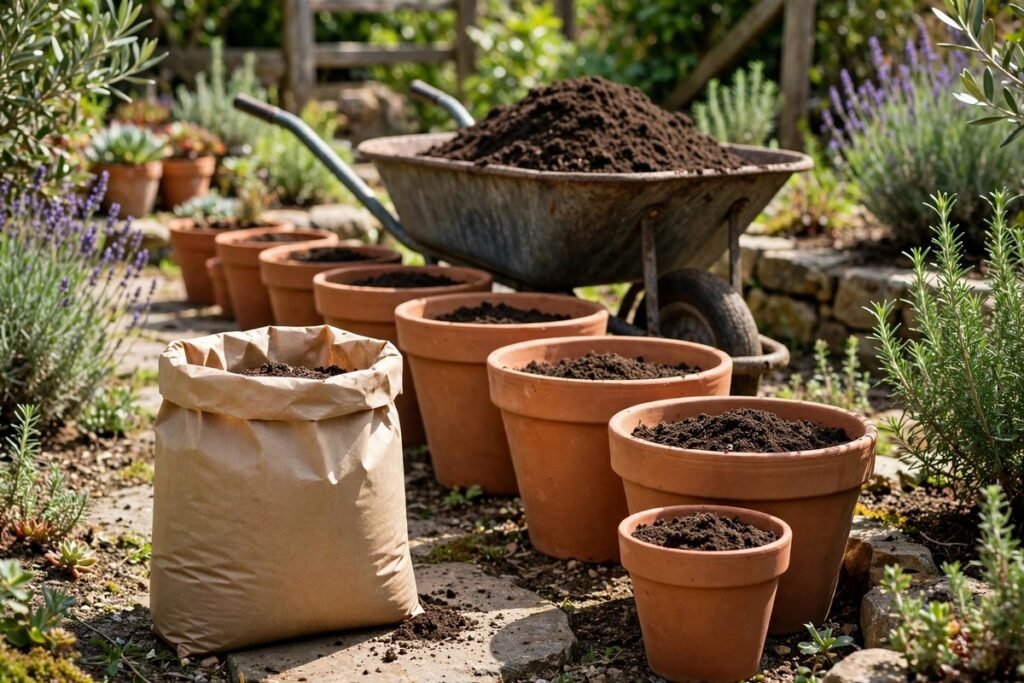
How Many Pots Does a Bag of Potting Soil Fill?
A 40 L bag of potting soil fills about two and a half 30 cm pots at 90 percent fill. It also fills 9 twenty cm pots and 19 fifteen cm pots. The exact count depends on pot size, pot depth, and how full you fill each pot. Use the table below to find your bag and pot size.
Use the Potting Soil Calculator to run your exact pots and bag size.
How the pots per bag number is worked out
Most pots taper toward the base, so the calculator treats a round pot as a frustum, a cone with its top cut off. Pot volume = pi x depth x (top squared + top x base + base squared) / 12, where base = 0.85 x top and pi is 3.1416. Use the same unit throughout, then divide cubic centimetres by 1000 to get litres. Soil in one pot = pot volume x fill percent, and this article uses 90 percent throughout, leaving a gap below the rim for watering. Pots per bag = bag volume / soil in one pot, rounded down, so 2.62 means 2 whole pots. Bags needed = ceil(soil needed / bag size), rounded up, so 2.3 bags means 3 bags.
Soil in one pot at 90 percent fill
These volumes are at 90 percent fill, not full to the rim.
| Pot top width | Pot depth | Soil per pot at 90 percent fill |
|---|---|---|
| 10 cm | 10 cm | 0.61 L |
| 15 cm | 15 cm | 2.05 L |
| 20 cm | 18 cm | 4.36 L |
| 25 cm | 22 cm | 8.33 L |
| 30 cm | 28 cm | 15.27 L |
| 35 cm | 30 cm | 22.28 L |
| 40 cm | 35 cm | 33.94 L |
| 50 cm | 40 cm | 60.61 L |
A typical 12 inch (30 cm) round pot about 11 inches deep holds roughly 17 litres before the gap below the rim. Check it: pi x 28 x (900 + 765 + 650.25) / 12 = 16971 cubic cm = 16.97 L, and 16.97 x 0.90 = 15.27 L at 90 percent fill. Volume grows fast: a 30 cm pot holds about three and a half times a 20 cm pot, because 15.27 / 4.36 = 3.50.
Pots per bag table
Each cell is the number of whole pots one bag fills at 90 percent fill, rounded down. A cell showing 0 means one bag does not fill even one pot of that size.
| Bag size | 10 cm pot | 15 cm pot | 20 cm pot | 25 cm pot | 30 cm pot | 35 cm pot | 40 cm pot | 50 cm pot |
|---|---|---|---|---|---|---|---|---|
| 10 L | 16 | 4 | 2 | 1 | 0 | 0 | 0 | 0 |
| 20 L | 32 | 9 | 4 | 2 | 1 | 0 | 0 | 0 |
| 25 L | 41 | 12 | 5 | 2 | 1 | 1 | 0 | 0 |
| 40 L | 65 | 19 | 9 | 4 | 2 | 1 | 1 | 0 |
| 50 L | 82 | 24 | 11 | 5 | 3 | 2 | 1 | 0 |
| 60 L | 98 | 29 | 13 | 7 | 3 | 2 | 1 | 0 |
Read across for your bag size, then down for your pot size. A 10 L bag fills no 30 cm pot, which needs 15.27 L, and a 60 L bag still fills no 50 cm pot, which needs 60.61 L, short by only 0.61 L.
How to read the table
For a 40 L bag and a 30 cm pot, 40 / 15.27 = 2.62, about two and a half pots by volume, but 2 whole pots when you plan, using 30.54 L and leaving 9.46 L. For a 25 L bag, 25 / 15.27 = 1.64, about 1.6 thirty cm pots by volume, and 1 whole pot when you count. For the same bag and a 20 cm pot, 25 / 4.36 = 5.73, about 5.7 twenty cm pots by volume, and 5 whole pots when you count, using 21.80 L. For a 50 L bag and a 15 cm pot, 50 / 2.05 = 24.39, so 24 whole pots, using 49.20 L and leaving 0.80 L.
Worked examples
A 40 L bag and 30 cm pots: 40 / 15.27 = 2.62, count 2 whole pots, leaving 9.46 L. For 3 thirty cm pots, soil needed is 3 x 15.27 = 45.81 L, bags needed is ceil(45.81 / 40) = 2 bags, because 45.81 / 40 = 1.15. A 25 L bag fills 5 twenty cm pots, 12 fifteen cm pots, and 41 ten cm pots. A 50 L bag and 15 cm pots: 50 / 2.05 = 24.39, count 24 whole pots. One 50 cm pot needs 60.61 L, so a 60 L bag gives 0 whole pots. Two 60 L bags leave 59.39 L, two 40 L bags leave 19.39 L.
How to work out bags for a mixed set of pots
Add the soil for each group first, then add extra, then divide by the bag size and round up. Four 30 cm pots, 28 cm deep, hold about 15 L each at 90 percent fill, and six 20 cm pots, 18 cm deep, hold about 4.4 L each. With 5 percent extra, that is about 92 L, and 3 bags of 40 L. Check it: 4 x 15.27 = 61.08 L, 6 x 4.36 = 26.16 L, total 87.24 L. With 5 percent extra, 87.24 x 1.05 = 91.60 L, about 92 L. Bags needed is ceil(91.60 / 40) = 3 bags, because 91.60 / 40 = 2.29.
Compressed bags and expanded volume
Bagged potting soil is sometimes compressed. The volume on the bag may be the compressed volume, the expanded volume, or both. Every figure in this article uses the expanded volume, the loose soil you get when you open the bag and loosen it. Check the label, and use the expanded volume as the bag size. If it lists only a compressed volume, do not use that number as if it were loose soil.
Loosen compressed soil before you measure it into pots. Break up clumps, let it expand, and fill lightly rather than packing it down hard. Add a small extra percent for settling. Refresh reused soil from healthy plants with compost and slow release feed, and discard soil from diseased plants. Use the Compost Calculator to work out the compost volume.
Bag sizes in cubic feet and gallons
Bag sizes are sold in litres in many places, and in cubic feet in others. Use the litres figure in the division.
| Bag size in litres | Bag size in cubic feet | Bag size in US gallons |
|---|---|---|
| 10 L | 0.35 | 2.64 |
| 20 L | 0.71 | 5.28 |
| 25 L | 0.88 | 6.61 |
| 40 L | 1.41 | 10.57 |
| 50 L | 1.77 | 13.21 |
| 60 L | 2.12 | 15.85 |
Conversions: 1 L equals 0.0353 cubic feet, 1 cubic foot equals 28.3 L, and 1 US gallon equals 3.785 L. A 1.5 cubic foot bag is 42.45 L, close to a 40 L bag but not the same, so use 42.45 L in the division.
Common mistakes
Rounding pots up instead of down. A result of 2.62 pots is 2 whole pots, not 3.
Rounding bags down instead of up. A result of 2.29 bags is 3 bags, not 2.
Using the top width as if the pot were a straight cylinder. A tapered pot holds less than a straight pot of the same top width.
Using compressed volume as expanded volume. A compressed bag expands when opened, so use the expanded volume on the bag.
Forgetting settling and spillage. Soil settles after watering, and some spills, so add a small extra percent.
Guessing pot depth from pot width. A shallow bowl and a tall pot can share a top width, so measure depth.
Frequently asked questions
Q: How many pots does a bag of potting soil fill?
A: It depends on pot size. A 40 L bag fills 2 whole 30 cm pots, 9 twenty cm pots and 19 fifteen cm pots at 90 percent fill.
Q: How many 30 cm pots does a 40 litre bag fill?
A: About two and a half pots by volume, which is 2 whole pots. Soil per 30 cm pot is 15.27 L, and 40 divided by 15.27 is 2.62. Two pots use 30.54 L, leaving 9.46 L.
Q: How many 15 cm pots does a 50 litre bag fill?
A: 24 whole pots. Soil per 15 cm pot at 90 percent fill is 2.05 L, and 50 divided by 2.05 is 24.39. Twenty four pots use 49.20 L, leaving 0.80 L in the bag.
Q: How many bags of potting soil do I need for a mixed set of pots?
A: Add the soil for each group, add extra, then divide by the bag size and round up. Four 30 cm pots and six 20 cm pots need 87.24 L before extra, 91.60 L with 5 percent extra, about 92 L, which is 3 bags of 40 L.
Q: Does a bag of potting soil fill more pots if it is compressed?
A: No, the count uses expanded volume, the loose soil you get after opening the bag. Check the expanded volume on the bag label and use that number.
Q: How much potting soil do I need for one large planter?
A: Work from the pot volume at 90 percent fill. A 50 cm pot needs 60.61 L, so one 60 L bag is not enough, and you need 2 bags of 60 L or 2 bags of 40 L. For a garden bed, use the Garden Volume Calculator to work out the volume.
Run your exact pots and bag size through the Potting Soil Calculator. For more guides, browse the garden guides.
More guides
How to Choose a Fertilizer Rate: Meet Nitrogen or Cap Every Nutrient
Learning how to choose a fertilizer rate starts with one choice. You either meet a chosen nutrient target, usually nitrogen, and accept…
Read guide
Too Much Phosphorus From Fertilizer: Surplus, Signs and Fixes
Too much phosphorus from fertilizer is a surplus that appears when a balanced blend meets nitrogen and supplies twice the phosphate the…
Read guide
Fertilizer NPK Numbers Explained: What N, P2O5 and K2O Mean
Fertilizer npk numbers are the three percentages on a fertilizer bag, listed in the order nitrogen, phosphate and potash. They tell you…
Read guide