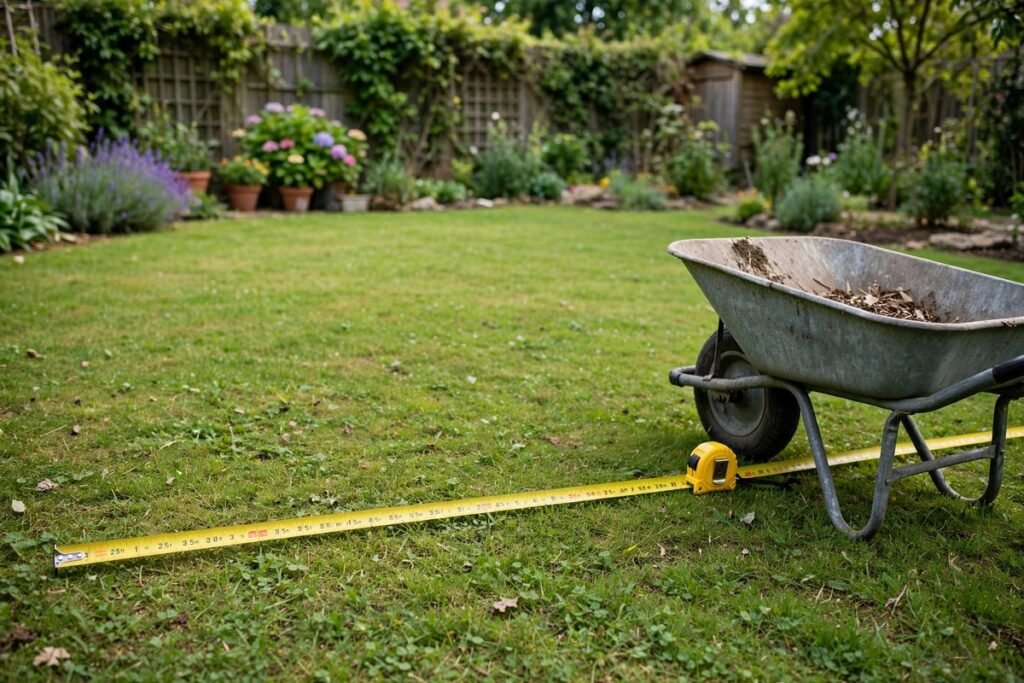
To learn how to measure a garden area, sketch the lawn or bed, split it into rectangles, circles, triangles or ovals, measure each part in straight lines along the ground, work out each area with the matching formula, add the parts together, subtract any patio or building, then check the total in the Garden Area Calculator before you order material.
Why Measure First and Order Second
An order for seed, mulch, sod or fertiliser starts with area. The amount you need follows from the area you cover, so a wrong area gives a wrong order. A garden that looks small can be much larger once every corner is counted, and a large garden can shrink once a patio, a path and a shed are taken out. When the area is settled, you enter the same total into the calculator for the material you plan to use, and that calculator gives the amount from its own rate. One careful measure serves every material that covers the same ground.
What You Need Before You Start
You need only a few simple tools. A long tape measure is the main tool. A tape of 10 m or longer suits a lawn, while a shorter tape suits a small bed. A notebook and a pencil come next, because you will sketch the garden and write each length on the sketch as you go. A few short pegs or stones help to mark corners so the tape stays in place. A second person helps on a long run. Walk the garden once before you measure, and note where the lawn ends, where a bed begins, and where a patio sits.
Sketch and Split the Garden Into Shapes
Start with a rough sketch. Draw the outline of the garden, then draw lines inside it to split it into simple shapes. A rectangle suits most lawns and beds. A circle suits a round bed. A triangle suits a corner that comes to a point. An oval suits a long curved bed. Cover the whole garden without large gaps or overlaps.
Give each shape a name, such as Lawn, Round Bed and Corner. For a rectangle, you need length and width. For a circle, you need the diameter. For a triangle, you need the base and the height. For an oval, you need length and width. Three sections are often enough.
| Shape | What to measure | Formula |
|---|---|---|
| Rectangle | Length and width | Length x width |
| Circle | Diameter | Pi x diameter squared / 4 |
| Triangle | Base and height | Base x height / 2 |
| Oval | Length and width | Pi x length x width / 4 |
Measure Each Section in Straight Lines
Measure in straight lines along the ground. Lay the tape from one corner to the next in a direct line, keep it flat, and read it where it meets the next corner. Do not follow a curve with the tape. Measure each edge twice. If the two readings agree, write the number down. If they differ, measure a third time and look for the cause.
Write each length on the sketch beside its shape as soon as you take it. Use clear numbers, write the unit beside each number, and keep the unit the same for every length. Measure the diameter of a round bed across the middle, through the centre. For a triangle, measure the base along one side, then measure the height from that base to the opposite point at a right angle.
Worked Example You Can Check
A worked example shows how separate areas add to one total. The lawn is a rectangle 10 m long and 5 m wide, so 10 x 5 gives 50 sq m. The round bed has a diameter of 3 m, so Pi x 9 / 4 gives 7.07 sq m. The corner has a base of 4 m and a height of 3 m, so 4 x 3 / 2 gives 6 sq m. Add the parts: 50 + 7.07 + 6 gives 63.07 sq m.
To convert that total to square feet, multiply square metres by 10.764. So 63.07 x 10.764 gives 678.9 sq ft, which is about 679 sq ft. The Garden Area Calculator gives the same total when you enter those three sections. Use the same check on your own garden.
| Section | Shape | Calculation | Area |
|---|---|---|---|
| Lawn | Rectangle | 10 x 5 | 50 sq m |
| Round bed | Circle | Pi x 3 squared / 4 | 7.07 sq m |
| Corner | Triangle | 4 x 3 / 2 | 6 sq m |
| Total | All sections | 50 + 7.07 + 6 | 63.07 sq m |
Mistakes That Make an Order Wrong
Five mistakes cause most wrong orders. Mixed units is the first. If one length is in metres and another is in feet, the areas cannot be added together as they stand. Keep every length in the same unit. Guessing a length is the second. A length that looks about 5 m can in fact be 6 m or 4 m. Measure every edge. Measuring along a slope surface is the third, so measure the flat distance underneath instead. Forgetting to subtract a patio, a path or a shed base is the fourth. Measure each one and subtract it from the total. Measuring once only is the fifth. A second reading catches most slips.
| Mistake | What happens | How to avoid it |
|---|---|---|
| Mixed units | Total is wrong by a large amount | Measure every part in the same unit |
| Guessing a length | Order is based on a guess | Measure every edge with a tape |
| Measuring along a slope | Slope figure is too large | Measure the flat distance underneath |
| Forgetting a patio | You order for ground not covered | Subtract each paved area |
| Measuring once only | A small error stays in the total | Measure each edge twice |
Keep Units Matched From Tape to Total
Units cause more errors than any other part of measuring, because a unit mistake hides inside a number that looks correct. A length written as 5 can mean 5 m or 5 ft, and the two give very different areas. Write the unit beside every length, and use the same unit for every section. If you start in metres, stay in metres.
Conversions belong at the end, not in the middle. Measure, work out each area, add the areas, and only then convert the total. The Garden Area Calculator converts the total into square metres, square feet, square yards, acres or hectares. Check it: 1 sq m equals 10.764 sq ft, and 1 acre equals 43,560 sq ft, which is about 4,047 sq m.
Subtract Patios, Paths and Buildings
A garden outline often contains parts that will not be covered. A patio, a path, a shed base and a driveway strip all sit inside the boundary but take no seed, mulch, sod or fertiliser. Treat each paved part as its own section, measure it in the same way as the lawn, and subtract its area from the total. Measure a patio as a rectangle. Take its length and width, work out its area, and write it on the sketch beside the word patio. Do the same for each path, even a narrow one. A path 10 m long and 1 m wide is 10 sq m. Add the lawn and bed sections first, then subtract the paved total.
How to Use the Total in Other Calculators
Once the total is checked, it becomes the input for the next step. The Garden Area Calculator itself gives area and unit conversions only. It does not give a seed weight, a fertiliser rate, a mulch volume, a sod count, a soil volume, a bag count or a plant count. Those amounts come from the calculators that cover each material, and each asks for the area and gives the amount.
For grass seed, enter the total area into the Grass Seed Calculator. For mulch, enter the same total into the Mulch Calculator. For sod or fertiliser, the workflow is the same. Measure the area first, check the total, then enter that total into the calculator for the material you plan to use. Keep a note of which total belongs to which area, so a front lawn total is not used for a back lawn of a different size.
A Simple Check Before You Order
Before you order, run a short check. Read each length on the sketch and ask if it matches the ground you walked. Add the areas again and compare the sum with the total from the Garden Area Calculator. Check that every length uses the same unit, that every paved part has been subtracted, and that every slope was measured as a flat distance. If any answer is no, fix that part and check the total again. Keep the sketch with the order note.
Frequently Asked Questions
Q: How do I measure a garden area that is not a rectangle?
A: Sketch the garden, split it into rectangles, circles, triangles or ovals, measure each part, work out each area, and add the parts together.
Q: What is the easiest way to measure a lawn for seed?
A: Measure in straight lines along the ground, keep every measurement in the same unit, work out each area, add the sections together, and use that total in the Grass Seed Calculator.
Q: Do I need to subtract a patio when I measure a garden?
A: Yes. Measure the patio as a separate rectangle, work out its area, and subtract it from the total.
Q: How do I convert square metres to square feet?
A: Multiply square metres by 10.764 to get square feet. For example, 63.07 sq m multiplied by 10.764 gives about 679 sq ft.
Q: How do I measure a slope correctly?
A: Measure the flat distance underneath the slope, not along the ground surface, because the ground surface is longer than the flat distance.
Q: Should I measure before I order mulch, sod or fertiliser?
A: Yes. Measure the area first and check the total, then enter that total into the calculator for the material you plan to use.
More guides

How to Choose a Fertilizer Rate: Meet Nitrogen or Cap Every Nutrient
Learning how to choose a fertilizer rate starts with one choice. You either meet a chosen nutrient target, usually nitrogen, and accept…
Read guide
Too Much Phosphorus From Fertilizer: Surplus, Signs and Fixes
Too much phosphorus from fertilizer is a surplus that appears when a balanced blend meets nitrogen and supplies twice the phosphate the…
Read guide
Fertilizer NPK Numbers Explained: What N, P2O5 and K2O Mean
Fertilizer npk numbers are the three percentages on a fertilizer bag, listed in the order nitrogen, phosphate and potash. They tell you…
Read guide