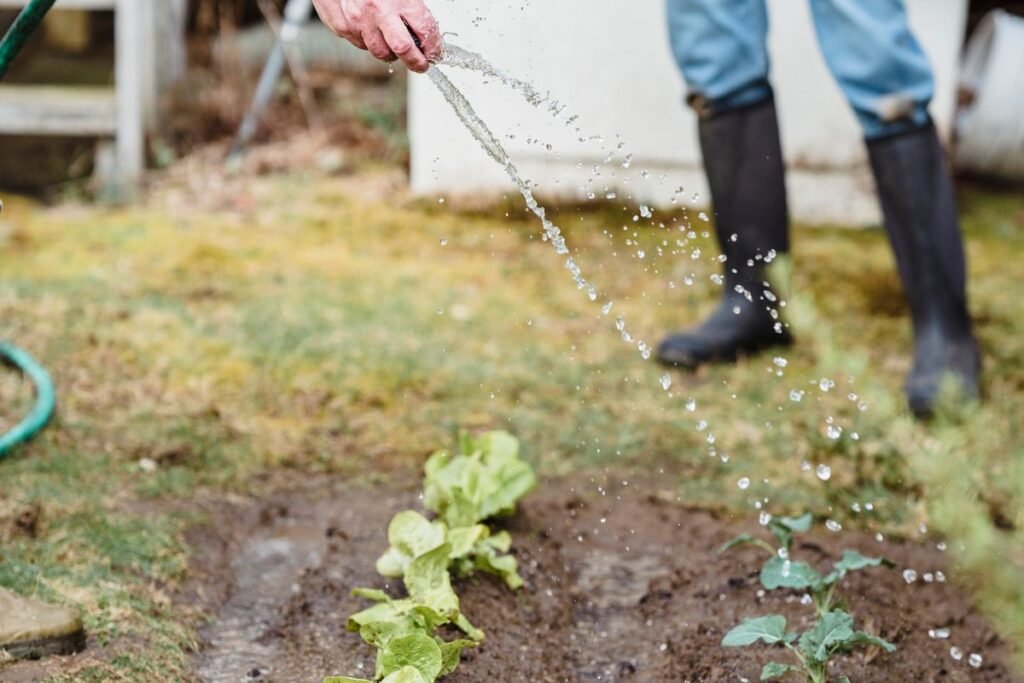
Watering in litres and gallons starts with one figure. A garden that needs 1 in of water a week needs 0.62 US gallons for every square foot, before losses. A 100 sq ft garden therefore needs 62.0 gallons a week at 100 percent, or 82.7 gallons with a 75 percent efficient sprinkler.
This blog gives imperial tables only. Every table uses sq ft for area and inches for weekly depth, and every volume is in US gallons. There are no metric tables in this blog. The metric worked example appears in one short section near the end, kept separate and labelled as a rounded equivalent, not an exact conversion. Table 1 covers depth, Table 2 covers area, Table 3 covers rain, Table 4 covers soil, and Table 5 covers minutes.
Watering in Litres and Gallons: How the Imperial Tables Work
Watering in litres and gallons is the same calculation in two unit systems, and this blog stays in the imperial system throughout. The calculator page gives both unit facts, and the imperial fact is the one this blog uses. One inch of water over 1 sq ft is 0.62 US gallons. The weekly need used in every table is 1 in a week, which is the only weekly need figure verified on the calculator page. A vegetable garden needs about 25 mm a week from rain and watering combined, and 25 mm is the same weekly need as 1 in on the page.
Rainfall figures are calculator inputs, not claims about any real place. The calculation has four steps, and the tables follow the same order. First, work out the shortfall. Shortfall equals weekly need minus rain, and it never goes below zero. Second, work out the water to apply. Water equals shortfall times area divided by method efficiency. Third, split the water into sessions by soil. Sand needs 3 sessions, loam needs 2 sessions, and clay needs 1 session. Fourth, work out the minutes. Minutes equal water per session divided by hose flow. The Garden Watering Schedule Calculator follows the same four steps.
Where the 0.62 Factor Comes From
One inch of water over 1 sq ft is 0.62 US gallons, and that figure is stated on the calculator page. It is a volume, not a rate, and it scales in direct proportion to area and depth. Double the area and the volume doubles. Double the depth and the volume doubles. Halve either one and the volume halves.
The 0.62 figure is the gross water before losses. It is the amount that must reach the soil, not the amount that must leave the hose or sprinkler. The only efficiency figure verified on the calculator page is 75 percent for a sprinkler, from the worked example. This blog therefore shows two columns wherever efficiency is applied. One column is at 100 percent, which means no loss, and the other column is at 75 percent sprinkler. Other methods are described only as enter your method’s efficiency, with no invented percentage.
Table 1: Gallons per Square Foot by Weekly Depth in Inches
Table 1 shows the water for each depth in inches, first as gallons per square foot and then as gallons for a 100 sq ft garden and a 200 sq ft garden. The depths are 0.25 in, 0.5 in, 0.75 in and 1 in. These depths are shortfall depths, which means the depth still to apply after rain. The area columns are at 100 percent, which means no loss.
| Weekly depth | Gallons per sq ft | Gallons for 100 sq ft | Gallons for 200 sq ft |
|---|---|---|---|
| 0.25 in | 0.155 | 15.5 | 31.0 |
| 0.5 in | 0.310 | 31.0 | 62.0 |
| 0.75 in | 0.465 | 46.5 | 93.0 |
| 1 in | 0.620 | 62.0 | 124.0 |
Table 2: Gallons a Week by Garden Area at 1 in Weekly Need
Table 2 shows the full weekly total for a garden that needs 1 in a week and had no rain. Garden areas run from 16 sq ft, which is a 4 ft by 4 ft bed, through 32 sq ft, 50 sq ft, 100 sq ft, 200 sq ft, 400 sq ft, 500 sq ft and 1,000 sq ft. The first column is at 100 percent, and the second is at 75 percent sprinkler. If the garden area falls between two rows, use the formula for the exact area.
| Garden area | Gallons a week at 100 percent | Gallons a week at 75 percent sprinkler |
|---|---|---|
| 16 sq ft | 9.9 | 13.2 |
| 32 sq ft | 19.8 | 26.5 |
| 50 sq ft | 31.0 | 41.3 |
| 100 sq ft | 62.0 | 82.7 |
| 200 sq ft | 124.0 | 165.3 |
| 400 sq ft | 248.0 | 330.7 |
| 500 sq ft | 310.0 | 413.3 |
| 1000 sq ft | 620.0 | 826.7 |
Table 3: Gallons Left to Apply After Rain on a 100 sq ft Garden
Table 3 shows what rain leaves to apply on a 100 sq ft garden with a weekly need of 1 in. Rain amounts are 0 in, 0.25 in, 0.5 in, 0.75 in and 1 in. Shortfall equals 1 in minus rain, and it never goes below zero. At 1 in of rain the shortfall is zero, so no watering is needed that week. The volumes are shown at 100 percent and at 75 percent sprinkler, as in Table 2. Every quarter inch of rain on 100 sq ft is worth 15.5 gallons at 100 percent. Scale the figures by area for other garden sizes.
| Rain this week | Shortfall | Gallons at 100 percent | Gallons at 75 percent sprinkler |
|---|---|---|---|
| 0 in | 1 in | 62.0 | 82.7 |
| 0.25 in | 0.75 in | 46.5 | 62.0 |
| 0.5 in | 0.5 in | 31.0 | 41.3 |
| 0.75 in | 0.25 in | 15.5 | 20.7 |
| 1 in | 0 in | 0 | 0 |
Table 4: Gallons per Session by Soil Type
Table 4 splits the weekly total into sessions by soil. Sand needs 3 sessions, loam needs 2 sessions, and clay needs 1 session. The totals in Table 4 are at 75 percent sprinkler, with a full 1 in weekly need and no rain. The totals are 41.3 gallons for a 50 sq ft garden, 82.7 gallons for a 100 sq ft garden, and 165.3 gallons for a 200 sq ft garden. The session figures are worked from the unrounded totals, then rounded to one decimal place, so a session figure times the session count may differ from the total by 0.1 gallons. That difference is rounding only.
| Garden area | Weekly total at 75 percent sprinkler | Sand 3 sessions gallons per session | Loam 2 sessions gallons per session | Clay 1 session gallons per session |
|---|---|---|---|---|
| 50 sq ft | 41.3 | 13.8 | 20.7 | 41.3 |
| 100 sq ft | 82.7 | 27.6 | 41.3 | 82.7 |
| 200 sq ft | 165.3 | 55.1 | 82.7 | 165.3 |
Table 5: Minutes per Session at Two Example Flows
Table 5 turns gallons per session into minutes. Minutes equal water per session divided by hose flow, and the flow must be in gallons per minute for the minutes to come out in minutes. The flows in Table 5 are 3 gallons per minute and 5 gallons per minute. These are clearly labelled example flows, worked through the same formula, never page figures. The calculator page gives only one hose flow, which is 12 L per minute from a 10 L bucket filled in 50 seconds. The page does not state the imperial equivalent of that flow, so this blog does not convert it into gallons per minute as a page fact. The session gallons are the 100 sq ft figures from Table 4.
| Soil | Sessions | Gallons per session | Minutes at 3 gal per minute example flow | Minutes at 5 gal per minute example flow |
|---|---|---|---|---|
| Sand | 3 | 27.6 | 9.2 | 5.5 |
| Loam | 2 | 41.3 | 13.8 | 8.3 |
| Clay | 1 | 82.7 | 27.6 | 16.5 |
Worked Example: 100 sq ft Vegetable Bed After Half an Inch of Rain
A 100 sq ft vegetable bed needs 1 in of water a week from rain and watering combined. Half an inch of rain fell this week, so the shortfall is 1 in minus 0.5 in, which equals 0.5 in. The gross water is 0.5 times 100 times 0.62, which equals 31.0 gallons. With a 75 percent efficient sprinkler, the water to apply is 31.0 divided by 0.75, which equals 41.3 gallons. The bed is on loam, so the calculator gives 2 sessions. Each session is 41.3 divided by 2, which equals 20.7 gallons. At the 3 gallons per minute example flow, each session runs for 20.7 divided by 3, which equals 6.9 minutes.
Metric Example Kept Separate
The metric worked example from the calculator page is kept separate here, in litres only, as a rounded equivalent, not an exact conversion. A 20 m2 vegetable bed needing 25 mm a week, after 5 mm of rain, needs 20 mm more. The water is 533 L with a 75 percent efficient sprinkler, as two 267 L sessions of about 22 minutes at 12 L per minute. The shortfall is 25 minus 5, which equals 20 mm. The water is 20 times 20 divided by 0.75, which equals 533.3 L, shown as 533 L. The area of 20 m2 is about 215 sq ft, not a round imperial figure, so do not present this metric example as an exact imperial conversion.
How to Use the Calculator
First, measure the garden area in sq ft. Second, set the weekly need to 1 in, which is the verified weekly need figure. Third, enter the rain that fell this week, in inches, from a rain gauge or a weather app. Fourth, choose the soil, sand, loam or clay, and choose the watering method. Fifth, time the hose to find its flow, using the bucket test from the calculator page, where a 10 L bucket in 50 seconds is 12 L per minute. Sixth, read the water to apply, the number of sessions and the minutes from the calculator, then check the result against the nearest table in this blog. The Drip Irrigation Planner can plan drip lines once the gallons per session are known. Morning is best for watering, because less water evaporates and leaves dry quickly, which reduces disease.
What the Calculator Does Not Give
The calculator gives water to apply, sessions by soil and minutes at hose flow, from area, weekly need, rain, soil and method. It gives no cost figure, so this blog gives no cost figure. It gives no pump or pressure figures, so this blog gives no pump or pressure figures. It gives no sprinkler hardware sizing, so this blog gives no sprinkler hardware sizing. It gives no soil moisture measurement, so this blog gives no soil moisture measurement. It gives no per crop need beyond the weekly need input, so this blog gives no per crop need. The Crop Water Requirement Calculator can work out crop water use by crop and stage. Rain collected from a roof can help meet the gallons in the tables, and the Rain Barrel Calculator works out how much rainwater a roof collects, while the Rainwater Harvesting Calculator works out the yearly collection.
Common Mistakes
One mistake is to use the full 1 in weekly need as the amount to apply, without subtracting rain. At 100 sq ft that mistake adds 31.0 gallons at 100 percent after half an inch of rain, because the shortfall is 0.5 in, not 1 in. A second mistake is to use the gross gallons as the amount to apply with a sprinkler, without dividing by 0.75. At 100 sq ft and 1 in, the gross figure is 62.0 gallons and the sprinkler figure is 82.7 gallons, so the garden would be short by 20.7 gallons. A third mistake is to use the 75 percent sprinkler figure for every method, when the page gives no efficiency figure for drip, hose or any other method. The right approach for another method is to enter your method’s efficiency in the calculator, with no invented percentage in this blog. A fourth mistake is to apply the whole weekly total in one session on sand, when sand needs 3 sessions. The total is the same, but one large session on sand drains past the roots before the plants can use it. A fifth mistake is to mix metric and imperial inputs in one calculation, for example by entering a metric area as sq ft. A sixth mistake is to convert the page flow of 12 L per minute into gallons per minute as a page fact.
Frequently Asked Questions
Q: How many gallons does a 100 sq ft garden need a week at 1 in?
A: 62.0 gallons at 100 percent, or 82.7 gallons with a 75 percent efficient sprinkler, when no rain fell.
Q: How much water is 1 in over 1 sq ft in gallons?
A: 0.62 US gallons. Multiply the garden area in sq ft by the shortfall in inches, then by 0.62, to find the gross gallons that must reach the soil.
Q: How do I subtract rain from my weekly watering in gallons?
A: Shortfall equals weekly need minus rain, and it never goes below zero. A 100 sq ft garden after 0.5 in of rain has a shortfall of 0.5 in, so it needs 31.0 gallons at 100 percent, or 41.3 gallons at 75 percent sprinkler.
Q: How many gallons per session on sand, loam and clay for a 100 sq ft garden?
A: At 75 percent sprinkler the total is 82.7 gallons. Sand needs 27.6 gallons in each of 3 sessions, loam needs 41.3 gallons in each of 2 sessions, and clay needs 82.7 gallons in 1 session.
Q: How long should each session run in minutes?
A: Minutes equal water per session divided by hose flow in gallons per minute. Table 5 uses example flows of 3 and 5 gallons per minute only. The page flow is 12 L per minute, and this blog does not convert that figure into gallons per minute as a page fact.
Q: Is the metric example of 533 L the same as an imperial table row?
A: No. The metric example is a 20 m2 bed needing 533 L, and 20 m2 is about 215 sq ft, not a round imperial figure. The metric example is a rounded equivalent kept separate, not an exact conversion.
More guides
How to Choose a Fertilizer Rate: Meet Nitrogen or Cap Every Nutrient
Learning how to choose a fertilizer rate starts with one choice. You either meet a chosen nutrient target, usually nitrogen, and accept…
Read guide
Too Much Phosphorus From Fertilizer: Surplus, Signs and Fixes
Too much phosphorus from fertilizer is a surplus that appears when a balanced blend meets nitrogen and supplies twice the phosphate the…
Read guide
Fertilizer NPK Numbers Explained: What N, P2O5 and K2O Mean
Fertilizer npk numbers are the three percentages on a fertilizer bag, listed in the order nitrogen, phosphate and potash. They tell you…
Read guide