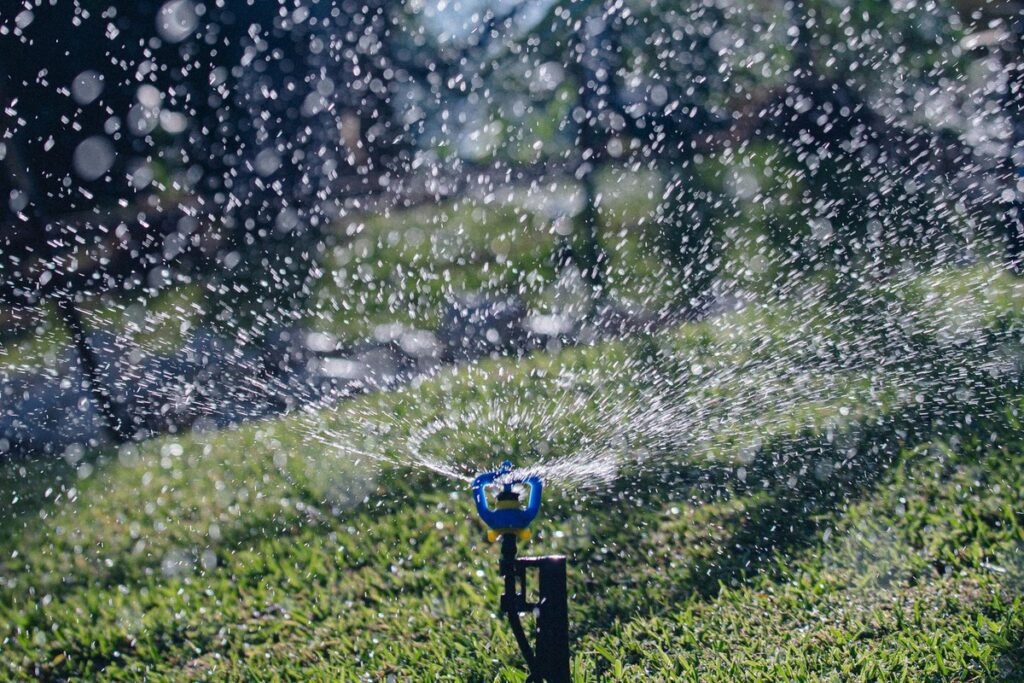
Precipitation rate from spacing tells you how fast water lands on a lawn when heads sit in a set grid. For the verified example in this guide, a full circle head throwing 5 m at 10 L/min, spaced 5 by 5 m, applies 24 mm per hour. That single rate then sets run time. To apply 12 mm at 24 mm per hour takes 30 minutes.
It shows the formula, works the verified example in full, then shows what changes when flow rises or spacing widens.
What Precipitation Rate From Spacing Means
Precipitation rate is the depth of water that lands on the ground in one hour. It is measured in mm per hour, or in inches per hour in imperial units. When you know the rate, you know how long to run a zone to apply a chosen depth.
Spacing matters because the same flow spread over a larger area gives a lower rate. The area each head serves is head spacing times row spacing. A small area gives a high rate, and a large area gives a low rate.
A full circle head covers pi times radius squared. A 5 m throw covers about 79 sq m, and a 15 ft throw covers about 707 sq ft. Heads overlap in a layout, so the rate comes from spacing, not from that circle.
The Formula in Plain Words
Precipitation rate equals full circle flow times 60 divided by head spacing times row spacing. In symbols, PR equals Q times 60 divided by S times L, where Q is full circle flow in L/min, S is head spacing in m, L is row spacing in m, and PR comes out in mm per hour.
In US units, PR in inches per hour equals 96.25 times gpm divided by S times L in feet. Mixing the two forms gives a wrong answer.
Run time equals depth divided by precipitation rate. If depth is in mm and rate is in mm per hour, run time comes out in hours. Multiply by 60 to get minutes.
The Verified Worked Example in Full
The verified example uses a full circle head throwing 5 m at 10 L/min, spaced 5 by 5 m. The area each head serves is 5 times 5, which is 25 sq m.
Flow is 10 L/min, so in one hour the head delivers 600 litres. In one line, 10 times 60 divided by 5 times 5 is 600 divided by 25, which is 24 mm per hour.
Now find run time for a depth of 12 mm. Run time equals depth divided by rate, so 12 divided by 24 is 0.5 hours. Half an hour is 30 minutes. That is the verified result. That rate holds only at 5 by 5 m spacing.
Rate by Flow at Fixed Spacing
Spacing stays fixed at 5 by 5 m below. Other rows are example inputs worked through the same formula.
| Flow (L/min) | Head spacing (m) | Row spacing (m) | Precipitation rate (mm per hour) |
|---|---|---|---|
| 5 | 5 | 5 | 12 |
| 7.5 | 5 | 5 | 18 |
| 10 | 5 | 5 | 24 |
| 12.5 | 5 | 5 | 30 |
| 15 | 5 | 5 | 36 |
| 20 | 5 | 5 | 48 |
The pattern is direct. Doubling flow from 5 to 10 L/min doubles the rate from 12 to 24 mm per hour. Doubling again to 20 L/min doubles the rate again to 48 mm per hour. A rate of 48 mm per hour sits well above the range most lawns take without runoff.
Rate by Spacing at Fixed Flow
Flow stays fixed at 10 L/min below. Other rows are example inputs worked through the same formula.
| Flow (L/min) | Head spacing (m) | Row spacing (m) | Precipitation rate (mm per hour) |
|---|---|---|---|
| 10 | 4 | 4 | 37.5 |
| 10 | 5 | 5 | 24 |
| 10 | 6 | 6 | 16.7 |
| 10 | 7 | 7 | 12.2 |
| 10 | 8 | 8 | 9.4 |
| 10 | 10 | 10 | 6 |
Spacing enters the formula twice, once as head spacing and once as row spacing. Moving from 5 by 5 m to 10 by 10 m multiplies the area by four, from 25 sq m to 100 sq m, and the rate falls to one quarter, from 24 to 6 mm per hour. Moving from 5 by 5 m to 4 by 4 m shrinks the area to 16 sq m and lifts the rate to 37.5 mm per hour.
Why Full Circle Flow Is Used for Part Circle Heads
Readers often ask why the formula uses full circle flow even when a head only waters part of a circle. The answer is the matched precipitation assumption. The calculator assumes matched precipitation nozzles. Under that assumption, a part circle head and a full circle head apply water at the same rate over the area each one serves.
A half circle head uses about half the flow over half a circle, so the flow per unit of area stays the same. A quarter circle head uses about a quarter of the flow over a quarter of the circle. Flow follows arc, so rate stays even across heads with different arcs.
The full circle flow is the common base that makes the comparison work. If you put the part circle flow into the formula as if it were a full circle flow, you would understate the rate for that head. Mixed nozzles break this assumption and apply water unevenly.
What Happens When Spacing Widens
Wider spacing lowers the rate and raises run time. Take the verified flow of 10 L/min. At 5 by 5 m spacing the rate is 24 mm per hour, so 12 mm takes 30 minutes. At 7 by 7 m spacing the rate is 12.2 mm per hour, so the same 12 mm takes about 59 minutes. At 10 by 10 m spacing the rate is 6 mm per hour, so the same 12 mm takes 120 minutes. The depth has not changed. The flow has not changed. Only spacing has changed, and run time has doubled, then doubled again. Very tight spacing gives a very high rate, and a high rate can run off before it soaks in, especially on clay soils.
Triangular Spacing and Row Spacing
Triangular spacing staggers each row so heads sit in the gaps of the row before. It gives more even coverage than a square grid at the same head spacing.
In a triangular layout, row spacing is head spacing times 0.866. For a head spacing of 5 m, row spacing is 5 times 0.866, which is 4.33 m. The area each head serves is 5 times 4.33, which is 21.65 sq m. That is smaller than the 25 sq m of a 5 by 5 m square layout, so the rate at the same flow is higher. At 10 L/min, the rate is 600 divided by 21.65, which is 27.7 mm per hour. That is an example input, not a verified figure.
Run Time by Depth at 24 mm per Hour
Run time is depth divided by rate. The table below uses the verified rate of 24 mm per hour.
| Depth to apply (mm) | Precipitation rate (mm per hour) | Run time (minutes) |
|---|---|---|
| 6 | 24 | 15 |
| 10 | 24 | 25 |
| 12 | 24 | 30 |
| 18 | 24 | 45 |
| 25 | 24 | 62.5 |
The table holds the three depths this guide names: 12 mm takes 30 minutes, 18 mm takes 45 minutes, and 25 mm takes 62.5 minutes. Read across from the depth you want. If your rate is 12 mm per hour instead of 24, the same 12 mm takes 60 minutes, not 30. The irrigation run time calculator works the same step for each zone.
The Imperial Example
The imperial form uses the same idea with gallons, feet, and inches. The verified imperial example is 2.5 gpm at 15 by 15 ft, which gives 1.07 in per hour. The area each head serves is 15 times 15, which is 225 sq ft. That is 96.25 times 2.5 divided by 225. 96.25 times 2.5 is 240.625. 240.625 divided by 225 is 1.069, shown as 1.07 in per hour.
Other rows below are example inputs at 15 by 15 ft. Only the row at 2.5 gpm is the verified example.
| Flow (gpm) | Head spacing (ft) | Row spacing (ft) | Precipitation rate (in per hour) |
|---|---|---|---|
| 1.5 | 15 | 15 | 0.64 |
| 2.0 | 15 | 15 | 0.86 |
| 2.5 | 15 | 15 | 1.07 |
| 3.0 | 15 | 15 | 1.28 |
| 3.5 | 15 | 15 | 1.50 |
A rate of 1.07 in per hour sits just above the 0.5 to 1 in per hour range most lawns take without runoff. At 1.07 in per hour, a depth of 0.5 in takes about 28 minutes. Use metric or imperial, but do not mix them in one calculation.
How to Use the Coverage Calculator
The sprinkler coverage calculator takes the same inputs this guide uses: flow, head spacing, row spacing, and depth. Put in your measured spacing and your flow, and it returns the coverage of one head, the precipitation rate, and the run time for your depth. One head covers pi times radius squared times arc divided by 360.
Use measured figures. If your layout is triangular, use the triangular row spacing. If your flow is a part circle flow, convert it to the full circle flow first.
The calculator gives no cost, pump, pressure, pipe sizing, or soil infiltration rate figures. For head count, the sprinkler calculator covers the next step, and the irrigation scheduling calculator helps set how often those runs happen.
Common Mistakes
- Using part circle flow as if it were full circle flow. That understates the rate.
- Using the single head circle as the area. The rate uses head spacing times row spacing.
- Forgetting row spacing. A layout can be tight along a row and wide between rows. Both spacings count.
- Mixing units. The metric form needs L/min and metres. The imperial form needs gpm and feet, with the 96.25 constant.
- Setting run time from a rate that ignores wind and low pressure. Wind and low pressure reduce real throw. A catch cup test confirms the real rate.
- Chasing a high rate to shorten run time. A high rate above the 12 to 25 mm per hour range can run off, especially on clay soils.
Frequently Asked Questions
Q: What is a good precipitation rate for lawns?
A: Most lawns take 12 to 25 mm per hour without runoff, which is 0.5 to 1 in per hour. Work your rate from flow and spacing, then set run time from depth divided by rate.
Q: How much area does one sprinkler head cover?
A: A full circle head covers pi times radius squared. A 5 m throw covers about 79 sq m, and a 15 ft throw covers about 707 sq ft. Heads overlap in a layout, so use head spacing times row spacing.
Q: Why is triangular spacing used?
A: Triangular spacing gives more even coverage. At the same head spacing it serves less area per head, 21.65 square metres against 25 square metres at 5 m spacing, so the rate is higher. Row spacing is head spacing times 0.866. The practical benefit is that the even overlap often lets you use a slightly wider head spacing in a triangular layout.
Q: Why do part circle heads use full circle flow in the formula?
A: The formula assumes matched precipitation nozzles, so a part circle head and a full circle head apply water at the same rate over the area each one serves. Full circle flow is the common base.
More guides
Hargreaves vs Penman Monteith: When the Simple Estimate Is Enough
Hargreaves vs penman monteith is a choice between a simple estimate from temperature alone and a fuller calculation from complete weather data.…
Read guide
Daily ET0 vs Monthly Average ET0: Planning vs Scheduling
Daily ET0 vs monthly ET0 is a choice between one day and a month. Use a monthly average to plan a season,…
Read guide
How Latitude and Date Change Your ET0
Latitude and ET0 are linked through Ra, the extraterrestrial radiation that reaches the top of the atmosphere. When latitude or date changes,…
Read guide