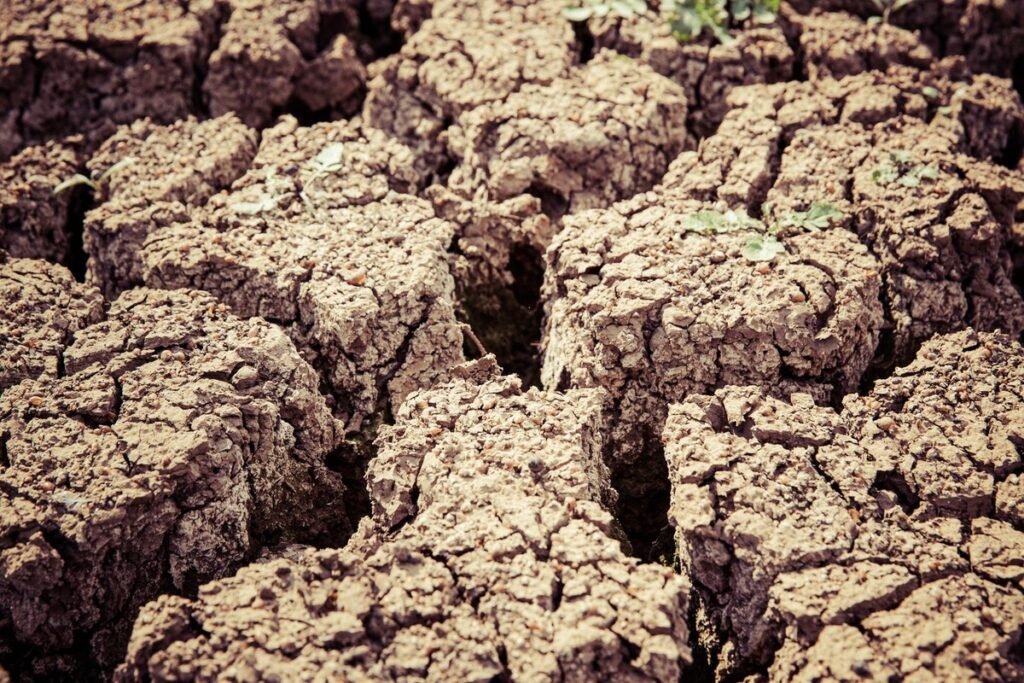
Allowable depletion is the share of soil water that plants can use before stress starts to affect growth. The usual range is 30 to 60 percent, and 50 percent is the default on the irrigation scheduling calculator. That share sets how much water each watering replaces and how many days pass before the next watering is due.
What allowable depletion means
Soil holds water in the spaces between soil particles, and plants draw on that stored water between waterings. Not all of it is usable. Some water stays bound so tightly to soil particles that roots cannot pull it free, and some drains away soon after watering. The water between those two limits is the available water. Allowable depletion is a share of that available water, not a share of all the water in the soil. A setting of 50 percent does not mean half the soil is dry. It means half of the usable store has been used, and the other half is still there for the roots.
How allowable depletion fits the formula
The calculator uses four steps, and allowable depletion sits in the second step. First, root zone water is available water percentage times root depth. Second, net depth is root zone water times allowable depletion. Third, the interval in days is net depth divided by daily water use, known as ET. Fourth, gross depth is net depth divided by the efficiency of the watering system. A change in allowable depletion flows through the whole result. Raise the percentage and the net depth rises, the interval lengthens, and the gross depth rises with it. Lower the percentage and every one of those numbers falls. The interval is an outcome, not a starting point.
The worked example on one loam bed
The anchor is the worked example from the calculator page. Loam holds about 17 percent available water. With roots 30 cm deep, root zone water is 0.17 times 300 mm, which is 51 mm. That 51 mm is the usable store. At 30 percent, net depth is 15.3 mm and the interval at 5 mm a day is about 3 days. At 50 percent, net depth is 25.5 mm and the interval is about 5 days. At 60 percent, net depth is 30.6 mm and the interval is about 6 days. Gross depth at 80 percent efficiency is shown in the table.
| Allowable depletion | Net depth | Interval at 5 mm a day | Gross depth at 80 percent efficiency |
|---|---|---|---|
| 30 percent | 15.3 mm | About 3 days | 19.1 mm |
| 50 percent | 25.5 mm | About 5 days | 31.9 mm |
| 60 percent | 30.6 mm | About 6 days | 38.3 mm |
Moving from 30 percent to 60 percent doubles the net depth and doubles the interval. A three day interval means more trips, but each trip is shorter. A six day interval means fewer trips, but each watering must soak deeper.
Why 50 percent is the default
At 50 percent, about half the available water is used before watering, which is the point the calculator page gives for knowing when to irrigate. Half used and half left is a balance. The soil is moist enough that roots can still draw water without strain for most of the interval, yet dry enough that the watering that follows has room to soak in without running off the surface or draining straight past the roots. The default also protects against treating the full available water as usable. Plants slow their growth long before they wilt in an obvious way, and by the time wilting is easy to see, growth has already been lost.
Sensitive crops need a lower setting
Some crops show stress sooner than others. Their leaves may wilt in afternoon heat, their growth may check after a dry spell, or their fruit may suffer while the leaves still look fair. For those crops, the safe share of available water is smaller, so allowable depletion should sit at the lower end of the 30 to 60 percent range. No per crop figure is given here. On the loam anchor, moving from 50 percent to 30 percent cuts net depth from 25.5 mm to 15.3 mm and cuts the interval from about 5 days to about 3 days. The plants get water sooner, while the soil is still moist enough for easy uptake.
Young plants need shorter intervals
Young plants with small root systems need shorter intervals, and the calculator page says so plainly. Root zone water is available water percentage times root depth, so halving root depth halves the store, the net depth, and the interval. On loam at 50 percent, roots 15 cm deep hold 25.5 mm and give an interval of about 2.6 days at 5 mm a day. Roots 30 cm deep give about 5 days. Roots 60 cm deep give 10.2 days.
| Root depth on loam | Root zone water | Net depth at 50 percent | Interval at 5 mm a day |
|---|---|---|---|
| 15 cm | 25.5 mm | 12.8 mm | About 2.6 days |
| 30 cm | 51 mm | 25.5 mm | About 5 days |
| 60 cm | 102 mm | 51 mm | About 10 days |
A young plant is doubly exposed: its store is small, and its roots occupy only the top layer of soil, which dries first. Water young plants more often with smaller depths, and lengthen the interval as roots grow deeper.
Soil texture changes the store
Available water capacity is the water a soil holds between field capacity, the water left after free drainage, and wilting point, the level below which plants cannot draw water fast enough. Sand holds about 7 percent available water, loam about 17 percent, and silt loam about 20 percent. Those are the only available water percentages given on the calculator page. At 30 cm roots, 50 percent depletion and 5 mm a day, sand gives a net depth of 10.5 mm and an interval of about 2 days, loam gives 25.5 mm and about 5 days, and silt loam gives 30 mm and 6 days.
| Soil at 30 cm roots | Available water | Root zone water | Net depth at 50 percent | Interval at 5 mm a day |
|---|---|---|---|---|
| Sand | About 7 percent | 21 mm | 10.5 mm | About 2 days |
| Loam | About 17 percent | 51 mm | 25.5 mm | About 5 days |
| Silt loam | About 20 percent | 60 mm | 30 mm | About 6 days |
Sand needs water often and in small amounts. No clay figure is used here, as the page gives none. The page does say clay holds more water, so it lasts longer between waterings, but it absorbs slowly, so water should be applied gently.
Daily water use moves the interval
Allowable depletion sets the depth. Daily water use, or ET, sets how fast that depth is used. The interval is net depth divided by daily ET. On the loam anchor, net depth at 50 percent is 25.5 mm. At 3 mm a day, the interval is 8.5 days. At 5 mm a day, it is about 5 days. At 7 mm a day, it is about 3.6 days. The 3 mm and 7 mm figures are example inputs, not figures from the calculator page.
| Daily water use, example input | Net depth at 50 percent | Interval |
|---|---|---|
| 3 mm a day | 25.5 mm | 8.5 days |
| 5 mm a day | 25.5 mm | About 5 days |
| 7 mm a day | 25.5 mm | About 3.6 days |
A bed watered every five days is right at 5 mm a day, late at 7 mm a day, and early at 3 mm a day. Late watering in hot weather is the costly error. Check ET from a local weather service or the crop water requirement calculator, and subtract effective rainfall from the next irrigation.
A rounded imperial example, kept separate
The worked example on the calculator page is metric only. The example below is a separate rounded imperial example, worked through the same formula, labelled as a rounded equivalent. Take loam with roots about 12 in deep. Root zone water is 0.17 times 12 in, which is 2.04 in, or about 2 in. At 50 percent, net depth is about 1 in, and the interval at about 0.2 in a day is about 5 days. At 30 percent, net depth is about 0.6 in and the interval is about 3 days. At 60 percent, net depth is about 1.2 in and the interval is about 6 days.
How to set your own allowable depletion
Start with the default. Enter your soil, root depth and daily water use into the irrigation scheduling calculator, keep 50 percent allowable depletion, and note the net depth, gross depth and interval. Then ask whether anything argues for a lower setting: a crop that wilts quickly, young plants with shallow roots, hot and windy weather, or sandy soil. If the answer to any of those is yes, move toward 30 percent. Check the soil at root depth before watering is due, and lower the setting if it is dry at depth. Adjust after rain, recheck ET when the weather changes, and recheck root depth as plants grow. The garden watering schedule calculator can help with the weekly plan, the drip irrigation planner can deliver shorter intervals steadily, and the rain barrel calculator shows how much a roof can supply.
Common mistakes
First, treating allowable depletion as a share of all soil water, rather than a share of available water, makes the store look larger than it is. Second, copying a percentage from another garden without its soil and roots: 60 percent on sand at 30 cm roots gives only 12.6 mm and about 2.5 days. Third, applying the net depth instead of the gross depth: at 60 percent on the loam anchor, net depth is 30.6 mm but gross depth at 80 percent efficiency is 38.3 mm, so applying only 30.6 mm leaves the soil short by about 6.1 mm each time. Fourth, ignoring young plants, whose small store needs more frequent, smaller waterings. Fifth, fixing the interval on a calendar when ET, roots or rain change. Sixth, watering on the old date after rain, when 10 mm of effective rain replaces about two days of use.
Frequently Asked Questions
Q: What is allowable depletion?
A: Allowable depletion is the share of available soil water that plants can use before stress affects growth. The usual range is 30 to 60 percent, and 50 percent is the default.
Q: Why is 50 percent the default allowable depletion?
A: At 50 percent, about half the available water is used before watering, which leaves a useful reserve for a hot day. Keep it unless a sensitive crop, young plants, or hot drying weather gives a reason to move lower.
Q: How does allowable depletion change the interval between waterings?
A: Net depth is root zone water times allowable depletion, and the interval is net depth divided by daily water use. On loam with 30 cm roots holding 51 mm, 30 percent gives about 3 days, 50 percent about 5 days, and 60 percent about 6 days.
Q: Should sensitive crops use a lower allowable depletion?
A: Yes. Sensitive crops show stress sooner, so they should use a smaller share of the store before watering. A lower setting gives a smaller net depth and a shorter interval.
Q: Do young plants need a different allowable depletion?
A: Young plants need shorter intervals because their roots are shallow and their store is small. On loam at 50 percent, roots 15 cm deep give about 2.6 days, roots 30 cm deep about 5 days.
Q: Does soil type change the effect of allowable depletion?
A: Yes. At 30 cm roots and 50 percent depletion, sand gives about 2 days, loam about 5 days, and silt loam about 6 days.
More guides

Head to Head Coverage Explained: Spacing, Corners, Edges and Middle
Head to head coverage means each sprinkler head sprays far enough to reach the head next to it, so the distance between…
Read guide
How Many Sprinkler Heads Do I Need
How many sprinkler heads do I need depends on lawn size and throw radius. A 10 by 6 metre lawn with 4…
Read guide
Sprinkler Calculator: A Worked Guide
A sprinkler calculator gives a head count and a zone count from lawn size and spray distance. For a 10 by 6…
Read guide