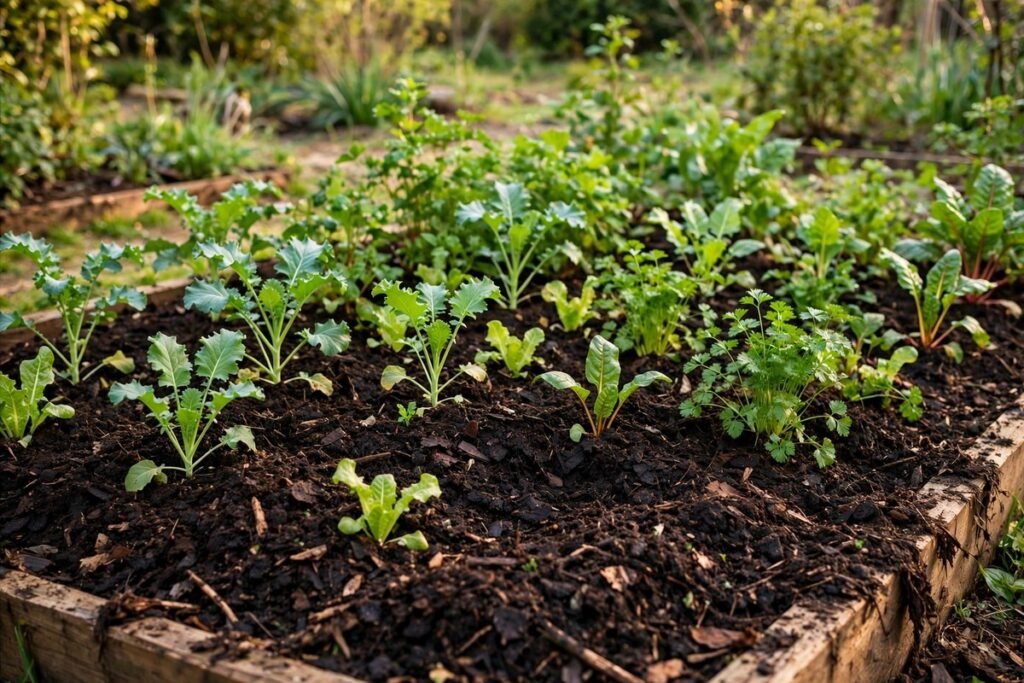
Can You Put Too Much Compost on a Garden?
Yes, you can put too much compost on a garden. A yearly layer of 1 inch is plenty for most established beds, and a thicker layer every year can build up phosphorus and salts, raise pH, and lock up other nutrients. The risk is highest with manure compost, repeated heavy layers, and raised beds filled with compost alone.
Why compost can be too much of a good thing
Compost adds organic matter, feeds soil life, holds water in sandy soil, and loosens clay soil. It also adds nutrients, and that is where the problem starts. Every load adds nitrogen, phosphorus, potassium, calcium, magnesium and salts, and the amounts are not printed on the bag in the same way as a bag of fertiliser.
Plants remove only a modest amount of those nutrients in a harvest. Montana State University Extension states the scale plainly. One inch of composted manure adds more than 10 times the nitrogen and potassium removed by a vegetable harvest each year, and 50 times the phosphorus.
Phosphorus does not wash out easily in most garden soils. A poor, pale soil needs a generous first layer. A dark, crumbly soil that has had compost for years needs only a light top dressing, or no compost at all for a season, until a soil test says otherwise.
How much compost is safe each year
Oregon State University Extension gives 3 to 4 inches for a new bed, worked into the top 8 to 12 inches, and a quarter inch to 1 inch a year for an existing bed. Washington State University Extension gives 1 to 3 inches for a new planting, and about half an inch a year for an established bed. The Plant Calculator gives 1 to 2 inches a year as a common generous amount for vegetable beds.
Put together, the safe pattern is clear. A new bed gets a deep first layer, then a light yearly layer. An established bed gets a quarter inch to 1 inch a year in the stricter guidance, or 1 to 2 inches a year in the more generous guidance. The stricter range fits manure compost and beds that already test high in phosphorus. The more generous range fits plant based compost and sandy soil.
| Bed type | First year | Each year after that |
|---|---|---|
| New vegetable bed, poor soil | 3 to 4 inches, worked in | 1 inch |
| Existing vegetable bed, good soil | 1 inch | A quarter inch to 1 inch |
| Existing vegetable bed, sandy soil | 2 inches | 1 to 2 inches |
| Raised bed, filled with soil mix | 1 to 2 inches on top | A quarter inch to 1 inch |
| Lawn, top dressing | A quarter inch | A quarter inch |
A layer thicker than 4 inches in one go is rarely needed on an established bed. It can smother small plants and add a large nutrient load at once. If you have a deep layer to use up, spread it over a larger area instead of piling it on one bed.
How much that means in volume and bags
The calculator uses this formula:
volume = area x depth
bags = volume / bag size, rounded up
weight = volume x 0.6 tonnes per cubic metre, as a guide
One cubic yard covers 324 square feet at 1 inch deep, 162 square feet at 2 inches deep, 108 square feet at 3 inches deep, and 81 square feet at 4 inches deep.
A 10 by 10 foot bed is 100 square feet. At 1 inch deep it needs 8.33 cubic feet, about 0.31 cubic yards, or 9 bags of 1 cubic foot, 6 bags of 1.5 cubic feet, or 5 bags of 2 cubic feet. At 4 inches deep it needs 33.33 cubic feet, about 1.23 cubic yards, or 34 bags of 1 cubic foot, 23 bags of 1.5 cubic feet, or 17 bags of 2 cubic feet.
In metric terms, top dressing 20 square metres of beds with 5 cm of compost takes 1 cubic metre, 20 bags of 50 litres, weighing roughly 600 kg. Use the Compost Calculator for the yearly amount only.
Phosphorus, salt and pH
Phosphorus build up is slow, quiet and hard to undo. A bed can look dark and rich while its soil test phosphorus climbs year after year. High phosphorus can lock up iron and zinc, so leaves turn yellow between the veins even though iron is present in the soil. It can reduce the growth of mycorrhizal fungi, the soil fungi that help roots take up nutrients and water.
University of Minnesota Extension gives a clear threshold. If soil phosphorus is above 25 on a Bray test or 18 on an Olsen test, do not use a phosphorus containing fertiliser for a few years. Compost often contains phosphorus, especially if it contains manure, so the same logic applies to compost.
Salt build up is the faster problem. High salts pull water out of roots, so plants wilt even when you water well. Leaf edges can scorch, growth can stall, and germination can fail. Manure compost is generally higher in salts than plant compost. Raised beds are at higher risk, because rain does not wash salts through them as freely as it does in open ground. High pH is a related problem. Soils that have received excessive compost tend to be too basic, with a pH above 7, and many nutrients become less available. The ideal pH range for most fruits and vegetables is 6.0 to 7.0.
Signs and how to fix it
Signs are useful, but they are not proof on their own. Yellow leaves, slow growth and poor fruit set can have many causes, including drought, cold soil, pests and a true deficiency. Use the signs below as a prompt to test the soil, not as a diagnosis by themselves.
| Sign | What it may mean | What to check first |
|---|---|---|
| Leaves yellow between the veins, growth slow | Iron or zinc locked up by high phosphorus or high pH | Soil test for phosphorus, pH and salts |
| Leaf edges scorched, plants wilt despite watering | Salt build up pulling water from roots | Soluble salts test, and check if manure compost was used |
| Seedlings fail to germinate, or die young | High salts, high ammonium, or unfinished compost | Use only finished compost, test salts |
The first step to fix a bed is to stop adding compost. Use nitrogen only fertiliser sources until calcium, potassium and phosphorus levels have come back down. The second step is to test the soil for pH, organic matter, phosphorus and potassium, plus soluble salts, calcium, magnesium, sodium and ammonium. Test again the next year.
If salts are high and the soil drains well, water deeply to leach salts down and away from the root zone. If phosphorus is high, grow hungry crops and remove the harvest, avoid phosphorus fertiliser, and add high carbon material such as straw or dry leaves if the soil needs organic matter without more phosphorus. If the bed is small, consider removing some of the compost rich soil and spreading it over a larger area. Plant based compost is generally lower in salts and phosphorus than manure compost. Unfinished compost can burn roots, so use only finished compost. Recovery takes time. Phosphorus falls slowly, and salts fall faster if the soil drains well.
How to get it right next year
Start with a soil test, not with a delivery. A test in autumn, after the harvest, gives you time to plan the spring. If organic matter is below 3 percent, a generous layer is justified. If organic matter is already high and phosphorus is high, skip the compost and use a cover crop instead.
Use the calculator to keep the dose honest. A 1 inch layer on a 10 by 10 foot bed is only 8.33 cubic feet. A 4 inch layer on the same bed is 33.33 cubic feet, four times as much, and four times the phosphorus and salts. Keep a simple record each year of the date, the bed, the compost type, the depth and the volume. Do not spread a thick layer every year without a soil test, do not fill a raised bed with compost alone, and do not use manure compost at the same rate as plant compost. A light yearly layer and a soil test every year or two will keep a garden fertile without building up the nutrients that cause trouble.
FAQs
Q: Can you put too much compost on a garden?
A: Yes. A yearly layer of 1 inch is plenty for most established beds. Thicker layers every year can build up phosphorus and salts, raise pH, and lock up iron and zinc.
Q: How much compost should I add each year?
A: For an existing vegetable bed, a quarter inch to 1 inch a year is the stricter guidance, and 1 to 2 inches a year is the more generous guidance. Use the lower end for manure compost and for beds that already test high in phosphorus. A new bed can take 3 to 4 inches in the first year.
Q: What are the signs of too much compost?
A: Yellow leaves between the veins, scorched leaf edges, wilting despite watering, seedlings that fail to germinate, and soil that forms clods. Use these signs as a prompt to test the soil, not as a diagnosis on their own.
Q: How do I fix soil with too much compost?
A: Stop adding compost, test the soil for pH, organic matter, phosphorus, potassium and soluble salts, then follow the test. Water deeply to leach salts if the soil drains, grow hungry crops and remove the harvest to draw down phosphorus, and add straw or dry leaves if the soil needs organic matter without more phosphorus.
Q: Is manure compost worse than plant compost?
A: Manure compost is richer in nutrients, phosphorus, calcium and salts than plant based compost, so it needs a lighter yearly amount and more frequent soil testing. Plant based compost is generally safer at the same depth, but it can still build up phosphorus if it is applied thickly every year.
Q: Can too much compost raise soil pH?
A: Yes. Soils that have received excessive compost tend to be too basic, with a pH above 7. In a high pH soil many nutrients become less available, so plants can show deficiency symptoms despite an excess of nutrients in the soil.
More guides
How to Choose a Fertilizer Rate: Meet Nitrogen or Cap Every Nutrient
Learning how to choose a fertilizer rate starts with one choice. You either meet a chosen nutrient target, usually nitrogen, and accept…
Read guide
Too Much Phosphorus From Fertilizer: Surplus, Signs and Fixes
Too much phosphorus from fertilizer is a surplus that appears when a balanced blend meets nitrogen and supplies twice the phosphate the…
Read guide
Fertilizer NPK Numbers Explained: What N, P2O5 and K2O Mean
Fertilizer npk numbers are the three percentages on a fertilizer bag, listed in the order nitrogen, phosphate and potash. They tell you…
Read guide