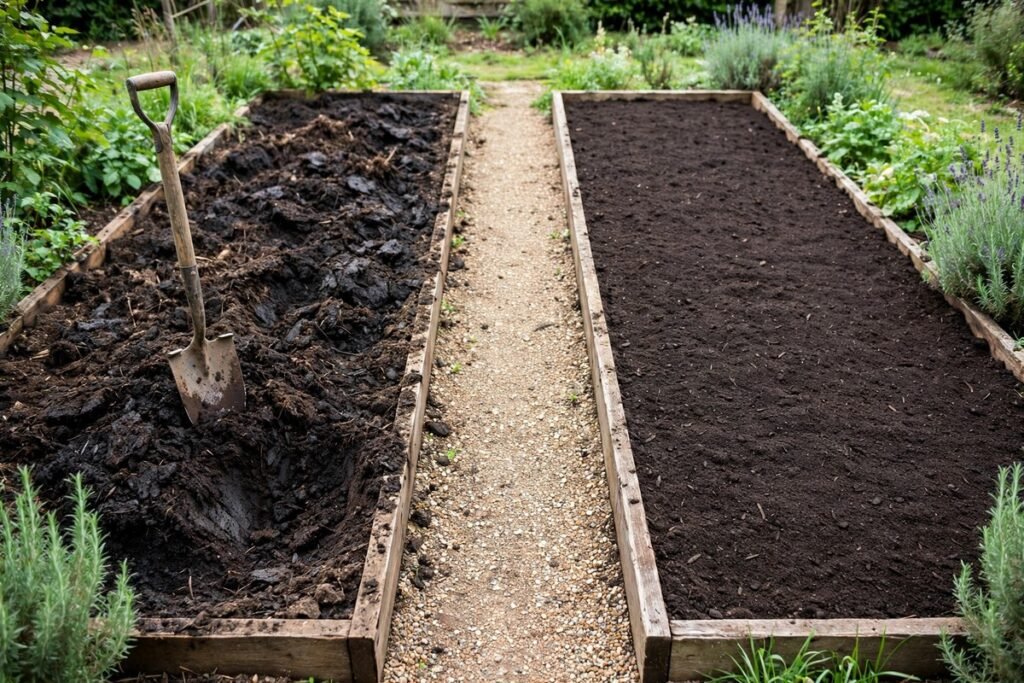
Dig in compost for a new bed, when you want compost mixed through the root zone before planting. Top dress compost for a planted bed, when you want to feed the surface without disturbing roots. For the same 5 by 2 metre bed, digging in needs 10 bags of 50 litres, while a 2.5 centimetre top dress needs 5 bags.
Use the Soil Amendment Calculator to work out your own bed before you buy compost. Enter the length and width of the bed, the depth you will dig, the share of compost you want in the mix, and your bag size. The calculator gives the layer to spread, the volume, and the number of bags. The examples below use that calculator and its stated formula, so you can repeat the same steps with your own measurements.
What digging in means
Digging in means spreading compost on a bed and then mixing it into the soil to a stated depth. You spread a layer, fork it in, and the compost ends up mixed through the top layer of soil. Roots then grow into soil that already holds compost through that depth, rather than waiting for compost to move down from the surface.
What top dressing means
Top dressing means spreading a thin layer of compost on the surface of the soil and leaving it there. You do not dig it in. Rain, watering, worms, and soil life move it down over time. The surface layer feeds the soil from above, and the bed keeps its structure while the compost works in.
How the calculator works out the dig in amount
The Soil Amendment Calculator uses simple volume blending. It starts with the area of the bed, the depth you will dig, and the share of compost you want in the final mix. It then works out the layer to spread before you dig.
The formula is: layer to spread equals dig depth multiplied by amendment share. Volume equals area multiplied by layer. Bags equals volume divided by bag size, rounded up to a whole bag.
Worked example: dig in for a 5 by 2 metre bed
Take a bed that is 5 metres long and 2 metres wide. The area is 5 multiplied by 2, which equals 10 square metres. Plan to dig to a depth of 20 cm, and plan for compost to make up 25 percent of that worked layer.
First work out the layer to spread. Dig depth is 20 cm. Amendment share is 25 percent, which is 0.25 as a decimal. Layer equals 20 cm multiplied by 0.25, which equals 5 cm. That is the layer of compost to spread on the surface before digging.
Next work out the volume. Convert the layer to metres. 5 cm equals 0.05 m. Volume equals area multiplied by layer, so 10 square metres multiplied by 0.05 m equals 0.5 cubic metres. Convert that to litres. 0.5 cubic metres multiplied by 1000 equals 500 litres.
Next work out the bags. Use bags of 50 litres. Bags equals 500 litres divided by 50 litres, which equals 10 bags. There is no rounding up needed here, because 500 divides exactly by 50.
Worked example: top dress the same bed
Now use the same bed for top dressing. The bed is still 5 metres long and 2 metres wide, so the area is still 10 square metres. The difference is that there is no dig depth and no share to work out. You choose the layer you will spread on the surface, and the volume follows from area multiplied by layer.
Take a top dress layer of 2.5 cm. This is a thin layer, stated here as the layer being spread for this example. Convert it to metres. 2.5 cm equals 0.025 m. Volume equals area multiplied by layer, so 10 square metres multiplied by 0.025 m equals 0.25 cubic metres. Convert that to litres. 0.25 cubic metres multiplied by 1000 equals 250 litres.
Work out the bags. Use bags of 50 litres. Bags equals 250 litres divided by 50 litres, which equals 5 bags. Again there is no rounding up needed, because 250 divides exactly by 50.
Comparison for the same bed
The table below puts the worked examples side by side for the same 10 square metre bed.
| Method | Layer | Volume | Bags of 50 litres |
|---|---|---|---|
| Dig in at 25 percent of 20 cm | 5 cm | 0.5 cubic metres | 10 |
| Top dress | 2.5 cm | 0.25 cubic metres | 5 |
| Dig in at 30 percent of 20 cm | 6 cm | 0.6 cubic metres | 12 |
| Top dress at 5 cm | 5 cm | 0.5 cubic metres | 10 |
An imperial example for the same idea
The same comparison works in feet and inches. Take a bed of 100 square feet. Plan a top dress layer of 1 inch. Convert the layer to feet. 1 inch equals 1 divided by 12 feet, which is 0.0833 feet. Volume equals area multiplied by layer, so 100 square feet multiplied by 0.0833 feet equals 8.33 cubic feet. Convert to cubic yards by dividing by 27. 8.33 divided by 27 equals 0.31 cubic yards, rounded to two decimal places.
When to dig in
Dig in when the bed is new. The soil is bare, you can work it without harming plants, and you want compost mixed through the root zone before the first crop goes in. The calculator page gives 5 to 8 cm of compost as a common layer for new beds, roughly 25 to 30 percent of the top 20 to 25 cm. That range fits a bed that needs a clear lift in organic matter from the start.
When to top dress
Top dress when the bed is already planted. The crop is growing, the roots fill the soil, and digging would cut roots and set plants back. A thin layer on the surface feeds the bed without that damage. Keep the layer off stems and crowns, spread it evenly, and water it in if the surface is dry.
Can you use both methods
Yes, you can use both methods at different times for the same bed. Many gardeners dig in when they build a bed, then top dress in later years to keep it fed. That pattern fits the two roles in this blog. Digging in sets the base. Top dressing maintains it. Use the Compost Calculator to check a compost volume, and the Raised Bed Soil Calculator for a new raised bed fill.
Common mistakes
First, comparing the methods without stating the layer. A reader who hears that digging in needs 10 bags and top dressing needs 5 bags may think digging in always needs double. That is only true for the layers used here, 5 cm against 2.5 cm. Change either layer and the gap changes. Always state the dig depth, the share, and the top dress layer, so the comparison can be checked.
Second, using compost as the whole fill. Compost is an amendment, not a complete growing medium for most beds. Filling a bed with compost alone can sink, hold too much water, or give plants a mix that does not hold structure. Mix compost with soil, as the calculator formula assumes, and use a fill calculator for a new raised bed.
Third, forgetting to round bags up. A result of 4.5 bags means you need 5 bags. A result of 2.25 bags means you need 3 bags. Rounding down leaves part of the bed uncovered, and the uncovered part will not get the same feed as the rest. The calculator uses ceil for bags, which means round up to the next whole bag.
Fourth, adding lime, sulfur, or fertiliser rates from a compost amount. This blog and the calculator give bulk compost amounts only. The calculator page states that you should test soil first before adding lime, sulfur, or fertiliser. A soil test, not a compost volume, sets those rates. Do not use a bag count to guess a nutrient rate.
How to decide for your bed
Start with the state of the bed. If it is new or empty, dig in. If it is planted or established, top dress. That one question settles most cases.
Q: How much compost do I need to dig into a 5 by 2 metre bed?
A: For a 20 cm dig at 25 percent compost, spread a 5 cm layer. That is 10 square metres multiplied by 0.05 m, which equals 0.5 cubic metres, or 500 litres, which is 10 bags of 50 litres.
Q: How much compost do I need to top dress the same bed?
A: For a 2.5 cm top dress layer on the same 10 square metre bed, the volume is 10 multiplied by 0.025 m, which equals 0.25 cubic metres, or 250 litres, which is 5 bags of 50 litres.
Q: Is top dressing always half the amount of digging in?
A: No. The half in this blog comes from the layers used, 2.5 cm against 5 cm, on the same area. A thicker top dress layer needs more compost, and a lower dig in share needs less. State the layer or the share before you compare.
Q: Should I dig compost in or leave it on top for a new bed?
A: Dig it in for a new bed, because the bed is empty and you want compost mixed through the root zone before planting. The calculator page notes a layer of 5 to 8 cm is common for new beds, roughly 25 to 30 percent of the top 20 to 25 cm.
Q: Can I add compost without digging?
A: Yes. Spreading compost on top every year lets worms mix it in, and the calculator page describes this as the no dig approach. Use a thin layer on an established bed, keep it off stems and crowns, and leave the soil structure in place.
Q: Do I need a soil test before I add compost?
A: A soil test is the way to set lime, sulfur, and fertiliser rates, and the calculator page states that you should test soil first for those inputs. This blog gives bulk compost amounts only, and it does not give rates for lime, sulfur, or fertiliser.
More guides
How to Choose a Fertilizer Rate: Meet Nitrogen or Cap Every Nutrient
Learning how to choose a fertilizer rate starts with one choice. You either meet a chosen nutrient target, usually nitrogen, and accept…
Read guide
Too Much Phosphorus From Fertilizer: Surplus, Signs and Fixes
Too much phosphorus from fertilizer is a surplus that appears when a balanced blend meets nitrogen and supplies twice the phosphate the…
Read guide
Fertilizer NPK Numbers Explained: What N, P2O5 and K2O Mean
Fertilizer npk numbers are the three percentages on a fertilizer bag, listed in the order nitrogen, phosphate and potash. They tell you…
Read guide