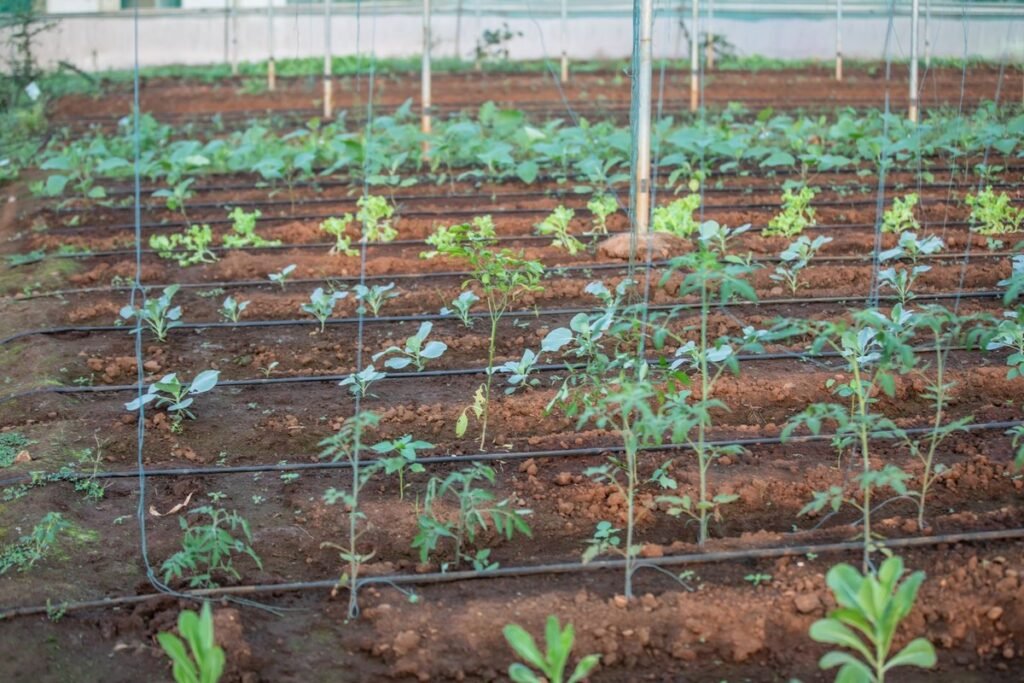
A drip irrigation planner turns rows, spacing and emitter flow into a shopping list and a zone plan. Six 10 m rows with one line each, 30 cm spacing and 2 L/h emitters need 198 emitters, 396 L/h of flow, one zone on a 1,000 L/h supply, and about 66 m of tubing plus 10 percent spare.
What the drip irrigation planner works out
The planner takes rows, emitter spacing and flow, and gives emitters, tubing and fittings, total flow and how many zones the supply can feed. You enter the number of rows, their length and spacing, then set how many drip lines run along each row. You choose emitter spacing, enter emitter flow and supply flow, and print the parts list.
The five formulas in plain words
Emitters per line equals floor of row length divided by emitter spacing. Floor means round down to the whole number below the result, never up. A row that gives 33.33 emitters per line has 33 emitters.
Emitters equals emitters per line times rows times lines per row. Total flow equals emitters times emitter flow. Zones equals ceil of total flow divided by supply, where ceil means round up, so even a small excess over supply needs another zone. Tubing equals rows times lines times row length plus header.
Worked example step 1: emitters per line and total emitters
The worked example uses six 10 m rows with one line each, 30 cm emitter spacing and 2 L/h emitters. Row length is 10 m and spacing is 30 cm, which is 0.30 m. Floor of 10 divided by 0.30 is floor of 33.33, which is 33 emitters per line.
Total emitters equals emitters per line times rows times lines per row. That is 33 times 6 times 1, which is 198 emitters. The table below shows how the count changes with row length at the same 30 cm spacing, for six rows with one line each.
| Row length | Emitters per line | Total emitters for six rows |
|---|---|---|
| 5 m | 16 | 96 |
| 8 m | 26 | 156 |
| 10 m | 33 | 198 |
| 12 m | 40 | 240 |
| 15 m | 50 | 300 |
Worked example step 2: total flow
Total flow equals emitters times emitter flow. The worked layout has 198 emitters and each emitter flows at 2 L/h. That is 198 times 2, which is 396 L/h, the flow the whole layout draws when every emitter runs at once.
Emitter flow changes the total in direct proportion. A layout with 4 L/h emitters draws 792 L/h, still below a 1,000 L/h supply, so it would still run as one zone. A layout with 8 L/h emitters draws 1,584 L/h, above that supply, so it would need more than one zone.
| Emitter flow | Calculation | Total flow |
|---|---|---|
| 1 L/h | 198 times 1 | 198 L/h |
| 2 L/h | 198 times 2 | 396 L/h |
| 4 L/h | 198 times 4 | 792 L/h |
| 8 L/h | 198 times 8 | 1584 L/h |
Worked example step 3: zones from supply
Zones equals ceil of total flow divided by supply. The worked layout draws 396 L/h and the supply is 1,000 L/h. Ceil of 396 divided by 1,000 is ceil of 0.396, which is 1 zone.
Supply flow can be measured at the tap with a bucket. That measured flow is the supply figure the planner uses.
If total flow were 1,020 L/h on a 1,000 L/h supply, the result would be 2 zones, even though the excess is only 20 L/h. Split the layout so each zone draws no more than the supply, for example three rows on each zone. The sprinkler calculator covers sprinkler zones, with different head flows.
Worked example step 4: tubing and spare
Tubing equals rows times lines times row length plus header. Row tubing on its own for the worked layout is 6 times 1 times 10, which is 60 m. The planner page gives about 66 m of tubing plus 10 percent spare for the six 10 m rows. The page does not state the header length, so this guide does not split the 66 m into row tubing, header and spare parts.
Measure your own header and add it to the 60 m of row tubing, then add spare, and round the result up to a whole buyable length. Buy 198 emitters for the worked layout, rounded up to the next whole pack size. If emitters are sold in packs of 50, buy four packs, which is 200 emitters, not three packs.
Imperial example: a rounded equivalent
The imperial example is separate from the metric example, and it is a rounded equivalent, not an exact conversion. It uses six 30 ft rows at 12 in spacing, and needs 180 emitters and 90 gph.
Emitters per line is floor of row length divided by emitter spacing. Row length is 30 ft and spacing is 12 in, which is 1 ft. Floor of 30 divided by 1 is 30 emitters per line. Total emitters is 30 times 6 times 1, which is 180 emitters. That matches the page figure.
Total flow is emitters times emitter flow. The page gives total flow as 90 gph for 180 emitters, which implies an emitter flow of 0.5 gph, because 90 divided by 180 is 0.5. The page does not state the imperial emitter flow, so this guide states it as implied at 0.5 gph, not as a stated page figure.
The table below shows the imperial emitter count by row length at 12 in spacing, for six rows with one line each.
| Row length | Emitters per line | Total emitters for six rows |
|---|---|---|
| 20 ft | 20 | 120 |
| 25 ft | 25 | 150 |
| 30 ft | 30 | 180 |
| 40 ft | 40 | 240 |
| 50 ft | 50 | 300 |
Keep metric with metric and imperial with imperial in one calculation, and label each result with its units.
How to use the planner in five steps
The page gives five steps, in the order the formulas need. First, enter the number of rows, their length and spacing. Second, set how many drip lines run along each row. A second line doubles the emitters and the row tubing for each row. Third, choose emitter spacing. About 30 cm (12 in) suits close planted crops, and wider spacing suits shrubs.
Fourth, enter emitter flow and supply flow. Emitter flow sets total flow, and supply flow sets the zone count. Fifth, print the parts list, the buy list for the layout. If the emitter count looks high, check the spacing first, because a spacing typed as 3 cm instead of 30 cm will give ten times too many emitters.
Spacing by soil
Emitter spacing follows soil, because water spreads further sideways in clay than in sand. About 30 cm (12 in) on sandy soil and close planted vegetables, 45 cm (18 in) on loam, and up to 60 cm (24 in) on clay.
| Soil and planting | Emitter spacing | Emitters | Total flow |
|---|---|---|---|
| Sandy soil and close planted vegetables | 30 cm (12 in) | 198 | 396 L/h |
| Loam | 45 cm (18 in) | 132 | 264 L/h |
| Clay | 60 cm (24 in) | 96 | 192 L/h |
At 45 cm spacing, emitters per line is floor of 10 divided by 0.45, which is floor of 22.22, which is 22. Total emitters is 22 times 6, which is 132, and total flow is 132 times 2, which is 264 L/h. At 60 cm spacing, emitters per line is 16, total emitters is 96, and total flow is 192 L/h.
The parts list
The planner prints a parts list from the layout you entered, covering emitters, tubing and fittings. Emitters are the count the formulas give, rounded up to the next whole pack. Tubing is the row tubing plus header, plus spare, rounded up to the next whole buyable length. Fittings vary by brand and layout, so the planner does not give a fixed fitting count.
Drip systems usually also need a filter, a pressure regulator and a backflow preventer. The filter keeps grit out of the emitters. The pressure regulator drops mains pressure to the low pressure drip needs. Drip works at about 1 to 2 bar (15 to 30 psi), well below normal mains pressure, so a regulator is needed in most cases. For help planning watering days, the garden watering schedule calculator plans days between watering sessions.
Inline drip line, pressure and long runs
Inline drip line has emitters built in, so skip the separate emitter count if you use it. Do not add punch in emitters to inline drip line as well, because that doubles the emitters and the flow.
Long runs and slopes need pressure compensating emitters, which give a steadier flow where pressure changes from one end to the other. A drip line run is typically up to 60 m (200 ft) for 16 mm (1/2 in) tubing, less with high flow emitters. If a row is longer than 60 m, feed it from the middle or split it into two shorter runs. The sprinkler coverage calculator covers sprinkler limits, not drip limits.
What the planner does not give
The planner does not give a price for any part, pump sizing figures, watering duration figures, per plant water need figures, or a total flow capacity check against tubing size. It gives the 60 m run limit above, and no header length, no fitting counts by brand, and no soil infiltration rate figures. The rain barrel calculator covers stored water volume, and the irrigation scheduling calculator covers watering frequency.
Common mistakes
First, do not count 34 emitters on a 10 m row at 30 cm spacing. Floor of 10 divided by 0.30 is 33, not 34. Second, do not forget lines per row. Two lines per row doubles the emitters and the row tubing. Third, do not read total flow as supply flow.
Fourth, do not invent a header length. The page gives about 66 m of tubing plus 10 percent spare, and the header length is not stated on the page. Fifth, do not run a line past 60 m on 16 mm tubing. Sixth, do not use plain emitters on a long run or a slope. Use pressure compensating emitters there. Seventh, do not add punch in emitters to inline drip line. Eighth, do not mix units in one calculation. For run time planning, the irrigation run time calculator works from depth and rate.
FAQs
Q: How far apart should drip emitters be?
A: About 30 cm (12 in) on sandy soil and close planted vegetables, 45 cm (18 in) on loam and up to 60 cm (24 in) on clay, where water spreads further sideways.
Q: How long can a drip line run be?
A: Typically up to 60 m (200 ft) for 16 mm (1/2 in) tubing, less with high flow emitters.
Q: Do I need a pressure regulator for drip irrigation?
A: Yes, in most cases. Drip works at about 1 to 2 bar (15 to 30 psi), well below normal mains pressure.
Q: How many emitters can one zone run?
A: Divide your supply flow by emitter flow. A 1,000 L/h supply runs about 500 emitters of 2 L/h.
Q: What parts does a drip system need besides emitters and tubing?
A: Drip systems usually also need a filter, a pressure regulator and a backflow preventer, plus fittings that match your tubing size and layout.
More guides
Hargreaves vs Penman Monteith: When the Simple Estimate Is Enough
Hargreaves vs penman monteith is a choice between a simple estimate from temperature alone and a fuller calculation from complete weather data.…
Read guide
Daily ET0 vs Monthly Average ET0: Planning vs Scheduling
Daily ET0 vs monthly ET0 is a choice between one day and a month. Use a monthly average to plan a season,…
Read guide
How Latitude and Date Change Your ET0
Latitude and ET0 are linked through Ra, the extraterrestrial radiation that reaches the top of the atmosphere. When latitude or date changes,…
Read guide