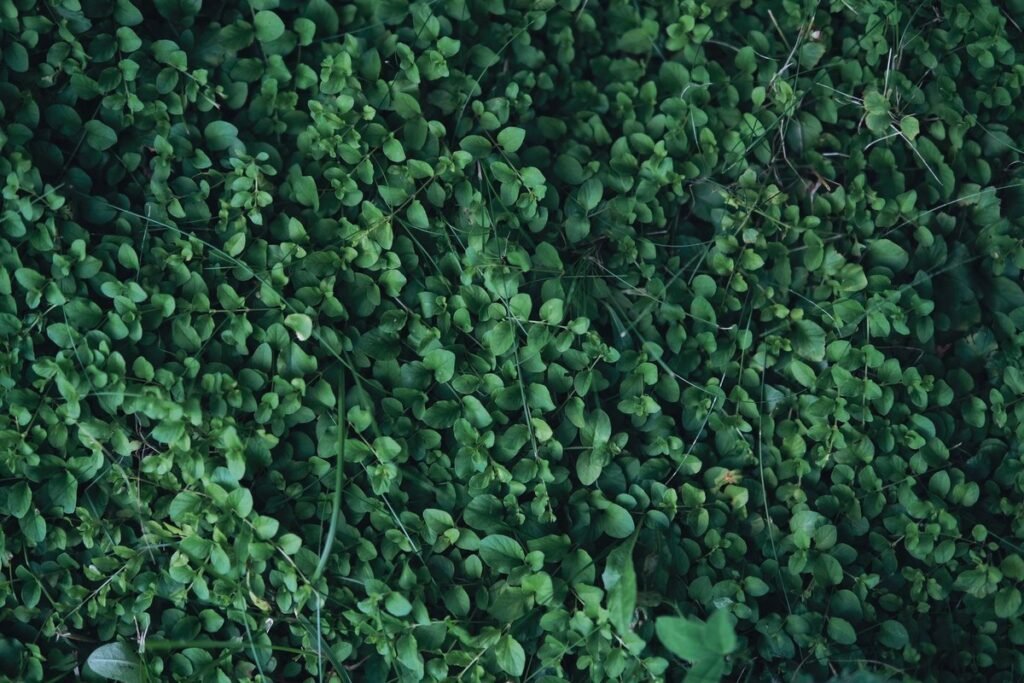
Ground cover plants per square metre tell you how many plants to buy for a bed, and this blog gives those densities in metric tables only, with plant counts and flats for a named area.
What a metric density tells you
A density is plants per square metre. It answers one question. At a given spacing, how many plants fit in one square metre of ground. A small spacing gives a high density and faster cover. A wide spacing gives a low density and fewer plants to buy. Spacing sets density, area times density sets the plant count, and the plant count sets the flats. The tables in this blog use metric figures only. The companion blog gives the same tables in imperial figures, for a bed measured in square feet.
The formula in plain words
Plants per square metre equals 1 divided by spacing squared, with spacing in metres. Spacing squared means spacing times spacing. At 30 cm spacing, spacing in metres is 0.3, spacing squared is 0.09, and 1 divided by 0.09 is 11.11 plants per square metre on a square grid.
A triangular layout uses the same spacing, but the rows are staggered, so the plants sit closer together in the gaps. Plants per square metre on a triangular layout equals 1 divided by spacing squared times 0.8660254. At 30 cm spacing, that is 12.83 plants per square metre.
Plants per hectare equals plants per square metre times 10,000, because one hectare is 10,000 square metres. At 30 cm spacing, that is 111,111 plants per hectare square and 128,300 plants per hectare triangular. A per hectare figure is a density for a large area, not an order for a garden bed.
The triangular uplift is exact. 1 divided by 0.8660254 is 1.1547, so a triangular layout needs 15.47 percent more plants than a square grid at the same spacing. Plants always round up, because you cannot buy part of a plant. Flats always round up too. Densities are shown to 2 decimal places.
Worked example: 10 square metres at 30 cm
The page metric example covers 10 square metres with plants 30 cm apart in a square grid, with 5 percent extra.
Spacing is 0.3 m. Plants per square metre equals 1 divided by 0.09, which is 11.11. Plants before extra equals 10 times 11.11, which is 111.11. With 5 percent extra, plants equals 111.11 times 1.05, which is 116.667, rounded up to 117 plants.
Flats of 18 equals 117 divided by 18, which is 6.5, rounded up to 7 flats. Covering 10 square metres at 30 cm spacing in a square grid takes 117 plants including 5 percent extra, and 7 flats of 18.
Mulch for the same area is 0.5 cubic metres at 5 cm depth, which is 500 litres. Metric defaults are rounded equivalents of the imperial defaults, not exact conversions. 10 square metres is 107.64 square feet, not 100 square feet, and 30 cm is 11.81 inches, not 12 inches.
Table 1: metric densities by spacing
Table 1 gives plants per square metre and plants per hectare for six spacings, on a square grid and on a triangular layout. Read the row for your spacing, then read across for the layout you plan to use.
| Spacing | Plants per m² square | Plants per m² triangular | Plants per hectare square | Plants per hectare triangular |
|---|---|---|---|---|
| 15 cm | 44.44 | 51.32 | 444,444 | 513,200 |
| 20 cm | 25.00 | 28.87 | 250,000 | 288,675 |
| 30 cm | 11.11 | 12.83 | 111,111 | 128,300 |
| 40 cm | 6.25 | 7.22 | 62,500 | 72,169 |
| 45 cm | 4.94 | 5.70 | 49,383 | 57,022 |
| 60 cm | 2.78 | 3.21 | 27,778 | 32,075 |
Density falls fast as spacing widens. At 15 cm spacing, a square grid needs 44.44 plants per square metre. At 30 cm spacing, it needs 11.11, which is about one quarter of the 15 cm figure, because the spacing has doubled. At 60 cm spacing, it needs 2.78.
At every spacing, the triangular figure is higher by the same 15.47 percent uplift. At 15 cm spacing, triangular density is 51.32 against 44.44 square.
Table 2: plant counts for 10 square metres
Table 2 turns the densities into an order for one named area. It uses 10 square metres, a square grid, 5 percent extra, and flats of 18. Read the row for your spacing, then read the plants and the flats.
| Spacing | Plants | Flats of 18 |
|---|---|---|
| 15 cm | 467 | 26 |
| 20 cm | 263 | 15 |
| 30 cm | 117 | 7 |
| 40 cm | 66 | 4 |
| 45 cm | 52 | 3 |
At 15 cm spacing, 10 square metres needs 467 plants and 26 flats. At 20 cm spacing, it needs 263 plants and 15 flats. At 30 cm spacing, it needs 117 plants and 7 flats. At 40 cm spacing, it needs 66 plants and 4 flats. At 45 cm spacing, it needs 52 plants and 3 flats.
Triangular counts for 10 square metres
A triangular layout needs more plants than a square grid at the same spacing. The counts below use the same area, the same extra percentage, and the same flats of 18 as Table 2, with a triangular layout only.
At 15 cm spacing, a triangular layout needs 539 plants and 30 flats. At 20 cm spacing, it needs 304 plants and 17 flats. At 30 cm spacing, it needs 135 plants and 8 flats. At 40 cm spacing, it needs 76 plants and 5 flats. At 45 cm spacing, it needs 60 plants and 4 flats.
Triangular at 30 cm gives 135 plants against 117 plants square, which is 18 more plants, and 15.4 percent more after rounding. Flats rise from 7 flats square to 8 flats triangular. Choose the layout before you order.
How the extra percentage changes the order
The calculator default extra for losses is 5 percent, with a range of 0 to 50 percent. The extra percentage changes the plant count, but it does not always change the flat count.
On 10 square metres at 30 cm spacing on a square grid, 0 percent extra gives 112 plants, 5 percent extra gives 117 plants, 10 percent extra gives 123 plants, and 20 percent extra gives 134 plants. Flats of 18 are 7 flats at 0 percent, 7 flats at 5 percent, 7 flats at 10 percent, and 8 flats at 20 percent.
Flats are commonly 18, 32 or 36 depending on cell size, and the calculator default is 18 plants per flat. Enter 1 for individual pots.
Mulch in metric only
Mulch volume equals area times 5 cm depth. The calculator gives mulch as a shopping list item at 5 cm depth only.
For a metric bed, 10 square metres gives 0.5 cubic metres of mulch, 25 square metres gives 1.25 cubic metres, 50 square metres gives 2.5 cubic metres, and 100 square metres gives 5 cubic metres. Mulch covers the soil between plants until they spread.
How to use the calculator
The page gives five steps in order. First, measure the area to plant. Second, choose a ground cover or enter its spacing. Third, choose a square or staggered layout. Fourth, enter plants per flat, or 1 for individual pots. Fifth, mulch between plants until they spread.
The calculator defaults are area 10 square metres, spacing 30 cm, square layout, plants per flat 18, and extra for losses 5 percent.
The Ground Cover Calculator gives plants, flats, and mulch from area, spacing, layout, plants per flat, and extra percentage. It gives no plant cost, no seed count, no yield figure, no fertiliser rate, no watering figure, no soil volume, and no coverage time in days or weeks.
What to check before you plant
Spread rate varies with soil, light and variety. Closer spacing gives faster cover at higher cost. Remove perennial weeds before planting. Ground cover typically takes one to three growing seasons to fill in.
The Plant Spacing Calculator covers a single spacing on a square grid, the Plants per Square Foot Calculator covers plants per square foot, the Plants per Acre Calculator covers plants per acre and per hectare, and the Garden Area Calculator covers measuring the garden area. Use the companion imperial blog for imperial tables.
Frequently asked questions
Q: How many ground cover plants per square metre at 30 cm spacing?
A: 11.11 plants per square metre on a square grid, and 12.83 plants per square metre on a triangular grid.
Q: How many ground cover plants do I need for 10 square metres at 30 cm spacing?
A: 117 plants with 5 percent extra on a square grid, which is 7 flats of 18 plants.
Q: How many more plants does a triangular layout need than a square grid?
A: 15.47 percent more plants at the same spacing. At 30 cm spacing on 10 square metres, a triangular layout needs 135 plants against 117 plants on a square grid, which is 18 more plants.
Q: How many ground cover plants per hectare at 30 cm spacing?
A: 111,111 plants per hectare on a square grid, and 128,300 plants per hectare on a triangular grid.
Q: How much mulch do I need for 10 square metres of ground cover?
A: 0.5 cubic metres of mulch at 5 cm depth.
Q: How many plants are in a flat of ground cover?
A: Commonly 18, 32 or 36 plants depending on cell size, and the calculator default is 18 plants per flat. Check with your nursery.
More guides

How to Choose a Fertilizer Rate: Meet Nitrogen or Cap Every Nutrient
Learning how to choose a fertilizer rate starts with one choice. You either meet a chosen nutrient target, usually nitrogen, and accept…
Read guide
Too Much Phosphorus From Fertilizer: Surplus, Signs and Fixes
Too much phosphorus from fertilizer is a surplus that appears when a balanced blend meets nitrogen and supplies twice the phosphate the…
Read guide
Fertilizer NPK Numbers Explained: What N, P2O5 and K2O Mean
Fertilizer npk numbers are the three percentages on a fertilizer bag, listed in the order nitrogen, phosphate and potash. They tell you…
Read guide