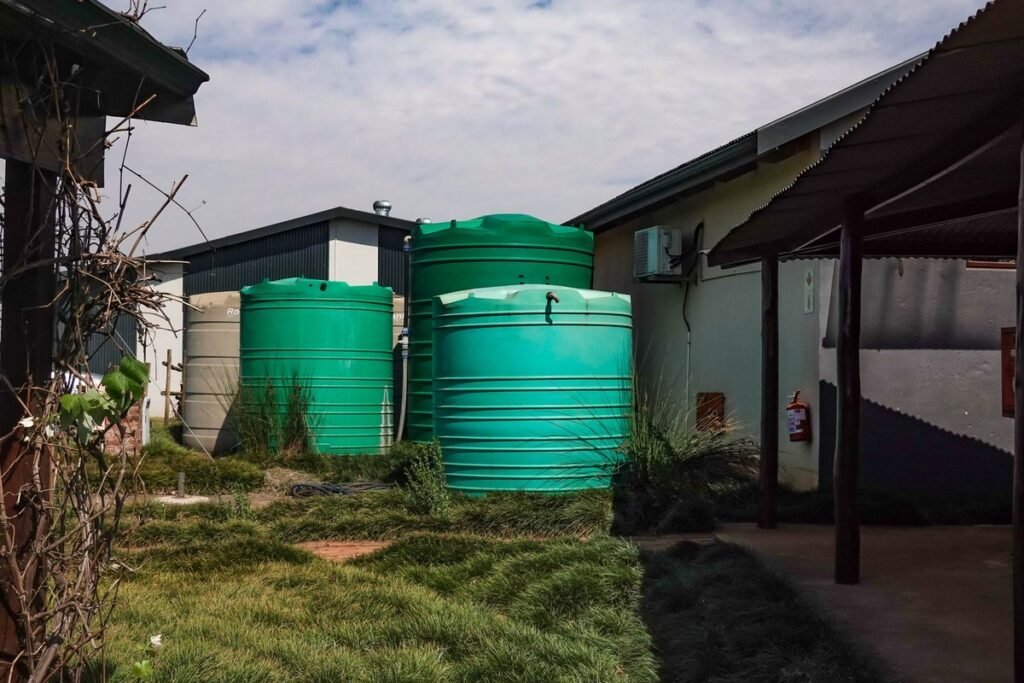
how big a rainwater tank do i need? Size storage to capture one typical 25 mm storm from your roof, or to cover a few weeks of garden watering, and use the larger of the figures. For an 80 square metre roof, one 25 mm storm gives 1,710 litres, while three weeks at 500 litres per week needs 1,500 litres.
That short answer is the whole method in the rainwater harvesting calculator. The calculator does not name a tank size for you. It suggests two ways to think about size: supply in a single storm, and demand over a few weeks of garden watering.
How Big a Rainwater Tank Do I Need for One Storm
Start with the storm rule, because it is the rule most people miss. A roof can collect a large volume in a short time, and storage that is too small lets the rest run away. The calculator uses a fixed 25 mm storm for its per storm figure.
The formula on the live page is collectable water equals roof area times rainfall times runoff coefficient times efficiency. For the per storm figure, rainfall is 25 mm and efficiency is 0.9, about 90 percent for gutter and first flush losses. The page states that 1 mm of rain on 1 square metre of roof is 1 litre.
The page does not state a runoff coefficient value for any roof type. The worked example lets us derive one value for a metal roof. An 80 square metre metal roof in an 800 mm rainfall area collects about 54,700 litres a year at 90 percent efficiency, and about 1,710 litres from one 25 mm storm. Working backwards gives 0.9497, which rounds to 0.95. So 0.95 is derived from the worked example arithmetic, not a page stated figure, and this guide uses it for a metal roof only.
With that derived metal coefficient, the per storm calculation is roof area times 25 times 0.95 times 0.9. That gives 21.375 litres for each square metre of roof in one 25 mm storm. For the worked example, 80 times 21.375 gives 1,710 litres.
The Two Rules the Calculator Suggests
The page FAQ asks how big a rainwater tank do i need, and it answers in one short line. Enough for a few weeks of garden use, or to capture one typical storm. The calculator suggests both. It does not say to pick the smaller figure, or to average the two figures.
The storm rule protects you against loss. If a storm delivers more water than your storage can hold, the extra water is gone. The weeks rule protects you against a dry spell. If rain does not fall for three weeks, storage sized for one week leaves you short for the other two weeks.
One Storm Plus Two Weeks of Storage
The table below adds two weeks at 500 litres per week to the storm volume for six metal roof sizes at the fixed 25 mm storm, using the derived coefficient 0.95 and efficiency 0.9, rounded to the nearest litre.
| Roof area in square metres | Water from one 25 mm storm in litres | Two weeks at 500 litres per week in litres | Combined storage in litres |
|---|---|---|---|
| 40 | 855 | 1,000 | 1,855 |
| 60 | 1,283 | 1,000 | 2,283 |
| 80 | 1,710 | 1,000 | 2,710 |
| 100 | 2,138 | 1,000 | 3,138 |
| 120 | 2,565 | 1,000 | 3,565 |
| 150 | 3,206 | 1,000 | 4,206 |
A 40 square metre roof gives 855 litres from one 25 mm storm, and the combined figure with two weeks at 500 litres per week is 1,855 litres. A 150 square metre roof gives 3,206 litres, and the combined figure is 4,206 litres. Measure the roof footprint, not the sloping surface area.
Storage for Two, Three and Four Weeks of Garden Use
The weeks rule needs only your weekly garden water use and the number of weeks you want storage to cover. Multiply weekly use by the number of weeks. The table below does that for 250, 500 and 1,000 litres per week, across two, three and four weeks.
| Weekly garden water use in litres | Storage for 2 weeks in litres | Storage for 3 weeks in litres | Storage for 4 weeks in litres |
|---|---|---|---|
| 250 | 500 | 750 | 1,000 |
| 500 | 1,000 | 1,500 | 2,000 |
| 1,000 | 2,000 | 3,000 | 4,000 |
At 250 litres per week, two weeks needs 500 litres and four weeks needs 1,000 litres. At 500 litres per week, the figures double to 1,000, 1,500 and 2,000 litres. Weekly use changes with garden size and the weather.
How to Use Both Rules Together
Put the two tables side by side for your roof and your weekly use. Work out the storm figure from the first table and the weeks figure from the second table. The larger figure meets both rules, because storage sized to it can hold one full storm and can also cover the chosen number of weeks.
Take the worked example. An 80 square metre metal roof gives 1,710 litres from one 25 mm storm. At 500 litres per week, three weeks needs 1,500 litres, so the storm rule governs. If the same roof served a garden using 1,000 litres per week, three weeks would need 3,000 litres, so the weeks rule would govern instead.
Try a second pair. A 60 square metre metal roof gives 1,283 litres from one 25 mm storm. At 250 litres per week, four weeks needs 1,000 litres, so the storm figure governs. At 500 litres per week, four weeks needs 2,000 litres, so the weeks figure governs.
This comparison is different from linking barrels together, the subject of the Batch 23 blog about linking rain barrels and choosing barrel size. That blog is about joining more than one barrel so the combined volume grows. This guide is about sizing storage from per storm volume and weeks of use. Use the rain barrel calculator if you want barrel numbers for a storm volume you already know.
Why Storage Size Decides How Much Rain You Actually Use
Rain falls unevenly through the year, and storage size decides how much you actually use. A yearly total of 54,700 litres sounds generous, but it does not mean 54,700 litres is available in any given week.
Think of storage as the bridge between a wet day and a dry week. A small store fills early in a storm and then overflows. A larger store holds more of that storm for the days that follow.
The 109 week figure in the worked example needs the same care. The page states the yearly total is enough for 109 weeks of watering at 500 litres a week, if you could store it. You cannot store a year of rain in garden storage, so it is a measure of scale, not a promise.
Imperial Examples Kept Separate
Metric and imperial examples are kept separate in this guide, and imperial figures are labelled as rounded equivalents, not exact conversions. The page gives one imperial factor, about 0.62 gallons per square foot per inch, minus losses. It also states that 1 inch of rain on 1,000 square feet is about 620 gallons.
| Roof area in square feet | Water from one 1 inch storm in gallons before losses |
|---|---|
| 500 | 310 |
| 1,000 | 620 |
| 1,500 | 930 |
| 2,000 | 1,240 |
A 500 square foot roof gives about 310 gallons from a 1 inch storm before losses, because 500 times 0.62 gives 310. A 1,000 square foot roof gives about 620 gallons.
Do not mix these imperial figures with the metric tables. The metric per storm table already allows for efficiency and for the derived metal runoff coefficient, while the imperial table does not, because the page gives no imperial worked example. If you work in imperial units, keep the weeks rule in gallons per week. A weekly use of 132 gallons per week, the rounded equivalent of 500 litres per week, for three weeks needs 396 gallons.
Common Mistakes When Sizing a Rainwater Tank
- Sizing storage from the yearly total alone. A yearly total of 54,700 litres does not mean storage should hold that much. Size storage from one storm and from a few weeks of use.
- Counting rain that falls on the sloping roof surface instead of the footprint. The calculator asks for roof footprint, the ground area under the roof.
- Forgetting losses. The page allows about 90 percent efficiency for gutter and first flush losses, and the derived metal coefficient allows for water lost from the roof.
- Using a weekly water use that is far too low. A figure built on 250 litres per week will fail a garden that really uses 500 litres per week.
- Choosing the smaller of the two rule figures. When the storm figure and the weeks figure differ, the smaller figure meets only one rule. Let the larger one govern.
- Mixing metric and imperial figures in one calculation. A storm volume in litres and a weekly use in gallons cannot be compared until both are in the same units.
- Ignoring local rules. The page states that you should check local rules on collecting rainwater. Make that check early, while the plan is still easy to change.
What the Calculator Does Not Tell You
The calculator gives per year water, per storm water and weeks of garden watering covered, and it does not give anything else. It gives no specific tank size in litres beyond the two rules in its FAQ. It gives no cost figures, no first flush volume, no pump or pipe figures, and no per crop water use figures. It gives no monthly breakdown or gutter sizing.
If you need a watering plan for the weeks your storage covers, use the garden watering schedule calculator to plan when and how often to water. The calculator gives no runoff coefficient value for any roof type on the page itself. The 0.95 figure for a metal roof is derived from the worked example arithmetic, not a page stated figure.
Rainwater for drinking needs treatment, and the page states that plainly. This guide is about garden watering. Do not treat a garden storage figure as a drinking water plan.
Frequently Asked Questions
Q: How big a rainwater tank do i need for a small garden?
A: Size storage to capture one typical 25 mm storm from your roof, or to cover a few weeks of garden watering, and use the larger of the two figures. At 250 litres per week, three weeks needs 750 litres.
Q: How much water does a 25 mm storm give from my roof?
A: For a metal roof, multiply roof area in square metres by 21.375 litres per square metre. An 80 square metre metal roof gives 1,710 litres.
Q: How many weeks of garden watering should storage cover?
A: The calculator suggests a few weeks of garden use. This guide works through two, three and four weeks. At 500 litres per week, three weeks needs 1,500 litres.
Q: Why is 0.95 used for a metal roof in this guide?
A: The value 0.95 is derived from the worked example arithmetic, not a page stated figure. Working backwards from the yearly figure for an 80 square metre metal roof gives 0.9497, which rounds to 0.95.
Q: Is rainwater good for plants?
A: Yes. The page states that rainwater is soft, free of chlorine and usually slightly acidic, which most plants like. That does not change the storage size you need.
More guides

How to Choose a Fertilizer Rate: Meet Nitrogen or Cap Every Nutrient
Learning how to choose a fertilizer rate starts with one choice. You either meet a chosen nutrient target, usually nitrogen, and accept…
Read guide
Too Much Phosphorus From Fertilizer: Surplus, Signs and Fixes
Too much phosphorus from fertilizer is a surplus that appears when a balanced blend meets nitrogen and supplies twice the phosphate the…
Read guide
Fertilizer NPK Numbers Explained: What N, P2O5 and K2O Mean
Fertilizer npk numbers are the three percentages on a fertilizer bag, listed in the order nitrogen, phosphate and potash. They tell you…
Read guide