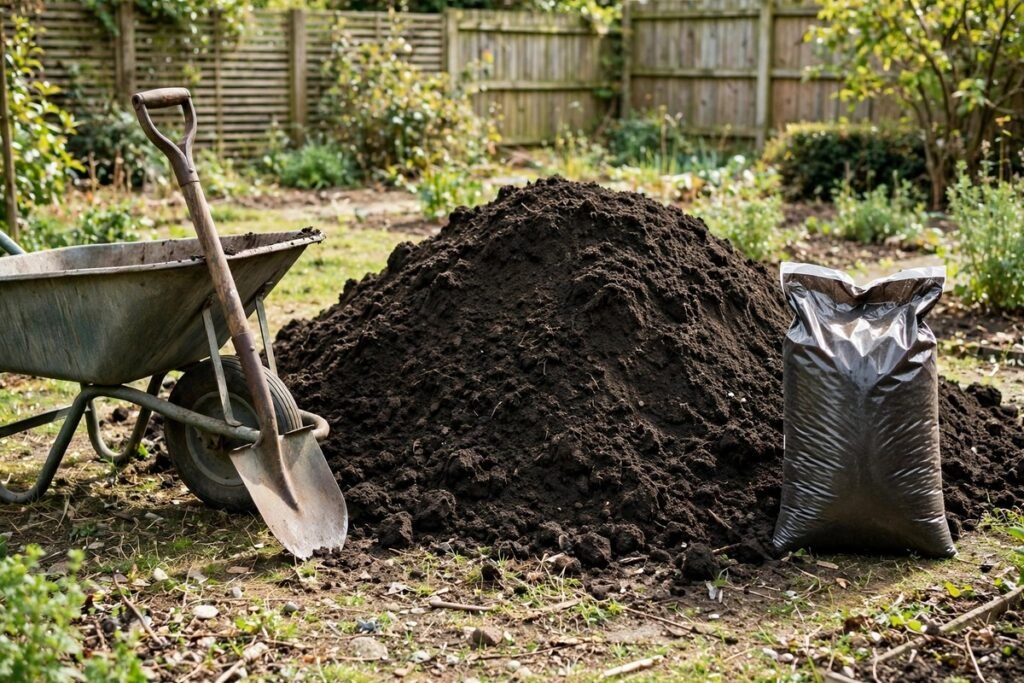
How heavy is a cubic metre of soil? Topsoil weighs about 1.3 tonnes per cubic metre, or about 1,290 kilograms, when it is at the typical density used in the worked example on this site. A cubic yard weighs about 1,900 to 2,700 pounds, or about 0.86 to 1.22 tonnes, because soil type and moisture change the weight.
Why soil weight changes so much
Soil weight is volume times bulk density. Damp soil is heavier than dry soil, because water adds weight to the same volume. Soil type also changes the weight, because topsoil, compost, and other garden materials do not share one density. The site worked example implies a topsoil density of about 1.29 tonnes per cubic metre. Exact density varies with moisture, so check with the supplier for other materials.
The formula for soil weight
Weight equals volume times bulk density. Volume is length times width times depth, with an extra amount added for settling. The Soil Calculator uses volume equals length x width x depth x (1 + extra), weight equals volume x bulk density, bags equals volume divided by bag size rounded up, and loads equals volume divided by truck size rounded up. Add 10 to 20 percent for settling.
Use the Soil Calculator for your own measurements. Keep the volume in one unit through the whole sum, then multiply by bulk density in the matching unit.
Worked example 1: 1 cubic metre of topsoil
Volume is 1 cubic metre. Density is 1.29 tonnes per cubic metre, the topsoil density implied by the site worked example. Weight is 1 x 1.29, which is 1.29 tonnes. To get kilograms, multiply 1.29 by 1000, which is 1,290 kilograms. To get pounds, multiply 1,290 by 2.2046, which is about 2,844 pounds. That figure is a planning figure for topsoil at this density only.
Worked example 2: 1 cubic yard of soil
The site FAQ gives a range for 1 cubic yard of soil, not a single figure. The range is 1,900 to 2,700 pounds, depending on soil type and moisture. To get tonnes, divide pounds by 2204.6. For the lower end, 1,900 divided by 2204.6 is 0.86 tonnes. For the upper end, 2,700 divided by 2204.6 is 1.22 tonnes. A cubic yard is 0.7646 cubic metres, so the range implies about 1.13 to 1.60 tonnes per cubic metre.
Weight by volume
The table below gives weight by volume. Use the topsoil figures only for topsoil at a density of 1.29 tonnes per cubic metre. Use the range when you need a figure for soil in general.
| Volume | Weight |
|---|---|
| 0.5 cubic metres | 0.645 tonnes, or 645 kilograms |
| 1 cubic metre | 1.29 tonnes, or 1,290 kilograms |
| 1 cubic foot | About 36.5 kilograms, or about 80 pounds |
| 1 cubic yard | 1,900 to 2,700 pounds, or 0.86 to 1.22 tonnes |
| 2.48 cubic metres | About 3.2 tonnes |
| 50 cubic feet | 3,515 to 4,995 pounds, or about 1.59 to 2.27 tonnes |
For 1 cubic foot, the calculation is 0.0283 cubic metres x 1.29 tonnes per cubic metre, which is 0.0365 tonnes, or 36.5 kilograms, or about 80 pounds. The site range gives 70 to 100 pounds per cubic foot.
Worked example 3: the site example, 2.48 cubic metres
The site worked example uses a 5 by 3 metre area at 15 cm deep, with 10 percent extra for settling. Area is 5 x 3, which is 15 square metres. Depth is 15 cm, which is 0.15 metres. Plain volume is 15 x 0.15, which is 2.25 cubic metres. With 10 percent extra, volume is 2.25 x 1.10, which is 2.475 cubic metres, shown as 2.48 cubic metres. Weight is 2.48 x 1.29, which is 3.1992 tonnes, shown as about 3.2 tonnes, or 3,200 kilograms.
The site example also gives 62 bags of 40 litres for this volume. Volume in litres is 2.48 x 1000, which is 2,480 litres. Bags are 2,480 divided by 40, which is 62 bags exactly. The site example also gives one truck load, as given. No truck size is given.
How heavy is a bag of soil?
Bag weight is bag volume times bulk density. A 40 litre bag holds 0.04 cubic metres, because 40 divided by 1000 is 0.04. At 1.29 tonnes per cubic metre, the weight is 0.04 x 1.29, which is 0.0516 tonnes, or 51.6 kilograms. That figure is labelled approximate, because bag volumes may be measured before compression and moisture changes the weight.
| Bag size | Weight |
|---|---|
| 20 litres | About 25.8 kilograms |
| 25 litres | About 32.3 kilograms |
| 40 litres | About 51.6 kilograms |
| 50 litres | About 64.5 kilograms |
| 1 cubic foot | About 36.5 kilograms, or about 80 pounds |
| 2 cubic feet | About 73.0 kilograms, or about 161 pounds |
A cubic yard holds about 27 bags of 1 cubic foot, because 1 cubic yard equals 27 cubic feet. It also holds 13.5 bags of 2 cubic feet by volume, but you cannot buy 13.5 bags, so buy 14 bags rounded up.
Worked example 4: a 40 litre bag of topsoil
Volume is 40 litres, which is 0.04 cubic metres. Density is 1.29 tonnes per cubic metre. Weight is 0.04 x 1.29, which is 0.0516 tonnes. To get kilograms, multiply 0.0516 by 1000, which is 51.6 kilograms. To get pounds, multiply 51.6 by 2.2046, which is about 114 pounds. Treat 51.6 kilograms as approximate, because bag volumes may be measured before compression and moisture changes the weight.
Worked example 5: a 10 by 10 foot garden at 6 inches deep
The site FAQ gives this garden as about 50 cubic feet, or 1.85 cubic yards. Length is 10 feet, width is 10 feet, and depth is 6 inches, which is 0.5 feet. Area is 10 x 10, which is 100 square feet. Volume is 100 x 0.5, which is 50 cubic feet. To get cubic yards, divide 50 by 27, which is 1.85 cubic yards. Weight comes from the site range for a cubic yard, which is 1,900 to 2,700 pounds. For the lower end, 1.85 x 1,900 is 3,515 pounds. For the upper end, 1.85 x 2,700 is 4,995 pounds. To get tonnes, divide pounds by 2204.6. For the lower end, 3,515 divided by 2204.6 is 1.59 tonnes. For the upper end, 4,995 divided by 2204.6 is 2.27 tonnes.
Car and trailer weight limits
Check vehicle and trailer weight limits before you collect soil. This guide does not give a specific vehicle limit, because limits change with the vehicle, the trailer, and the load. Check the limits for the exact vehicle and trailer you will use, in the manual or on the plate for that vehicle and trailer, before you load anything. If the total is close to the limit, make two trips, or order delivery.
Common mistakes
- Using one weight for every material. Different materials have different densities.
- Ignoring moisture. Damp soil weighs more than dry soil. Plan for damp soil.
- Using the volume before settling. Soil settles after watering, so add 10 to 20 percent for settling.
- Treating a bag label as an exact weight. Bag volumes may be measured before compression.
- Buying 13.5 bags. You cannot buy half a bag in this sense, so round up to 14 bags.
- Mixing units in one sum. That gives a wrong answer.
- Forgetting the weight when you plan collection. The same volume in kilograms can be more than a tonne.
- Inventing a truck capacity from the site example. The site example gives one truck load without stating the truck size.
Use the calculator for your own garden
Put your own measurements into the Soil Calculator and check the result against the method in this guide. Enter length, width, and depth, add 10 to 20 percent for settling, and read volume, weight, bags, and loads. For volume in other units, use the Garden Volume Calculator. For topsoil, use the Topsoil Calculator. For compost, use the Compost Calculator. For more guides, use the Guides page.
Frequently asked questions
Q: How heavy is a cubic metre of soil?
A: Topsoil weighs about 1.29 tonnes per cubic metre at the density used in the site worked example, which is 1,290 kilograms. The exact weight changes with soil type and moisture, so use 1.29 tonnes as a planning figure and check the supplier figure for the material you buy.
Q: How heavy is a cubic yard of soil?
A: A cubic yard of soil weighs about 1,900 to 2,700 pounds, or about 0.86 to 1.22 tonnes, from the site FAQ range. The range is wide because soil type and moisture change the weight.
Q: How heavy is a cubic foot of soil?
A: A cubic foot of soil weighs about 70 to 100 pounds at the site range, or about 36.5 kilograms at a topsoil density of 1.29 tonnes per cubic metre. Use the range for planning and the single topsoil figure only for topsoil at that density.
Q: How heavy is a 40 litre bag of soil?
A: A 40 litre bag weighs about 51.6 kilograms at a topsoil density of 1.29 tonnes per cubic metre. Treat the figure as approximate because bag volumes may be measured before compression and moisture changes the weight.
Q: How heavy is the soil for a 10 by 10 foot garden at 6 inches deep?
A: The garden holds about 50 cubic feet, or 1.85 cubic yards, and the soil weighs about 3,515 to 4,995 pounds, or about 1.59 to 2.27 tonnes, from the site range. Check vehicle and trailer limits before you collect it.
Q: How do I work out soil weight for my own garden?
A: Work out volume first with length x width x depth x (1 + extra), then multiply volume by bulk density to get weight. Use the Soil Calculator for your own measurements, add 10 to 20 percent for settling, and round bag counts up.
Work out your volume first, multiply by bulk density to get weight, and check the result against the tables in this guide. Topsoil weighs about 1.29 tonnes per cubic metre at the density used here, a cubic yard weighs 1,900 to 2,700 pounds, and a 40 litre bag weighs about 51.6 kilograms. Put those numbers into the Soil Calculator, allow for damp soil and settling, and order or collect with the real weight in front of you.
More guides
How to Choose a Fertilizer Rate: Meet Nitrogen or Cap Every Nutrient
Learning how to choose a fertilizer rate starts with one choice. You either meet a chosen nutrient target, usually nitrogen, and accept…
Read guide
Too Much Phosphorus From Fertilizer: Surplus, Signs and Fixes
Too much phosphorus from fertilizer is a surplus that appears when a balanced blend meets nitrogen and supplies twice the phosphate the…
Read guide
Fertilizer NPK Numbers Explained: What N, P2O5 and K2O Mean
Fertilizer npk numbers are the three percentages on a fertilizer bag, listed in the order nitrogen, phosphate and potash. They tell you…
Read guide