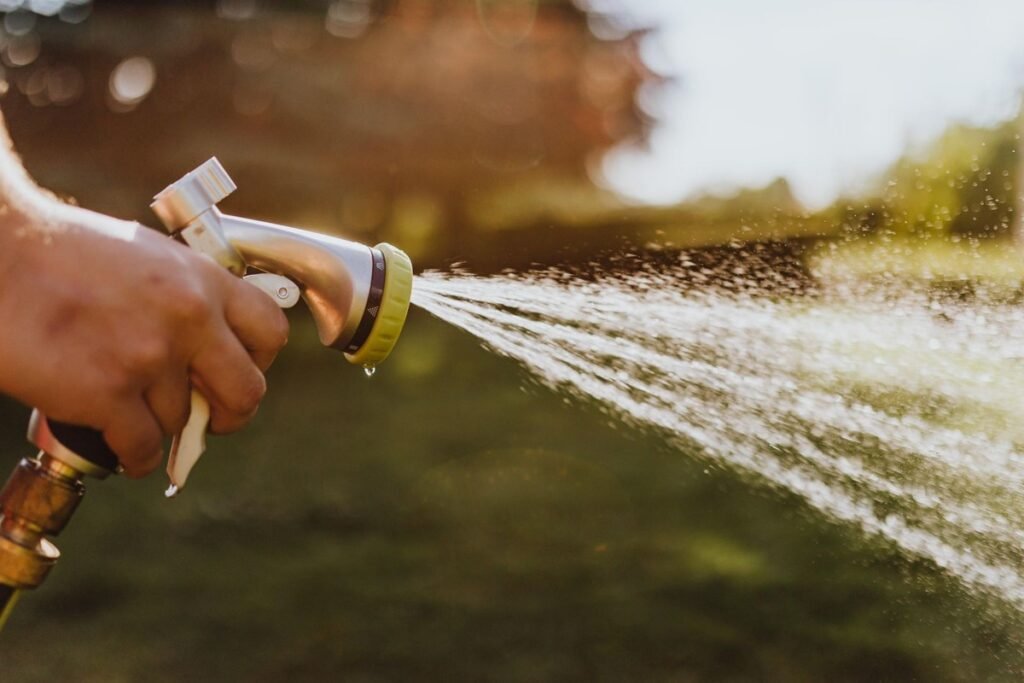
How long to water depends on hose flow and litres in one session. At the verified flow of 12 litres per minute, a 267 litre session takes about 22 minutes. Measure flow with a 10 litre bucket test, divide litres per session by litres per minute, and use the result as session time. Tables below show minutes for session volumes.
How long to water with the minutes formula
You need two numbers. The first is litres in one session. The second is hose flow in litres per minute. Divide litres per session by litres per minute and the result is minutes. Time is amount divided by rate. The calculator gives session volume in four steps. First, find shortfall. Shortfall is weekly need minus rain, and it cannot fall below zero. Second, find total water. Water is shortfall times area divided by method efficiency. Third, find the session count for your soil. Sand gives three sessions, loam gives two, and clay gives one. Fourth, divide total water by the session count to get litres per session. Then divide litres per session by hose flow to get minutes.
Weekly need of 25 mm is the only weekly need figure verified on the calculator page. Efficiency of 75 percent for a sprinkler is the only efficiency figure verified on the page. This blog does not invent a figure for any other method. One millimetre of water over 1 m2 is exactly 1 litre, and 1 in over 1 sq ft is 0.62 US gallons. Metric and imperial examples here are kept separate as rounded equivalents.
The bucket test in four steps
You cannot use the minutes formula until you know your hose flow. Time how long it takes to fill a bucket of known size. A 10 L bucket in 50 seconds is 12 L per minute. That is the only hose flow figure verified on the calculator page, and it is the flow used in the main minutes tables. Other flow rates appear later only as example flow rates you might measure, never as a typical flow or a page figure.
Do the test at the tap setting you will use for watering, with the hose and fitting you will use. Start timing when water starts to enter the bucket. Stop timing when water reaches the 10 litre mark. If your bucket has no litre mark, measure 10 litres into it first with a jug and mark the level. Flow in litres per minute is 10 divided by seconds, then multiplied by 60. For the verified case, 10 divided by 50 is 0.2, and 0.2 multiplied by 60 is 12. The Garden Watering Schedule Calculator asks for this flow figure, and the minutes it shows depend on it directly.
Minutes at 12 litres per minute for common session volumes
Table 1 gives minutes for session volumes from 50 litres to 600 litres at the verified flow of 12 litres per minute. Minutes is litres per session divided by 12, rounded to the nearest whole minute.
| Litres per session | Minutes at 12 litres per minute |
|---|---|
| 50 | About 4 |
| 100 | About 8 |
| 150 | About 13 |
| 200 | About 17 |
| 267 | About 22 |
| 300 | 25 |
| 400 | About 33 |
| 533 | About 44 |
| 600 | 50 |
A session of 150 litres is shown as about 13 minutes because 12.5 rounds up to 13. Read the table from your session volume, not from your total water. A total of 533 litres split into two sessions is two sessions of about 22 minutes each. The same total as one session is about 44 minutes.
Minutes by soil and area at 12 litres per minute
Table 2 shows how soil and area change minutes when shortfall is 20 mm and efficiency is 75 percent for a sprinkler. Shortfall of 20 mm comes from weekly need of 25 mm minus rain of 5 mm. Those rainfall figures are calculator inputs, not claims about any real place. Sand gives three sessions, loam gives two, and clay gives one.
Session figures are worked from unrounded totals.
| Area watered | Soil | Litres per session | Minutes at 12 litres per minute |
|---|---|---|---|
| 5 m2 | Sand | 44 | About 4 |
| 5 m2 | Loam | 67 | About 6 |
| 5 m2 | Clay | 133 | About 11 |
| 10 m2 | Sand | 89 | About 7 |
| 10 m2 | Loam | 133 | About 11 |
| 10 m2 | Clay | 267 | About 22 |
| 20 m2 | Sand | 178 | About 15 |
| 20 m2 | Loam | 267 | About 22 |
| 20 m2 | Clay | 533 | About 44 |
| 40 m2 | Sand | 356 | About 30 |
| 40 m2 | Loam | 533 | About 44 |
| 40 m2 | Clay | 1067 | About 89 |
Check one row. For 20 m2 of loam, total water is 20 times 20 divided by 0.75, which is 533 litres. Loam gives two sessions, so litres per session is 267 litres after rounding. Minutes is 267 divided by 12, which is 22.25, shown as about 22 minutes. That row is the page worked example. A larger area needs more total water, so minutes rise. Sand splits the total into three short sessions. Clay puts the whole total into one long session. A 40 m2 clay bed takes about 89 minutes in one session, while the same bed as loam takes about 44 minutes per session.
Minutes at example flow rates for a 267 litre session
Table 3 shows minutes for one session volume, 267 litres, at five flow rates. Each flow rate here is an example flow rate you might measure, worked through the same formula, and never presented as a typical flow or a page figure. The only verified flow figure is 12 litres per minute, from the 10 litre bucket in 50 seconds.
| Example flow rate you might measure | Minutes for a 267 litre session |
|---|---|
| 6 litres per minute | About 45 |
| 9 litres per minute | About 30 |
| 12 litres per minute | About 22 |
| 15 litres per minute | About 18 |
| 18 litres per minute | About 15 |
A flow of 6 litres per minute takes about twice as long as a flow of 12 litres per minute, because the rate is half. Minutes fall as flow rises, in exact proportion. If your bucket test gives a flow that is not in Table 3, divide your session volume by your flow. Your hose, your tap, and your fitting decide your flow.
Bucket fill times and what they mean for flow
Table 4 turns the bucket test around. It shows the flow that follows from five fill times for a 10 litre bucket. Each row is an example fill time you might measure. The flow is 10 divided by seconds, then multiplied by 60.
| Seconds to fill a 10 litre bucket | Flow in litres per minute | Minutes for a 267 litre session |
|---|---|---|
| 100 seconds | 6 | About 45 |
| 60 seconds | 10 | About 27 |
| 50 seconds | 12 | About 22 |
| 40 seconds | 15 | About 18 |
| 30 seconds | 20 | About 13 |
The row with 50 seconds is the verified row. A 10 litre bucket in 50 seconds is 12 litres per minute, and a 267 litre session at that flow is about 22 minutes. The other rows are example fill times only. A fill time of 100 seconds gives a flow of 6 litres per minute, and the same session takes about 45 minutes. Keep the bucket level and the tap at the same opening for the whole fill. If water splashes out, the level will be low and the time will look short, so the flow will look high.
Worked page example step by step
The page worked example uses a 20 m2 vegetable bed needing 25 mm a week, after 5 mm of rain. Shortfall is 25 minus 5, which is 20 mm. Total water is 20 times 20 divided by 0.75, which is 533 litres after rounding. Soil is loam, so sessions are two. Litres per session is 267 litres after rounding. Hose flow is 12 litres per minute. Minutes is 267 divided by 12, which is 22.25, shown as about 22 minutes. If rain were 10 mm instead of 5 mm, shortfall would be 15 mm, total water would be 400 litres, and minutes would be about 17 minutes. The page FAQ says a vegetable garden needs about 25 mm a week from rain and watering combined, more in hot dry weather. That extra need is stated as a direction, not as a number.
Why sessions change minutes even when total water stays the same
Total water is set by shortfall, area, and efficiency. Sessions do not change total water. Sessions change how total water is divided. Sand gives three sessions, loam gives two, and clay gives one. The same total gives a smaller session volume on sand than on clay, and fewer minutes per session at the same flow. Total minutes across all sessions stay the same. Plan three short visits for sand, two visits of about 22 minutes each for loam, and one visit of about 44 minutes for clay.
Morning watering and timing your session in the day
The calculator page FAQ says morning is best. Morning watering gives less evaporation, and leaves dry quickly, which reduces disease. Start early enough that a session can finish before the heat of the day. A session of about 22 minutes fits easily into a morning routine. A session of about 44 minutes needs a longer slot. A session of about 89 minutes on a large clay bed needs the earliest start you can manage, or a split of the area into smaller parts. The page FAQ also says how often to water. Usually two or three deep waterings a week in summer, more often on sandy soil, less on clay.
Common mistakes
The first mistake is guessing hose flow instead of measuring it. A 10 litre bucket test takes less than two minutes, and it gives a flow figure that belongs to your hose and your tap. The second mistake is using total water as session water. Total water is the water for the whole week, split across sessions. Read litres per session from the calculator, not total water. The third mistake is using a flow figure from another hose, another tap, or another fitting. Test the setup you will water with. The fourth mistake is rounding minutes down. A session of 150 litres at 12 litres per minute is 12.5 minutes, shown as about 13 minutes. The fifth mistake is treating an example flow rate as a typical flow. Only 12 litres per minute is verified on the calculator page. The sixth mistake is forgetting rain. Shortfall is weekly need minus rain. If you ignore rain, minutes will be too long.
What the calculator does not give
The calculator gives water to apply, sessions for your soil, and minutes per session at your hose flow. It gives no cost figure, no pump or pressure figures, no sprinkler hardware sizing, no soil moisture measurement, and no per crop need beyond the weekly need input. This blog gives none of those figures, and no hose diameter, nozzle flow rate, sprinkler coverage rate, or pressure figure. Containers, new plantings, and hot windy weather need more than this guide. The page gives no number for that extra need, so this blog gives none. Efficiency figures are typical, so minutes are a guide based on the inputs you enter.
How to use the calculator
Enter the area you water, in m2 or in sq ft. Set weekly need, or choose a garden type in the calculator. Enter the rain that fell this week, using a rain gauge or a weather app. Choose your soil and watering method. Time your hose to find its flow, using the 10 litre bucket test in this blog. The calculator shows water to apply, sessions for your soil, and minutes per session at your hose flow. Water for the minutes shown, in the sessions shown, and water early in the morning. The Rain Barrel Calculator gives storm water and barrel count from roof area and rainfall.
Frequently asked questions
Q: How long to water at 12 litres per minute for a 267 litre session?
A: About 22 minutes. Minutes is 267 divided by 12, which is 22.25, shown as about 22 minutes.
Q: How do I measure my hose flow?
A: Time how long it takes to fill a bucket of known size. A 10 L bucket in 50 seconds is 12 L per minute. Flow is 10 divided by seconds, then multiplied by 60.
Q: How long to water a 20 m2 loam bed after 5 mm of rain?
A: About 22 minutes per session, with two sessions. Shortfall is 20 mm, total water is 533 litres, litres per session is 267 litres, and minutes is 267 divided by 12.
Q: Why does clay take longer per session than sand?
A: Clay gives one session and sand gives three, so the same total is split into fewer, larger sessions on clay. Total minutes stay the same at the same flow.
Q: Is morning the best time to water?
A: Yes. Morning is best because there is less evaporation, and leaves dry quickly, which reduces disease.
Q: Does the calculator give a cost for watering?
A: No. The calculator gives water to apply, sessions, and minutes only. It gives no cost, no pump or pressure figures, no sprinkler hardware sizing, and no soil moisture measurement.
More guides

How to Choose a Fertilizer Rate: Meet Nitrogen or Cap Every Nutrient
Learning how to choose a fertilizer rate starts with one choice. You either meet a chosen nutrient target, usually nitrogen, and accept…
Read guide
Too Much Phosphorus From Fertilizer: Surplus, Signs and Fixes
Too much phosphorus from fertilizer is a surplus that appears when a balanced blend meets nitrogen and supplies twice the phosphate the…
Read guide
Fertilizer NPK Numbers Explained: What N, P2O5 and K2O Mean
Fertilizer npk numbers are the three percentages on a fertilizer bag, listed in the order nitrogen, phosphate and potash. They tell you…
Read guide