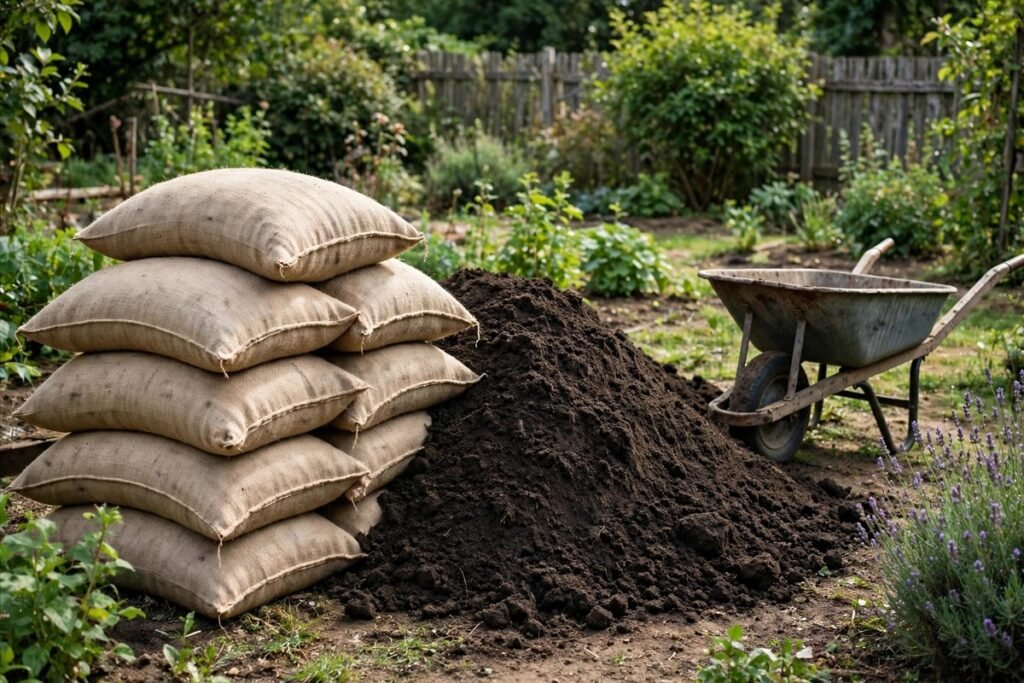
How many 40 lb bags of topsoil make a cubic yard? About 36 bags, when bagged topsoil weighs 53 lb per cubic foot. At that density a 40 lb bag holds about 0.75 cubic feet, and 27 cubic feet divided by 0.75 gives 36 bags. Because density varies, the buyable range is 34 to 38 bags.
Use the calculator first
Put your own numbers into the Topsoil Weight to Cubic Feet Calculator before you buy. Enter the weight on the bag and the density of your soil, and the calculator turns weight into volume in cubic feet. Then divide 27 by that volume to get bags per cubic yard. The examples below show the same arithmetic by hand.
The formula
Two formulas give the answer. First, volume equals weight divided by bulk density. A 40 lb bag divided by a density of 53 lb per cubic foot gives about 0.75 cubic feet. Second, bags per cubic yard equals 27 cubic feet divided by bag volume. One cubic yard holds 27 cubic feet, so 27 divided by 0.75 gives 36 bags. Density is the number that moves the answer. Bagged topsoil is usually damp and weighs about 50 to 55 lb per cubic foot.
Worked example 1: the site example
Take the worked example from the calculator page. A 40 lb bag at 53 lb per cubic foot holds 40 divided by 53, which is 0.75 cubic feet when rounded, or about 21 litres. Bags per cubic yard are 27 divided by 0.75, which is 36 bags exactly. The full yard of bagged topsoil weighs 36 times 40, which is 1440 lb.
Worked example 2: the range from 34 to 38 bags
At 50 lb per cubic foot, a 40 lb bag holds 40 divided by 50, which is 0.80 cubic feet. Bags per cubic yard are 27 divided by 0.80, which is 33.75, so buy 34 bags. At 55 lb per cubic foot, a 40 lb bag holds 40 divided by 55, which is 0.727 cubic feet. Bags per cubic yard are 27 divided by 0.727, which is 37.1, so buy 38 bags. The 36 bag figure sits in the middle of that range and applies at 53 lb per cubic foot only.
| Density | Bag volume | Exact bags | Bags to buy |
|---|---|---|---|
| 50 lb per cubic foot | 0.80 cubic feet | 33.75 | 34 |
| 53 lb per cubic foot | 0.75 cubic feet | 36 | 36 |
| 55 lb per cubic foot | 0.727 cubic feet | 37.1 | 38 |
Worked example 3: other bag sizes
Many bags print volume instead of weight. Use the same formula with the volume on the bag. A 1 cubic foot bag gives 27 divided by 1, which is 27 bags. A 1.5 cubic foot bag gives 27 divided by 1.5, which is 18 bags. A 2 cubic foot bag gives 27 divided by 2, which is 13.5 bags by exact count, so buy 14 bags. You cannot buy half a bag, and rounding down would leave you short.
| Bag size | Litres | Exact bags | Bags to buy |
|---|---|---|---|
| 0.75 cubic feet | 21.2 litres | 36 | 36 |
| 1 cubic foot | 28.3 litres | 27 | 27 |
| 1.5 cubic feet | 42.5 litres | 18 | 18 |
| 2 cubic feet | 56.6 litres | 13.5 | 14 |
Weight also tells you which material you hold. A 1.5 cubic foot bag of topsoil weighs about 60 to 80 lb, while the same size bag of potting mix weighs about 20 to 40 lb.
Why some pages say 27 bags
Some pages say 27 bags of 40 lb topsoil make a cubic yard. That answer assumes a 40 lb bag holds 1 cubic foot, which needs a density of 40 lb per cubic foot, from 40 divided by 1. Site density for bagged topsoil is 50 to 55 lb per cubic foot, so a 40 lb bag holds 0.73 to 0.80 cubic feet, not 1 cubic foot. A cubic yard at 27 bags times 40 lb gives 1080 lb, far below the weight of a yard of damp topsoil at site density. The 27 bag figure is correct only for a bag that prints 1 cubic foot on the label.
Why some pages say 54 bags
Other pages say 54 bags. That answer comes from bulk dense topsoil at 80 lb per cubic foot. At that density a 40 lb bag holds 40 divided by 80, which is 0.50 cubic feet, and 27 divided by 0.50 gives 54 bags. The arithmetic is correct for that density, but the density is wrong for bagged topsoil. Bagged topsoil is damp and loose, at 50 to 55 lb per cubic foot, while bulk dense topsoil is compacted and far heavier per cubic foot. The same mix up shows in a 1.5 cubic foot bag: at 80 lb per cubic foot it would weigh 120 lb, while the site range for topsoil is 60 to 80 lb.
Worked example 4: dry soil holds more volume
Dry soil is lighter than damp soil, so the same 40 lb buys more volume when the soil is dry. The site states dry soil can be 30 percent lighter, and that is the only moisture figure used in this guide. At 30 percent lighter than 53 lb per cubic foot, dry density is 53 times 0.70, which is 37.1 lb per cubic foot. A 40 lb bag of dry soil at that density holds 40 divided by 37.1, which is 1.08 cubic feet. Bags per cubic yard are 27 divided by 1.08, which is 25 bags. Treat this as an illustration of the 30 percent figure only.
Worked example 5: a bed and 10 percent extra
Take a raised bed 4 by 8 feet at 11 inches deep. Volume is 4 times 8 times 11 divided by 12, which is 29.33 cubic feet. Bags are 29.33 divided by 0.75, which is 39.11, so buy 40 bags. A bed 10 by 10 feet at 4 inches deep holds 33.33 cubic feet, so 33.33 divided by 0.75 is 44.44, buy 45 bags. For settling, add 10 percent before you buy. One cubic yard at 36 bags with 10 percent extra is 36 times 1.10, which is 39.6, so buy 40 bags.
Read the label before you buy
The volume printed on the bag controls the count, not the weight printed on the bag. Two bags can weigh 40 lb and hold different volumes, because density varies with moisture and packing. Read the cubic feet figure on the label first, then divide 27 by that figure. Bag labels may state volume before compression, so a bag that reads 0.75 cubic feet may settle to less in the bed.
Bags or bulk for one cubic yard
For one cubic yard, bags suit a small job with easy access and storage, while bulk suits a larger job where you can take a full load. One cubic yard in bags is 36 bags at 40 lb each, which is 1440 lb to carry and stack. Check that weight against your vehicle load limit. Work out the volume first with the Topsoil Calculator or the Soil Calculator, then turn that volume into bags with the method in this guide. For further reading, see the Guides. This guide gives no truck capacity, because the site does not state one.
Common mistakes
- Using 36 bags for every topsoil. The 36 bag figure applies at 53 lb per cubic foot only. Use the range 34 to 38 bags when density is unknown.
- Using the 27 bag figure for a 40 lb bag. That figure assumes a 1 cubic foot bag. A 40 lb bag holds about 0.75 cubic feet at site density.
- Using the 54 bag figure for bagged topsoil. That figure uses bulk dense density of 80 lb per cubic foot. Bagged topsoil sits at 50 to 55 lb per cubic foot.
- Rounding a bag count down, or presenting 13.5 bags as a buyable count. A result of 33.75 bags means 34 bags, and 13.5 bags means 14 bags. Exact counts and buyable counts are different numbers.
- Reading weight as volume. A 40 lb bag is a weight, not a volume. Divide weight by density to get volume, or read the cubic feet figure on the label.
- Forgetting extra for settling. Add 10 percent before you buy, not after. One cubic yard with 10 percent extra needs 40 bags, not 36 bags.
Frequently asked questions
Q: How many 40 lb bags of topsoil make a cubic yard?
A: About 36 bags at 53 lb per cubic foot. The buyable range is 34 to 38 bags across the site density range of 50 to 55 lb per cubic foot.
Q: How many cubic feet is a 40 lb bag of topsoil?
A: About 0.75 cubic feet at 53 lb per cubic foot, or about 21 litres. Across the site density range the volume is 0.73 to 0.80 cubic feet.
Q: Why do some pages say 27 bags of topsoil make a cubic yard?
A: It assumes a 40 lb bag holds 1 cubic foot, which needs a density of 40 lb per cubic foot. Site density for bagged topsoil is 50 to 55 lb per cubic foot.
Q: Why do some pages say 54 bags of topsoil make a cubic yard?
A: It uses bulk dense topsoil at 80 lb per cubic foot, where a 40 lb bag holds 0.50 cubic feet. Bagged damp topsoil sits at 50 to 55 lb per cubic foot.
Q: How many 40 lb bags do I need for a cubic yard with 10 percent extra?
A: One cubic yard needs 36 bags at the midpoint, and 36 times 1.10 is 39.6, so buy 40 bags.
Q: How much does a cubic yard of bagged topsoil weigh?
A: At the site midpoint, 36 bags times 40 lb gives 1440 lb per cubic yard. Check that weight against your vehicle load limit first.
Work out the volume on the bag, divide 27 by that volume, and round up. For a 40 lb bag of bagged topsoil the answer is about 36 bags per cubic yard, with a buyable range of 34 to 38 bags. Put your own numbers into the Topsoil Weight to Cubic Feet Calculator before you order.
More guides
How to Choose a Fertilizer Rate: Meet Nitrogen or Cap Every Nutrient
Learning how to choose a fertilizer rate starts with one choice. You either meet a chosen nutrient target, usually nitrogen, and accept…
Read guide
Too Much Phosphorus From Fertilizer: Surplus, Signs and Fixes
Too much phosphorus from fertilizer is a surplus that appears when a balanced blend meets nitrogen and supplies twice the phosphate the…
Read guide
Fertilizer NPK Numbers Explained: What N, P2O5 and K2O Mean
Fertilizer npk numbers are the three percentages on a fertilizer bag, listed in the order nitrogen, phosphate and potash. They tell you…
Read guide