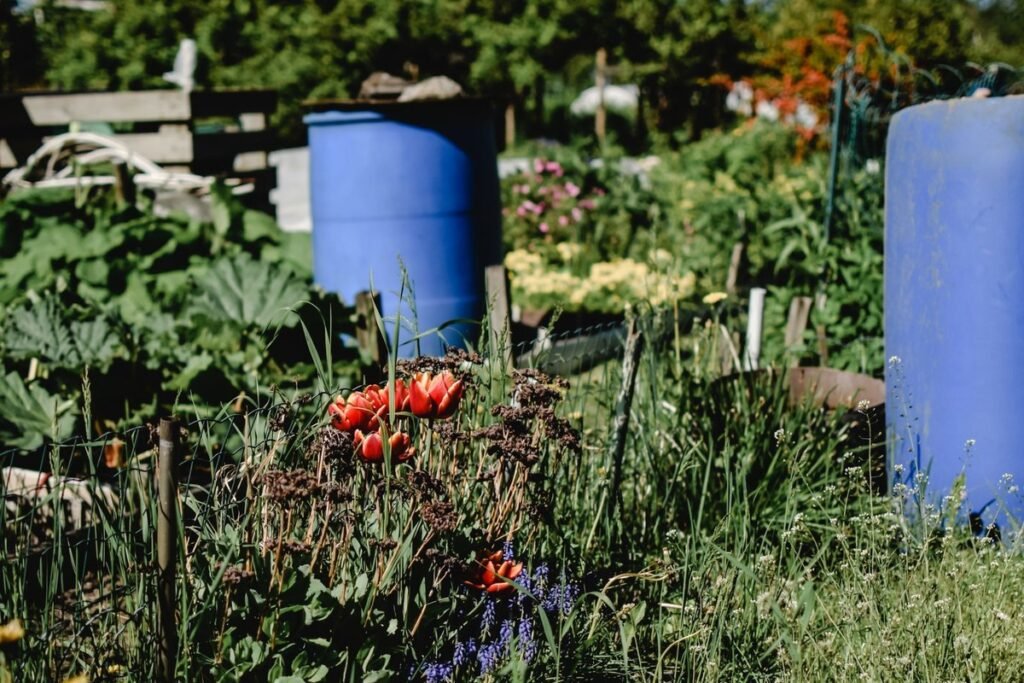
How many rain barrels do I need depends on your roof area and your storm size. For a 25 mm storm at 90 percent runoff, a 50 m2 roof needs 6 barrels of 200 L, an 80 m2 roof needs 9 barrels, and a 100 m2 roof needs 12 barrels. Count each downpipe separately.
The formula in one line
Water in litres equals roof area in m2 times rainfall in mm times runoff share. A 50 m2 roof in a 25 mm storm gives 50 times 25, which is 1,250 L before losses. At 90 percent runoff, that becomes 1,125 L. The page default of 90 percent suits most pitched roofs, and it is the runoff share used in every table in this blog.
Barrels equals storm water divided by barrel size, rounded up to the next whole barrel. A storm that gives 1,125 L needs 6 barrels of 200 L, because 1,125 divided by 200 is 5.625, and 5 barrels hold only 1,000 L. Use the roof footprint, not the sloping roof area, which overstates the water and the barrel count. The Rain Barrel Calculator shows the storm water and the barrel count together.
Worked example: 80 m2 at 25 mm
The page worked example uses a roof 10 by 8 m, which is 80 m2, in a 25 mm storm at 90 percent runoff. Roof area times rainfall is 80 times 25, which is 2,000 L. At 90 percent runoff, that becomes 1,800 L. Barrels equals 1,800 divided by 200, which is 9 exactly, so the answer is nine 200 L barrels. The page states the barrel as 200 L, and it states the same barrel as 55 gal.
A 200 L barrel on that 80 m2 roof fills with less than 3 mm of rain, because 200 divided by 80 times 0.90 is 2.78 mm. In imperial terms the page gives the same check as about 0.1 in on a 1,000 sq ft roof. That 1,000 sq ft figure is the rounded imperial equivalent of the 10 by 8 m roof, which is 80 m2, about 861 sq ft, not 1,000 sq ft.
Barrels by roof area and storm size
The table below gives storm water and barrels of 200 L for five roof areas and three storm sizes, all at 90 percent runoff.
| Roof area | 10 mm storm | 25 mm storm | 50 mm storm |
|---|---|---|---|
| 50 m2 | 450 L, 3 barrels | 1,125 L, 6 barrels | 2,250 L, 12 barrels |
| 80 m2 | 720 L, 4 barrels | 1,800 L, 9 barrels | 3,600 L, 18 barrels |
| 100 m2 | 900 L, 5 barrels | 2,250 L, 12 barrels | 4,500 L, 23 barrels |
| 120 m2 | 1,080 L, 6 barrels | 2,700 L, 14 barrels | 5,400 L, 27 barrels |
| 150 m2 | 1,350 L, 7 barrels | 3,375 L, 17 barrels | 6,750 L, 34 barrels |
How to read the table
Start with the 25 mm column, the storm size in the page worked example. A 50 m2 roof needs 6 barrels, an 80 m2 roof needs 9, a 100 m2 roof needs 12, a 120 m2 roof needs 14, and a 150 m2 roof needs 17. A 120 m2 roof gives 2,700 L, and 2,700 divided by 200 is 13.5, rounded up to 14.
Doubling the storm size doubles the water before the round up step. For a 100 m2 roof, a 10 mm storm gives 900 L and 5 barrels, a 25 mm storm gives 2,250 L and 12 barrels, and a 50 mm storm gives 4,500 L and 23 barrels. The 50 mm water is double the 25 mm water, but the count is 23, not 24, because 4,500 divided by 200 is 22.5, rounded up to 23.
Rainfall figures here are calculator inputs, not claims about any real place. Pick the storm size that matches the typical storm you want to catch, then read the barrel count for your roof area. The Garden Area Calculator can help with the roof footprint where the ground area is made of more than one simple shape.
One downpipe at a time
One downpipe serves only the roof area draining to it. A roof of 100 m2 with two downpipes does not send 2,250 L to each downpipe in a 25 mm storm. It sends the water from the part of the roof that drains to each downpipe, and only that part. If each downpipe serves half the roof, each serves 50 m2, and each needs 6 barrels at 25 mm, for 12 barrels in total across the roof.
Measure the length and width of the ground area under the roof that drains to your downpipe, as the calculator asks in its first step. Do not measure the whole roof and use that figure at every downpipe, and do not measure the sloping roof surface. The table below works three splits at a 25 mm storm and 90 percent runoff, with 200 L barrels.
| Whole roof | Area per downpipe | Water per downpipe | Barrels per downpipe | Total barrels |
|---|---|---|---|---|
| 100 m2, 2 downpipes | 50 m2 each | 1,125 L each | 6 each | 12 |
| 120 m2, 2 downpipes | 60 m2 each | 1,350 L each | 7 each | 14 |
| 150 m2, 3 downpipes | 50 m2 each | 1,125 L each | 6 each | 18 |
The first two rows match the whole roof counts, 12 barrels for 100 m2 and 14 for 120 m2. The third row does not match the whole roof count for 150 m2, which is 17 barrels, because 6 plus 6 plus 6 is 18. The gap comes from rounding up at each downpipe. The whole roof gives 3,375 L, and 3,375 divided by 200 is 16.875, rounded up to 17. Each 50 m2 section gives 1,125 L, and 1,125 divided by 200 is 5.625, rounded up to 6 at each downpipe.
Bigger storms need more barrels
A bigger storm needs more barrels on the same roof, and the increase is fast. On a 100 m2 roof at 90 percent runoff, a 10 mm storm needs 5 barrels, a 25 mm storm needs 12, and a 50 mm storm needs 23. The water rises from 900 L to 2,250 L to 4,500 L, and the barrel count follows the water. On a 150 m2 roof, the same three storms need 7, 17 and 34 barrels.
Planning for a bigger storm does not mean buying barrels for the largest storm ever recorded. It means choosing a storm size to catch, knowing what overflows beyond it, and fitting an overflow that directs excess water away from foundations. When the barrels at a downpipe are full, the next water must have a route away from the house.
Linking barrels or adding barrels
Linking kits connect barrels near the base so they fill together. That is the calculator page answer to whether you can link rain barrels together. Linked barrels at one downpipe share the water from that downpipe, so they fill at the same level and act as one larger store at that downpipe. Adding a separate barrel at a different downpipe does not help the first downpipe, because water from the first part of the roof never reaches the second downpipe.
Each extra 200 L barrel adds 200 L of storage at the downpipe where it stands. Two linked barrels hold 400 L, three hold 600 L, and six hold 1,200 L. For a 50 m2 roof at 25 mm, six linked barrels hold the full 1,125 L with 75 L of spare room, because six times 200 is 1,200.
What to do when the count is high
A count of 23 barrels for a 100 m2 roof at 50 mm, or 34 barrels for a 150 m2 roof at 50 mm, is high for most gardens. That does not mean the table is wrong, and it does not mean you must buy that many barrels. Start with the 25 mm column and decide how many barrels you can place at each downpipe.
Empty the barrels between storms where you can, because annual figures assume you do, which rarely happens, so real capture is lower. Check local rules on rainwater harvesting before you add storage, and do not use untreated rainwater for drinking.
Common mistakes
The first mistake is using the whole roof area at one downpipe. A 100 m2 roof with two downpipes does not send 2,250 L to each downpipe in a 25 mm storm. The second mistake is using the sloping roof area instead of the footprint. The third mistake is forgetting runoff share. At 90 percent runoff, a 50 m2 roof in a 25 mm storm gives 1,125 L, not 1,250 L. The fourth mistake is dividing and rounding down. A storm that gives 2,700 L needs 14 barrels, not 13, because 13 barrels hold only 2,600 L.
The fifth mistake is assuming one barrel is enough. A 200 L barrel on an 80 m2 roof fills with less than 3 mm of rain, so a 25 mm storm on that roof needs nine barrels, not one. The sixth mistake is fitting barrels with no overflow, or with an overflow that runs toward the house. The seventh mistake is treating an annual figure as water stored at once. Annual figures assume you empty barrels between storms, which rarely happens, so real capture is lower.
How to use the calculator
Measure the footprint of the roof area draining to your downpipe, using the Garden Area Calculator where the area is made of more than one shape. Open the Rain Barrel Calculator and enter that footprint, not the whole roof where more than one downpipe serves the roof. Set the runoff share to 90 percent, enter a typical storm rainfall in mm, and enter 200 L as the barrel size. Read the storm water and the barrel count, then repeat for each downpipe. The Rainwater Harvesting Calculator gives per storm and per year figures from the same inputs.
Frequently asked questions
Q: How many rain barrels do I need for a 100 m2 roof in a 25 mm storm?
A: 12 barrels of 200 L, because 100 times 25 times 0.90 is 2,250 L, and 2,250 divided by 200 is 11.25, rounded up to 12.
Q: How many rain barrels do I need for a 50 m2 roof in a 25 mm storm?
A: 6 barrels of 200 L, because 50 times 25 times 0.90 is 1,125 L, and 1,125 divided by 200 is 5.625, rounded up to 6.
Q: Is one rain barrel enough?
A: No. One 200 L barrel on an 80 m2 roof fills with less than 3 mm of rain, while a 25 mm storm there gives 1,800 L, which needs 9 barrels.
Q: Do I count the whole roof or one downpipe?
A: Count one downpipe at a time. One downpipe serves only the roof area draining to it, so work each downpipe separately and add the counts.
Q: How many barrels do I need for a 50 mm storm on a 100 m2 roof?
A: 23 barrels of 200 L, because 100 times 50 times 0.90 is 4,500 L, and 4,500 divided by 200 is 22.5, rounded up to 23.
Q: Can I link rain barrels together instead of adding separate barrels?
A: Yes. Linking kits connect barrels near the base so they fill together, and linked barrels at one downpipe share the water from that downpipe. Fit an overflow that directs excess water away from foundations when the linked barrels are full.
More guides

How Many Zones Does My Supply Need
If you are asking how many zones does my supply need, the answer comes from two numbers. Add up the flow of…
Read guide
Head to Head Coverage Explained: Spacing, Corners, Edges and Middle
Head to head coverage means each sprinkler head sprays far enough to reach the head next to it, so the distance between…
Read guide
How Many Sprinkler Heads Do I Need
How many sprinkler heads do I need depends on lawn size and throw radius. A 10 by 6 metre lawn with 4…
Read guide