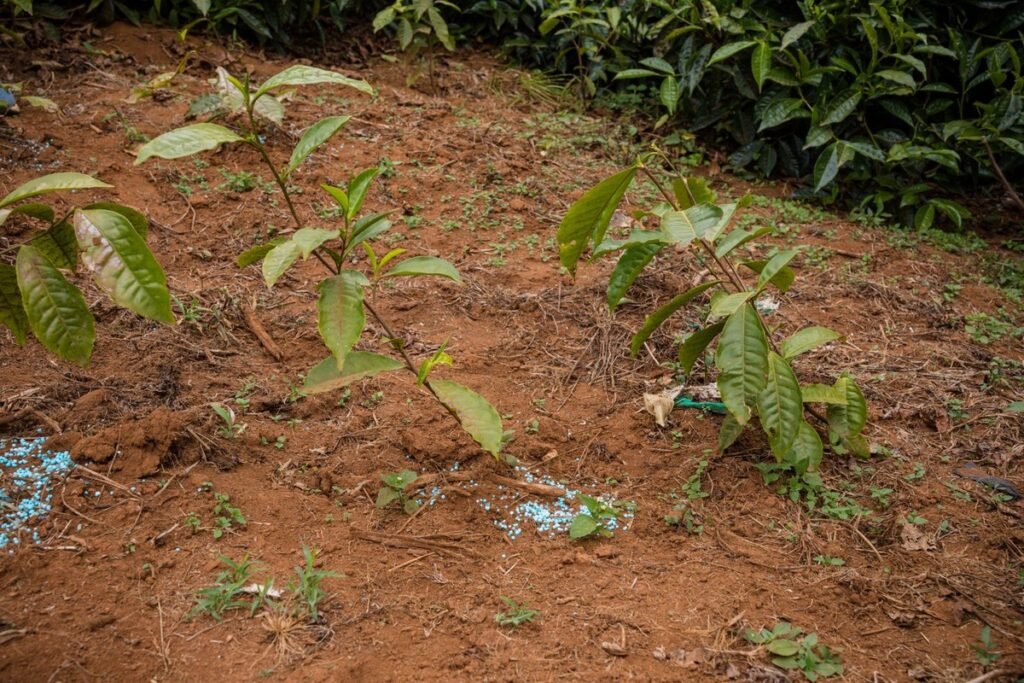
how much 10 10 10 per 1000 sq ft is 10 lb when your target is 1 lb of nitrogen per 1000 sq ft. If your target is 2 lb of nitrogen, the amount doubles to 20 lb. The tables below give the same result for other areas and targets.
There is no single bag amount that fits every plot, because the amount depends on the size of the area and the nitrogen target for that area. A small bed needs a small amount, and a large area needs a larger amount in direct proportion.
How Much 10 10 10 Per 1000 Sq Ft At Different Nitrogen Targets
The table below answers how much 10 10 10 per 1000 sq ft you need at four nitrogen targets. Each row starts from the target, divides by 10 percent, and gives the product to apply. Because the analysis is 10 percent of each nutrient, the P2O5 and K2O supplied match the nitrogen target in each row.
| Nitrogen target per 1000 sq ft | Product to apply per 1000 sq ft | P2O5 supplied | K2O supplied |
|---|---|---|---|
| 0.5 lb | 5 lb | 0.5 lb | 0.5 lb |
| 1 lb | 10 lb | 1 lb | 1 lb |
| 1.5 lb | 15 lb | 1.5 lb | 1.5 lb |
| 2 lb | 20 lb | 2 lb | 2 lb |
Use the 1 lb row as your reference point. Halving the target halves the product to 5 lb, and doubling the target doubles the product to 20 lb.
What The Three Numbers Mean
The three numbers in 10 10 10 are percentages of product weight. The first number is nitrogen, shown as N. The second number is phosphate, shown as P2O5. The third number is potash, shown as K2O. Each number is 10 percent, so 100 g of product supplies 10 g of each nutrient, and 100 lb supplies 10 lb of each nutrient.
How The Maths Works
The maths uses one formula: rate equals chosen target divided by that nutrient percentage. For 10 10 10, the percentage is 10 percent for every nutrient, so multiply the target by 10 to get the product amount in the same units. A target of 1 lb of nitrogen gives 10 lb of product, and a target of 2 lb gives 20 lb.
The worked example from the Fertilizer Requirement Calculator shows this clearly. To give 100 m2 a nitrogen target of 10 g per m2 with 10 10 10, apply 10 kg of product, which is 100 g per m2. The total nitrogen supplied is 1000 g, or 1 kg, and the product needed is 1 kg divided by 10 percent, which is 10 kg.
Amount By Area In Imperial Units
The table below gives the product amount by area at a nitrogen target of 1 lb per 1000 sq ft. Each row scales the 10 lb reference amount by area. A 500 sq ft area is half of 1000 sq ft, so it needs 5 lb. A 2000 sq ft area is twice 1000 sq ft, so it needs 20 lb.
| Area | Product to apply | Nitrogen supplied | P2O5 supplied | K2O supplied |
|---|---|---|---|---|
| 100 sq ft | 1 lb | 0.1 lb | 0.1 lb | 0.1 lb |
| 250 sq ft | 2.5 lb | 0.25 lb | 0.25 lb | 0.25 lb |
| 500 sq ft | 5 lb | 0.5 lb | 0.5 lb | 0.5 lb |
| 1000 sq ft | 10 lb | 1 lb | 1 lb | 1 lb |
| 2000 sq ft | 20 lb | 2 lb | 2 lb | 2 lb |
| 5000 sq ft | 50 lb | 5 lb | 5 lb | 5 lb |
If your target is 2 lb of nitrogen per 1000 sq ft, double every product amount in this table. If your target is 0.5 lb, halve every amount. For lawn areas, see How Much Fertilizer Per 1,000 Sq Ft of Lawn.
Amount By Area In Metric Units
The table below gives the product amount by area at a nitrogen target of 10 g per m2. The product rate is 100 g per m2 at this target, because 10 g divided by 10 percent equals 100 g. Each row multiplies that rate by the area. A 50 m2 area needs 5 kg, and a 200 m2 area needs 20 kg.
| Area | Product to apply | Nitrogen supplied | P2O5 supplied | K2O supplied |
|---|---|---|---|---|
| 10 m2 | 1 kg | 100 g | 100 g | 100 g |
| 25 m2 | 2.5 kg | 250 g | 250 g | 250 g |
| 50 m2 | 5 kg | 500 g | 500 g | 500 g |
| 100 m2 | 10 kg | 1000 g | 1000 g | 1000 g |
| 200 m2 | 20 kg | 2000 g | 2000 g | 2000 g |
Metric and imperial examples in this guide are kept separate and labelled as rounded equivalents, not exact conversions. Do not mix grams and pounds in one calculation.
What The Same Rate Also Supplies In P2O5 And K2O
Meeting a nitrogen target with 10 10 10 also supplies P2O5 and K2O at the same rate, because each nutrient is 10 percent of the product. At a nitrogen target of 1 lb per 1000 sq ft, 10 lb of product supplies 1 lb of P2O5 and 1 lb of K2O as well as 1 lb of nitrogen.
The worked example shows the problem clearly. The nitrogen target was 10 g per m2 and the P2O5 target was 5 g per m2, while the potash target was met exactly. Applying 10 kg of product to 100 m2 supplied 10 g per m2 of P2O5, which is 500 g more than the 5 g per m2 target across the whole area.
When To Use The No Nutrient Above Target Choice
The Fertilizer Requirement Calculator offers a choice called no nutrient above target. With this choice, the rate equals the smallest value of target divided by percentage across the nutrients. In plain terms, the calculator finds the nutrient that limits the rate first and sets the product amount from that nutrient, so no nutrient goes above its target. If your P2O5 target is low and your nitrogen target is high, basing the rate on nitrogen would oversupply phosphorus.
Using this choice means that at least one nutrient will fall short of its target. That shortfall is the gap, which equals supplied minus target. You can then top up the short nutrient with a single nutrient product, if that is what your soil test supports.
Weighing Tips And Rounding Up To Buyable Amounts
Weigh the product instead of guessing by volume, because a scoop can hold a different weight depending on how full it is and how the granules settle. Use kitchen scales for small amounts and bathroom scales for larger amounts, and weigh in the same units as your table.
Buying counts always round up to whole buyable numbers. If you need 12 lb and the smallest bag is 10 lb, buy two bags and keep the remainder sealed for the next application. If you need 2.5 kg and the smallest bag is 5 kg, buy one 5 kg bag. Do not round the application amount up in the same way. Apply the weighed amount from the table, and store any extra product for later use.
Soil Test First
Targets should come from a soil test. A soil test gives separate targets for nitrogen, phosphate and potash, and those targets reflect what your soil already holds. Generic targets can over apply phosphorus, because phosphorus stays in soil longer than nitrogen and can build up over seasons. If you apply 10 10 10 every time without a test, you may add phosphorus that your soil does not need, even when the nitrogen amount looks right.
If you have no test yet, use the calculator with the targets from a crop guide for your area, and treat the result as a starting point, not a fixed rule for every season. When you do get a test, enter the new targets and work out the amount again. If the test shows too much phosphorus, choose a fertilizer with a lower middle number, or meet nitrogen with a nitrogen only product instead.
Split Large Nitrogen Doses
Split large nitrogen doses through the season. The Fertilizer Requirement Calculator states this as an assumption, and it matters when your total nitrogen target is high. Instead of applying the whole product amount in one pass, divide the total into smaller applications spread across the growing period, and weigh each part separately. Each part still uses the same division by 10 percent, so a total of 20 lb split into two equal parts gives two applications of 10 lb each. Slow release products need the same total but release it over time, so do not add extra product to make up for the slower release.
Splitting also helps you check your work. After the first part, you can confirm the area covered and the amount used before you weigh the second part.
Common Mistakes
- Using a fixed bag amount for every area. The amount must scale with area, so a 500 sq ft bed needs half the amount for 1000 sq ft at the same target.
- Basing the rate on the wrong nutrient. Base the rate usually on nitrogen, unless the no nutrient above target choice is the right fit for your soil test.
- Mixing metric and imperial units in one calculation. Choose one system and stay in it. A gram target needs a gram answer, and a pound target needs a pound answer.
- Guessing the weight by eye. Weigh the product, because volume is not a reliable guide to weight.
- Rounding the application amount up to the nearest bag size. Round up only when buying. Apply the weighed amount from the table, and store the remainder.
- Skipping the soil test and repeating the same product every time. Without a test, phosphorus can build up while nitrogen is the only nutrient you meant to add.
Frequently Asked Questions
Q: How much 10 10 10 per 1000 sq ft do I need for 1 lb of nitrogen?
A: You need 10 lb of 10 10 10 per 1000 sq ft for a target of 1 lb of nitrogen. That amount also supplies 1 lb of P2O5 and 1 lb of K2O.
Q: How much 10 10 10 per 1000 sq ft do I need for 2 lb of nitrogen?
A: You need 20 lb of 10 10 10 per 1000 sq ft for a target of 2 lb of nitrogen. That amount also supplies 2 lb of P2O5 and 2 lb of K2O.
Q: How much 10 10 10 do I need for 100 m2 in metric units?
A: At a target of 10 g per m2 of nitrogen, you need 10 kg for 100 m2, which is 100 g per m2 of product. If your P2O5 target is 5 g per m2, the surplus is 500 g across the whole 100 m2 area.
Q: What do the three numbers in 10 10 10 mean?
A: The three numbers are N, P2O5 and K2O as percentages of product weight. Each number is 10 percent, so 100 g of product supplies 10 g of each nutrient, and 100 lb supplies 10 lb of each nutrient.
Q: Should I base the rate on nitrogen or on the lowest nutrient?
A: Base the rate usually on nitrogen. Use the no nutrient above target choice when you want to avoid any excess, usually because the phosphorus target is low.
Q: Do slow release products need a different total amount?
A: No. Slow release products need the same total but release it over time. Do not add extra product to make up for the slower release.
Use the Fertilizer Requirement Calculator to work out the exact amount for your area and targets. For a pH check, use the soil pH calculator. To check each nutrient on its own, use the nitrogen fertilizer calculator, the phosphorus fertilizer calculator, and the potassium fertilizer calculator.
More guides
How to Choose a Fertilizer Rate: Meet Nitrogen or Cap Every Nutrient
Learning how to choose a fertilizer rate starts with one choice. You either meet a chosen nutrient target, usually nitrogen, and accept…
Read guide
Too Much Phosphorus From Fertilizer: Surplus, Signs and Fixes
Too much phosphorus from fertilizer is a surplus that appears when a balanced blend meets nitrogen and supplies twice the phosphate the…
Read guide
Fertilizer NPK Numbers Explained: What N, P2O5 and K2O Mean
Fertilizer npk numbers are the three percentages on a fertilizer bag, listed in the order nitrogen, phosphate and potash. They tell you…
Read guide