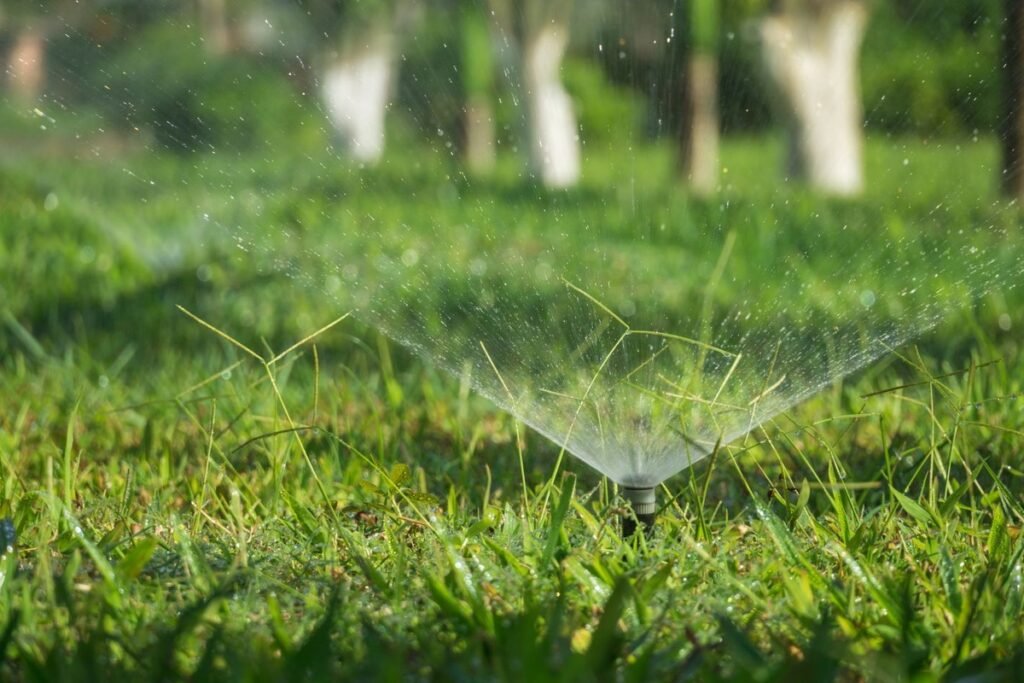
How much area does one sprinkler cover? A full circle head that throws 5 m covers about 79 square metres, and a full circle head that throws 15 ft covers about 707 square feet. The exact area depends on throw radius and arc, so a shorter throw or a part circle head covers far less.
Work out your area with the formula and tables below. Every radius except the verified 5 m and 15 ft examples is an example input.
What Sprinkler Coverage Area Means
Coverage area is the ground area that one sprinkler head can reach when it sprays in its set arc. A full circle head sprays in every direction, so its coverage is a full circle on the lawn. A half circle head sprays across one half of that circle, and a quarter circle head sprays across one quarter. The head sits at the centre of the circle.
Area is not the same as throw distance. A head that throws twice as far covers four times the area, because area grows with the square of the radius. In a real lawn, heads overlap, so the area served by each head in a finished layout is smaller than that circle.
The Coverage Formula
Coverage of one head is pi multiplied by radius squared multiplied by arc divided by 360. For a full circle head, the arc is 360, so the formula becomes pi times radius squared. For a half circle head, the arc is 180, so the area is half. For a quarter circle head, the arc is 90, so the area is one quarter.
Use 3.14159 for pi, and measure radius to the far edge of the wet pattern. Radius in metres gives area in square metres; radius in feet gives area in square feet.
Verified check: 25 times 3.14159 is 78.54 square metres, shown as about 79 square metres, for a 5 m throw. For a 15 ft throw, 225 times 3.14159 is 706.86 square feet, shown as about 707 square feet.
Full Circle Coverage by Throw Radius in Metric Units
The table below gives full circle coverage for example throw radii in metres. Each value is pi times radius squared, worked with pi equal to 3.14159 and rounded to two decimal places.
| Throw radius | Full circle area |
|---|---|
| 2 m | 12.57 square metres |
| 3 m | 28.27 square metres |
| 4 m | 50.27 square metres |
| 5 m | 78.54 square metres |
| 6 m | 113.10 square metres |
| 7 m | 153.94 square metres |
| 8 m | 201.06 square metres |
| 9 m | 254.47 square metres |
| 10 m | 314.16 square metres |
From 5 m to 6 m, area rises from 78.54 to 113.10 square metres, and from 9 m to 10 m it rises by 59.69 square metres.
Full Circle Coverage by Throw Radius in Imperial Units
The table below gives full circle coverage for example throw radii in feet. Each value is pi times radius squared, worked with pi equal to 3.14159 and rounded to two decimal places. These are rounded equivalents for readers who work in feet, not exact conversions of the metric table.
| Throw radius | Full circle area |
|---|---|
| 10 ft | 314.16 square feet |
| 12 ft | 452.39 square feet |
| 15 ft | 706.86 square feet |
| 18 ft | 1017.88 square feet |
| 20 ft | 1256.64 square feet |
| 25 ft | 1963.49 square feet |
| 30 ft | 2827.43 square feet |
A 10 ft throw covers 314.16 square feet, while a 20 ft throw covers 1256.64 square feet. Doubling the throw gives four times the area.
Half Circle and Quarter Circle Coverage
Part circle heads cover a fixed fraction of the full circle area for the same throw radius. A half circle head covers one half, and a quarter circle head covers one quarter.
| Throw radius | Half circle area | Quarter circle area |
|---|---|---|
| 3 m | 14.14 square metres | 7.07 square metres |
| 4 m | 25.13 square metres | 12.57 square metres |
| 5 m | 39.27 square metres | 19.63 square metres |
| 6 m | 56.55 square metres | 28.27 square metres |
| 7 m | 76.97 square metres | 38.48 square metres |
| 8 m | 100.53 square metres | 50.27 square metres |
A half circle head with a 5 m throw covers 39.27 square metres, half of 78.54, and a quarter circle head covers 19.63. With a 15 ft throw, the half circle area is 353.43 square feet and the quarter circle area is 176.71.
Arc matters as much as throw: a corner head may serve only one quarter of the area of a middle head with the same throw radius, so count each head by its real arc.
Why a Small Change in Throw Changes Area So Much
Area depends on radius squared, so a small change in throw has a large effect. A head that throws 4 m covers 50.27 square metres, while a head that throws 5 m covers 78.54 square metres, about 56 percent more area from a 1 m rise in throw.
The same pattern holds when throw falls. If wind or low pressure cuts a 5 m throw to 4 m, area falls from 78.54 to 50.27 square metres, a loss of more than one third. Compare area, not throw alone: a 7 m head covers 153.94 square metres against 78.54 for a 5 m head.
Why the Area in a Real Layout Is Less Than the Single Head Circle
A single head circle is a starting figure, not a layout figure. In a finished lawn, heads overlap. Each head waters ground its neighbours also water, so each head serves less than its full circle in the layout. Overlap is wanted, not wasted: it evens out the pattern.
The common layout rule is head to head coverage: heads are spaced so each head throws water all the way to the next head. In square spacing, spacing equals throw radius. In triangular spacing, row spacing is head spacing multiplied by 0.866. Either way, the working area per head is the spacing rectangle, not the full circle. A head spaced 5 m by 5 m serves a 25 square metre rectangle, even though its full circle covers 78.54 square metres.
Edges and corners need the same care. Edge heads are half circle and corner heads are quarter circle, yet they still need head to head spacing along the edge. Check the corners first.
How Much Area Does One Sprinkler Cover and How It Feeds Into Head Count
Coverage area is the first step toward head count, but it is not the whole step. Start with the lawn area, divide by the area one head covers, then adjust for overlap, arc and shape. The division gives a lower bound, not a final count.
Take an example lawn 10 m by 15 m, 150 square metres. Divide 150 by 78.54, the area of a 5 m full circle head, to get 1.91, which rounds up to 2 heads. Two heads cannot cover the corners or give head to head coverage. A workable layout needs heads along each edge and across the middle.
Take an imperial example. A lawn 30 ft by 50 ft is 1500 square feet. Divide 1500 by 706.86, the area of a 15 ft full circle head, to get 2.12, which rounds up to 3 heads. Three heads cannot give head to head coverage across that lawn, and the corners would be dry. Use the division only to sense check the scale.
Check your own inputs with the sprinkler calculator and the sprinkler coverage calculator.
Common Mistakes When Working Out Sprinkler Coverage
- Using throw distance as if it were area. A 10 m throw covers four times the area of a 5 m throw.
- Counting every head as a full circle. Corner heads cover a quarter and edge heads cover a half.
- Forgetting overlap. The single head circle is not the area served in a layout. The working area per head is the spacing rectangle.
- Mixing metric and imperial units. A radius in metres gives area in square metres, and a radius in feet gives area in square feet.
- Trusting throw on a windy day or at low pressure. Wind and low pressure reduce real throw.
- Using one head to cover a whole lawn. A single head leaves a dry ring at the edge and a wet patch near the head. Even a small lawn needs more than one head.
What Changes Real Throw and Real Coverage
Real throw is often shorter than the throw on a calm day. Wind bends the spray and low pressure weakens it, so real throw falls short. The calculator assumes matched precipitation nozzles: mixed nozzles apply water unevenly.
Check the real pattern with a catch cup test. Place straight sided cups across the lawn, run the zone for 15 minutes, and multiply the average depth by 4 for the hourly rate. Dry cups near the edge and full cups near the head mean spacing is too wide or throw is short.
Plan with the tables, then confirm with the test. If the test shows a shorter throw than planned, rework the area with the shorter radius before you buy heads. A plan built on a 6 m throw fails if the heads truly throw 5 m, because area falls from 113.10 to 78.54 square metres.
Frequently Asked Questions
Q: How much area does one sprinkler cover?
A: A full circle head that throws 5 m covers about 79 square metres, and a full circle head that throws 15 ft covers about 707 square feet. Area is pi times radius squared, so it depends on throw radius and arc.
Q: How do I work out the coverage area of a sprinkler head?
A: Multiply pi, 3.14159, by radius squared, then multiply by arc divided by 360. For a full circle head, arc is 360, so area is pi times radius squared.
Q: How much area does a half circle sprinkler cover?
A: Half the full circle area: 39.27 square metres with a 5 m throw, and 353.43 square feet with a 15 ft throw.
Q: Why does my lawn need more heads than the area division suggests?
A: It gives a lower bound only. Heads overlap, and edge and corner heads cover less area. Count heads on a layout plan.
Q: Does wind or low pressure change how much area a sprinkler covers?
A: Yes. Wind and low pressure reduce real throw, and area depends on radius squared, so a small drop in throw cuts area by a large amount.
Q: What is a good precipitation rate for lawns?
A: Most lawns take 12 to 25 mm per hour, or 0.5 to 1 in per hour, without runoff. Clay soils prefer the lower end of that range. Use the irrigation run time calculator to turn depth and rate into minutes.
How to Use the Coverage Tables
Start with your throw radius and arc, read the area from the table, and write it down as the single head area. Then sketch the lawn and lay out heads with spacing equal to throw radius. Count the heads on the sketch, with corner heads as quarter circle and edge heads as half circle. Trust the sketch over the division, because it allows for overlap and shape.
When the layout is set, plan watering with the garden watering schedule calculator so the area, depth and timing stay in step.
More guides

How to Choose a Fertilizer Rate: Meet Nitrogen or Cap Every Nutrient
Learning how to choose a fertilizer rate starts with one choice. You either meet a chosen nutrient target, usually nitrogen, and accept…
Read guide
Too Much Phosphorus From Fertilizer: Surplus, Signs and Fixes
Too much phosphorus from fertilizer is a surplus that appears when a balanced blend meets nitrogen and supplies twice the phosphate the…
Read guide
Fertilizer NPK Numbers Explained: What N, P2O5 and K2O Mean
Fertilizer npk numbers are the three percentages on a fertilizer bag, listed in the order nitrogen, phosphate and potash. They tell you…
Read guide