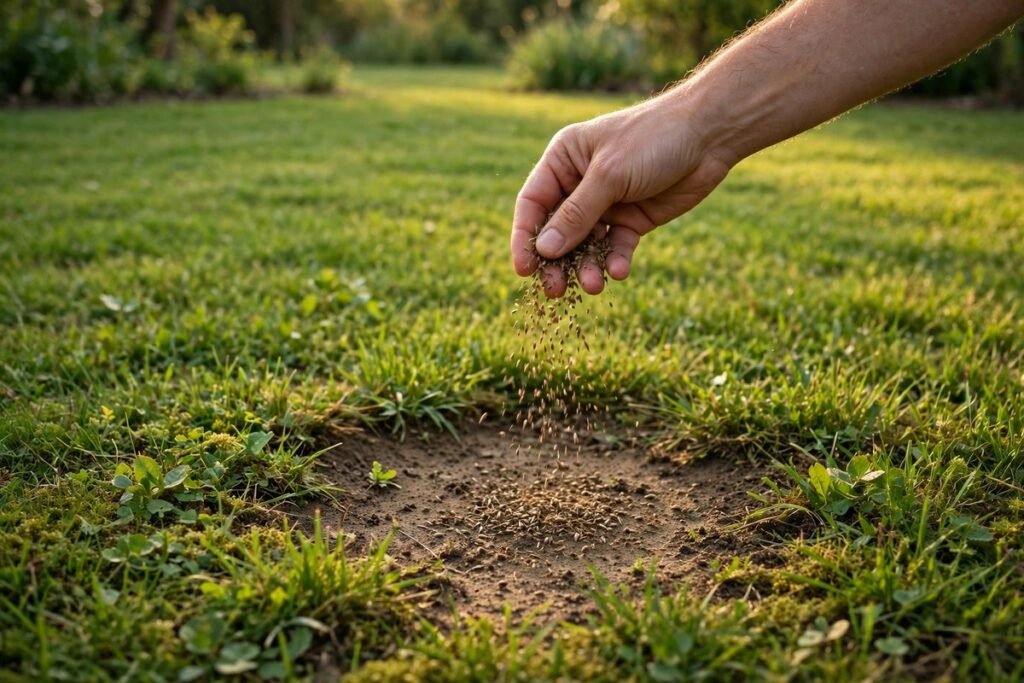
How Much Grass Seed for a Bare Patch?
A 1 sq m bare patch needs about 39 g of tall fescue seed at 35 g per sq m plus 10 percent extra. A 0.5 sq m patch needs about 19 g, a 2 sq m patch needs 77 g, and a 5 sq m patch needs about 193 g at the same rate.
Treat the patch as a small new lawn and use the full new lawn rate, not the overseeding rate. Use the Grass Seed Calculator to run your exact patch size and grass type. For whole lawn rates, see How Much Grass Seed Do I Need?
Why a bare patch needs the full new lawn rate
A bare patch is bare soil. There is no existing grass to fill the gap, so every plant in the finished patch has to come from seed you sow. That is the same job as a new lawn, only smaller.
Overseeding is different. You sow into a lawn that still has decent cover, so you need only about half the new lawn rate. Use that half rate on bare soil and the patch stays thin and weeds move in. Use the new lawn rate on the bag. That rate always wins.
How the calculation works
Area equals length times width. Seed equals area times sowing rate times 1 plus extra percent. Bags equals ceil of seed divided by bag size, where ceil means round up.
For a patch, use the full new lawn rate and add 10 percent extra for seed lost to birds, wind, and uneven spreading. An 80 sq m new lawn of tall fescue at 35 g per sq m plus 10 percent needs about 3.1 kg, which is four 1 kg bags: 80 times 35 is 2,800 g, or 2.8 kg, and 2.8 times 1.10 is 3.08 kg. A 1 sq m patch needs 35 times 1.10, which is 38.5 g, about 39 g, about 1.4 oz.
How much seed for patches of 0.5, 1, 2 and 5 sq m
This table uses tall fescue at 35 g per sq m plus 10 percent extra.
| Patch size | Patch size in sq ft | Seed with 10 percent extra |
|---|---|---|
| 0.5 sq m | 5.4 sq ft | About 19 g, about 0.7 oz |
| 1 sq m | 10.8 sq ft | About 39 g, about 1.4 oz |
| 2 sq m | 21.5 sq ft | 77 g, about 2.7 oz |
| 5 sq m | 53.8 sq ft | About 193 g, about 6.8 oz |
Check each row: 0.5 times 35 is 17.5 g, times 1.10 is about 19 g. 1 times 35 is 35 g, times 1.10 is about 39 g. 2 times 35 is 70 g, times 1.10 is 77 g. 5 times 35 is 175 g, times 1.10 is about 193 g. Split the seed in two and sow half in one direction and half across it. Add several patches together first: three 1 sq m patches need about 116 g.
How the amount changes at 25, 35 and 50 g per sq m
Most new lawns use about 25 to 50 g per sq m. At 25 g per sq m plus 10 percent, a 1 sq m patch needs about 28 g and a 2 sq m patch needs 55 g. At 50 g per sq m plus 10 percent, a 1 sq m patch needs 55 g and a 2 sq m patch needs 110 g. At 30 g per sq m, a 2 sq m patch needs 60 g times 1.10, which is 66 g.
Rates by grass type
Seed size drives the rate. A pound of Kentucky bluegrass contains far more seeds than a pound of tall fescue, so bluegrass needs far less weight.
| Grass type | Calculator rate per 1,000 sq ft | Live guide rate per 1,000 sq ft |
|---|---|---|
| Tall fescue | 5 to 8 lb | 8 to 10 lb |
| Perennial ryegrass | 5 to 8 lb | 7 to 8 lb |
| Kentucky bluegrass | About 2 to 3 lb | 2 to 3 lb |
| Fine fescues | Not stated on the calculator page | 3 to 6 lb |
There is a rate discrepancy to state plainly. The live guide cites Ohio State rates of tall fescue at 8 to 10 lb per 1,000 sq ft, while the calculator page gives 5 to 8 lb. This article uses the calculator numbers and does not invent a reconciled figure. Follow the rate on your own bag.
How to measure an irregular patch
Most bare patches are not neat rectangles, so measure the patch in a way that matches its shape.
| Shape | How to work out the area | Example area | Seed at 35 g per sq m plus 10 percent |
|---|---|---|---|
| Rectangle | Length times width | 1.5 m by 1 m is 1.5 sq m | 52.5 g times 1.10 is about 58 g |
| Circle | 3.14 times radius times radius | Diameter 0.6 m, radius 0.3 m, area 0.28 sq m | 9.8 g times 1.10 is about 11 g |
| Oval | 3.14 times one radius times the other radius | 1.2 m by 0.8 m, area 0.75 sq m | 26.25 g times 1.10 is about 29 g |
| Triangle | 0.5 times base times height | Base 1 m, height 0.8 m, area 0.4 sq m | 14 g times 1.10 is about 15 g |
| Strip | Length times average width | 3 m by 0.3 m is 0.9 sq m | 31.5 g times 1.10 is about 35 g |
The oval shows why shape matters: its bounding rectangle would give about 37 g, about 8 g too much. For a wavy patch, reduce the bounding rectangle by the share that is actually bare. Sow about 5 cm beyond the edge. That margin needs extra seed beyond the 10 percent; table amounts cover the patch area alone. A 1×1 m patch becomes 1.21 sq m with a 5 cm margin on all sides, +21 percent.
How much extra to allow
Allow 10 percent extra as a starting point. That covers seed eaten by birds, seed blown by wind, and uneven spreading by hand. Allow 20 percent only if you have a clear reason, such as active birds, a slope, or a windy spot. At 20 percent, a 1 sq m patch at 35 g per sq m needs 42 g, and a 5 sq m patch needs 210 g.
Do not allow 50 percent or double the rate. Overcrowded seedlings compete for light, water and nutrients, grow thin and weak, and are prone to disease. Keep leftover seed dry and cool. For a 39 g need and a 500 g bag, ceil of 39 divided by 500 is 1 bag.
Steps to get seed to soil contact
Seed that sits on dead grass, thatch, or bare compacted soil rarely grows. It needs to touch soil, stay moist, and get light.
First, find and fix the cause if you can. Second, remove dead grass, leaves, stones, and debris, and rake the surface to loosen the top soil. Third, level the patch with a thin layer of topsoil if it sits lower than the surrounding lawn.
Fourth, sow the seed evenly, in two halves, in two directions. Fifth, rake the seed in lightly, to no more than about a quarter inch of soil. Do not bury it deep. Sixth, firm the surface gently.
Seventh, water gently and keep the surface consistently moist until the new grass is established. A single dry afternoon can kill germinating seedlings, as the live guide warns. If you are re turfing a large area, use the Sod Turf Calculator and the Lawn Fertilizer Calculator
When to sow and common mistakes
Early autumn is ideal for cool season grasses, with spring as a second choice. In early autumn, soil is still warm and weeds are slowing down. Sow warm season grasses in late spring, once soil is warm. Do not sow in high summer if you cannot water it often.
Using the overseeding rate on bare soil is the most common mistake. It leaves the patch thin, because half rate seed cannot cover bare soil. Use the full new lawn rate. Sowing too heavily is the next mistake. Overcrowded seedlings compete and are prone to disease. Stick to the rate on the bag, plus 10 percent extra at most.
Burying seed too deep is also common, as seed covered by more than about a quarter inch of soil may not emerge. Letting the patch dry out kills most repairs after sowing.
Match the seed to the light and use of that patch. If more than a quarter of the lawn is bare, consider overseeding the whole lawn or re turfing. For related guides, see garden guides
Frequently asked questions
Q: How much grass seed do I need for a small bare patch?
A: At 35 g per sq m plus 10 percent, a 0.5 sq m patch needs about 19 g, a 1 sq m patch needs about 39 g, a 2 sq m patch needs 77 g, and a 5 sq m patch needs about 193 g.
Q: Should I use the overseeding rate or the new lawn rate for a bare patch?
A: Use the full new lawn rate. Overseeding uses roughly half that rate, and that half rate is too thin for bare soil.
Q: How do I measure an irregular bare patch?
A: Use length times width for a rectangle, 3.14 times radius times radius for a circle, 3.14 times one radius times the other radius for an oval, and 0.5 times base times height for a triangle.
Q: How much extra grass seed should I allow for a bare patch?
A: Allow 10 percent extra as a starting point, and 20 percent only if birds, wind, or a slope are likely to lose seed. Do not double the rate.
Q: Can I just throw grass seed on a bare patch?
A: It rarely works well. Seed needs contact with soil, so remove debris, rake and loosen the surface, sow evenly, rake it in lightly, firm it gently, and keep it moist.
Q: When is the best time to repair a bare patch?
A: Early autumn is ideal for cool season grasses, with spring as a second choice. Sow warm season grasses in late spring once soil is warm.
Measure the patch, weigh the seed, sow at the full new lawn rate, and keep it moist. Run your exact size through the Grass Seed Calculator
More guides

Head to Head Coverage Explained: Spacing, Corners, Edges and Middle
Head to head coverage means each sprinkler head sprays far enough to reach the head next to it, so the distance between…
Read guide
How Many Sprinkler Heads Do I Need
How many sprinkler heads do I need depends on lawn size and throw radius. A 10 by 6 metre lawn with 4…
Read guide
Sprinkler Calculator: A Worked Guide
A sprinkler calculator gives a head count and a zone count from lawn size and spray distance. For a 10 by 6…
Read guide