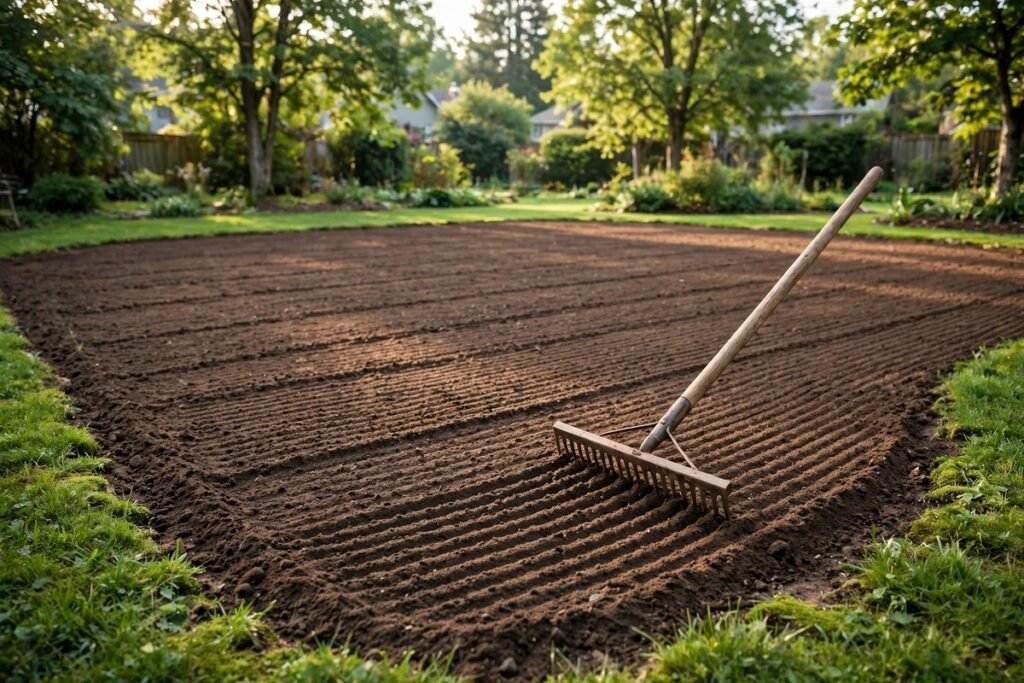
How Much Grass Seed for a New Lawn?
For a new lawn, measure length times width, multiply by the sowing rate for your grass, add 10 percent extra, then round up to whole bags. Most new lawns need 25 to 50 grams per square metre. An 80 square metre tall fescue lawn at 35 grams per square metre needs 3.1 kilograms, or four 1 kilogram bags.
Use the Grass Seed Calculator to run your exact area. For the full list of rates, see How Much Grass Seed Do I Need? as further reading.
The four step calculation
Measure the area. Pick the sowing rate for a new lawn. Add extra for waste and thin spots. Work out how many bags that weight means. An error in the area carries through every later figure.
The formulas are:
area = length x width
seed = area x sowing rate x (1 + extra %)
bags = ceil(seed / bag size)
Ceil means round up to the next whole number. You cannot buy part of a bag, so 3.1 kilograms in 1 kilogram bags means four bags.
Step 1: measure the area
Measure length and width in the same unit and multiply them. A lawn 10 metres long and 8 metres wide covers 80 square metres, because 10 x 8 = 80. A lawn 50 feet long and 40 feet wide covers 2000 square feet, because 50 x 40 = 2000.
Measure to the edge of the area you plan to sow. If the lawn is not a single rectangle, split it into rectangles, work out each one, and add the areas together. Do not guess the area from the size of the plot, because the plot includes the house, paths, beds and patio.
Step 2: pick the sowing rate
The sowing rate is the weight of seed for each unit of area, and it depends on the grass. A pound of Kentucky bluegrass contains far more seeds than a pound of tall fescue, so bluegrass needs far less weight for the same area.
Use the rate for a new lawn, not the rate for overseeding. Overseeding uses roughly half the new lawn rate, because it thickens grass that already exists. A new lawn from bare soil needs the full rate.
The rate on your seed bag always wins. If the bag rate differs from a table or a calculator, use the bag rate. Check whether the bag rate is for a new lawn or for overseeding, because many bags print the overseeding coverage in large type.
This table is a short reference only, using the calculator rates. It is not the full rate list.
| Grass | New lawn rate per 1000 square feet | New lawn rate per square metre |
|---|---|---|
| Tall fescue or perennial ryegrass | 5 to 8 lb | 25 to 50 g for most new lawns |
| Kentucky bluegrass | 2 to 3 lb | About 10 to 15 g |
Per square foot, new lawns typically need 0.003 to 0.01 lb, about 1.5 to 4.5 g, per square foot.
Step 3: add extra seed
Add 10 percent extra to the base weight, to cover seed lost to birds, seed that lands unevenly, thin spots, and seed that fails to germinate. It is not a licence to sow heavily. Sowing far above the rate crowds the seedlings, and crowded seedlings compete for water, light and nutrients.
Multiply the base weight by 1.10. A base weight of 2.8 kg becomes 3.08 kg, and a base weight of 25 lb becomes 27.5 lb. Do not add extra twice.
Step 4: work out the bags
Divide the total seed weight by the bag size, then round up. A total of 3.08 kg in 1 kg bags gives ceil(3.08 / 1) = 4 bags. A total of 27.5 lb in 25 lb bags gives ceil(27.5 / 25) = 2 bags, because 27.5 / 25 = 1.1.
The same total weight can mean one large bag or several small bags. Sow half the seed in one direction and half across it, rake it lightly, and keep the surface moist until the grass is established.
Worked example 1: 80 square metres of tall fescue
The lawn is 80 square metres, the grass is tall fescue at 35 g per square metre, the extra is 10 percent, and the bags are 1 kg each.
Base seed: 80 x 35 = 2800 g, which is 2.8 kg. Add extra: 2.8 x 1.10 = 3.08 kg, about 3.1 kg. Bags: ceil(3.08 / 1) = 4 bags. Buy four 1 kg bags, with 0.92 kg left over for patching thin spots.
Worked example 2: 5000 square feet of tall fescue
The lawn is 5000 square feet, the rate is 5 lb per 1000 square feet, the extra is 10 percent, and the bags are 25 lb each.
Base seed: 5000 / 1000 = 5 units, then 5 x 5 = 25 lb. Add extra: 25 x 1.10 = 27.5 lb. Bags: 27.5 / 25 = 1.1, and ceil(1.1) = 2 bags. Buy two 25 lb bags, with 22.5 lb left over.
A 50 lb bag at 5 lb per 1000 square feet covers about 10000 square feet for a new lawn, because 50 / 5 = 10.
Worked example 3: a small bluegrass lawn and a one acre lawn
Small lawn: a 2000 square foot new lawn of Kentucky bluegrass at 2 lb per 1000 square feet, plus 10 percent, in 5 lb bags. Base seed: 2000 / 1000 = 2 units, then 2 x 2 = 4 lb. Add extra: 4 x 1.10 = 4.4 lb. Bags: ceil(4.4 / 5) = 1 bag. Buy one 5 lb bag, with 0.6 lb left over.
One acre lawn: one acre is 43560 square feet. Use tall fescue at 200 lb per acre, inside the calculator range of about 200 to 350 lb per acre, plus 10 percent, in 50 lb bags. Base seed: 200 lb. Add extra: 200 x 1.10 = 220 lb. Bags: ceil(220 / 50) = 5 bags. Buy five 50 lb bags, with 30 lb left over.
A rate discrepancy you should know about
The calculator rates and the Ohio State rates in the live site guide do not agree for tall fescue.
The calculator gives tall fescue or ryegrass at typically 5 to 8 lb per 1000 square feet, and tall fescue at about 200 to 350 lb per acre. The live guide cites Ohio State University rates of tall fescue at 8 to 10 lb per 1000 square feet and about 350 to 435 lb per acre.
This article uses the calculator numbers for its worked examples, so the examples match the Grass Seed Calculator. If your seed bag gives a different rate, use the bag rate. Do not average the two sources into a new rate.
Common mistakes in a new lawn calculation
Using the overseeding rate on bare soil. Overseeding uses roughly half the new lawn rate, so using it on bare soil leaves the lawn about half short, thin and weedy.
Using the bag coverage figure without checking what it means. Bags often quote coverage at the overseeding rate, which is too thin for bare soil.
Rounding down the bags. A result of 3.08 kg means four bags, not three, because three bags give only 3 kg. Always round up.
Sowing too much to be safe. More seed does not mean a thicker lawn. Overcrowded seedlings compete and are prone to disease.
Burying the seed or letting it dry out. Most grass seed should be lightly raked in, no more than about a quarter inch deep. Seed that dries out after it starts to germinate can die in a single dry afternoon.
What to do after you sow
Sow half the seed in one direction and half across it, rake it lightly, and water gently. Keep the top inch consistently moist until germination. Early autumn is ideal for cool season grasses, with spring as a second choice. If you are re turfing instead of seeding, use the Sod Turf Calculator. A starter fertiliser helps establishment, and the Lawn Fertilizer Calculator turns a nitrogen rate into product and bags.
Frequently asked questions
Q: How much grass seed do I need for a new lawn?
A: Measure length times width, multiply by the sowing rate, add 10 percent extra, then round up to whole bags. An 80 square metre tall fescue lawn at 35 grams per square metre needs about 3.1 kilograms, or four 1 kilogram bags.
Q: How much grass seed do I need per 1000 square feet for a new lawn?
A: Typically 5 to 8 lb for tall fescue or ryegrass, and about 2 to 3 lb for Kentucky bluegrass. A 5000 square foot tall fescue lawn at 5 lb per 1000 square feet needs 27.5 lb after 10 percent extra, and two 25 lb bags.
Q: How many bags of grass seed do I need for a new lawn?
A: Divide the total seed weight, after the 10 percent extra, by the bag size, then round up. For the 80 square metre example, 3.08 kg in 1 kg bags means four bags. For the 5000 square foot example, 27.5 lb in 25 lb bags means two bags.
Q: How much grass seed do I need per acre for a new lawn?
A: Roughly 100 to 400 lb per acre depending on grass type, and about 200 to 350 lb per acre for tall fescue. At 200 lb per acre plus 10 percent, one acre needs 220 lb, or five 50 lb bags.
Q: Can I use the overseeding rate for a new lawn?
A: No. Overseeding uses roughly half the new lawn rate, because it thickens grass that already exists. A new lawn from bare soil needs the full rate. Bare patches inside an existing lawn should be treated as a new lawn, at the full rate.
Q: What if my seed bag gives a different rate from the calculator?
A: Use the bag rate. The rate on your seed bag always wins. Use the same four steps with the bag rate in place of the calculator rate.
Measure the lawn, pick the new lawn rate, add 10 percent, and round up to whole bags. Run your exact area through the Grass Seed Calculator. For more guides, browse the garden guides.
More guides
How to Choose a Fertilizer Rate: Meet Nitrogen or Cap Every Nutrient
Learning how to choose a fertilizer rate starts with one choice. You either meet a chosen nutrient target, usually nitrogen, and accept…
Read guide
Too Much Phosphorus From Fertilizer: Surplus, Signs and Fixes
Too much phosphorus from fertilizer is a surplus that appears when a balanced blend meets nitrogen and supplies twice the phosphate the…
Read guide
Fertilizer NPK Numbers Explained: What N, P2O5 and K2O Mean
Fertilizer npk numbers are the three percentages on a fertilizer bag, listed in the order nitrogen, phosphate and potash. They tell you…
Read guide