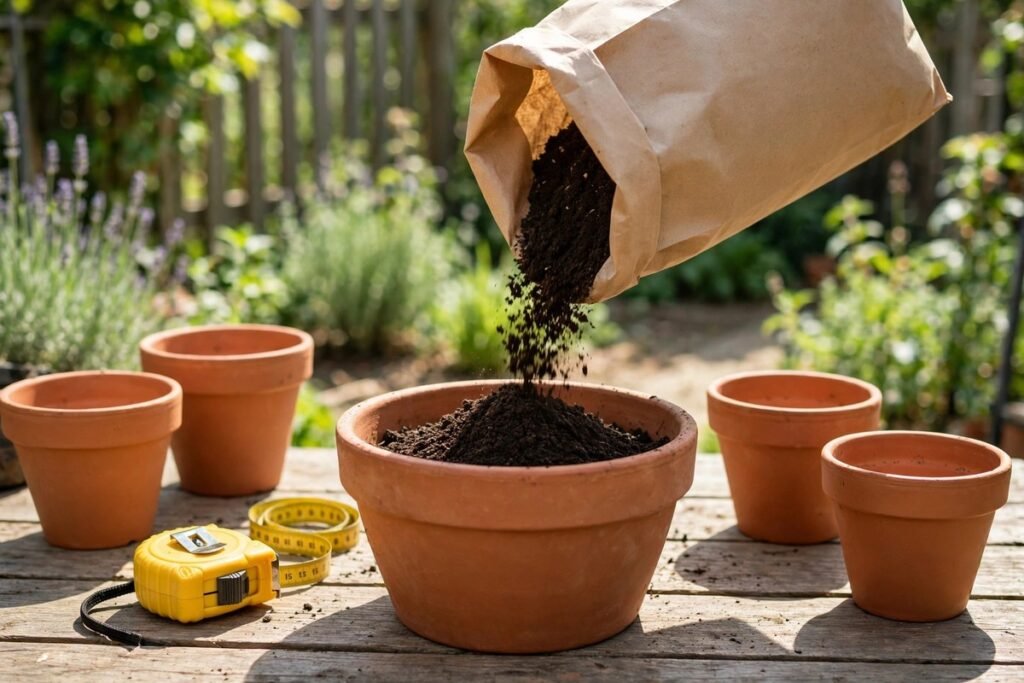
How Much Potting Soil for a 12 Inch Pot?
A 12 inch pot needs about 15.27 litres of potting soil when you fill it to 90 percent, which leaves a gap below the rim for watering. That is about 0.54 cubic feet, or about 4.03 US gallons. One 25 litre bag fills one pot, and one 40 litre bag fills about two and a half pots.
Use the Potting Soil Calculator to run your exact pot sizes, pot count, fill percent and bag size.
Why a 12 inch pot holds less than a cylinder suggests
Most round pots taper towards the base. The top is wider than the bottom, so the pot is a frustum, a cone with its top cut off. For a 12 inch pot 28 cm deep, the cylinder volume is 19.79 litres. The frustum volume is 16.97 litres, which is 2.82 litres less, about 14 percent less.
The frustum working for a 12 inch pot step by step
The calculator formula for a round pot is round pot volume equals pi times depth times top squared plus top times base plus base squared divided by 12. Base equals 0.85 times top, the typical taper used by the calculator.
Step 1: a 12 inch pot is 30 cm across the top. Step 2: base equals 0.85 times 30, which is 25.5 cm. Step 3: top squared is 900, top times base is 765, and base squared is 650.25, which add to 2315.25. Step 4: pi times 28 times 2315.25 divided by 12 equals 16,972 cubic cm, or 16.97 litres to the rim. Step 5: at 90 percent fill, 16.97 times 0.90 equals 15.27 litres, which is 0.54 cubic feet and 4.03 US gallons.
Round pot volumes at a glance
Full volume is the volume to the rim. Volume at 90 percent is the amount to buy for one pot before extra for settling. Cubic feet and US gallons are shown for the 90 percent volume only.
| Top width and depth | Full volume in litres | Volume at 90 percent in litres | Volume at 90 percent in cubic feet | Volume at 90 percent in US gallons |
|---|---|---|---|---|
| 10 cm top, 10 cm deep | 0.67 | 0.61 | 0.02 | 0.16 |
| 15 cm top, 15 cm deep | 2.27 | 2.05 | 0.07 | 0.54 |
| 20 cm top, 18 cm deep | 4.85 | 4.36 | 0.15 | 1.15 |
| 25 cm top, 22 cm deep | 9.26 | 8.33 | 0.29 | 2.20 |
| 30 cm top, 28 cm deep | 16.97 | 15.27 | 0.54 | 4.03 |
| 30 cm top, 25 cm deep | 15.15 | 13.64 | 0.48 | 3.60 |
| 35 cm top, 30 cm deep | 24.75 | 22.28 | 0.79 | 5.89 |
| 40 cm top, 35 cm deep | 37.71 | 33.94 | 1.20 | 8.97 |
| 45 cm top, 38 cm deep | 51.82 | 46.64 | 1.65 | 12.32 |
| 50 cm top, 40 cm deep | 67.35 | 60.61 | 2.14 | 16.01 |
Read the table by top width first, then by depth. A 30 cm pot 28 cm deep holds 15.27 litres at 90 percent fill. A 30 cm pot 25 cm deep holds 13.64 litres. A 15 cm pot holds 2.05 litres, and a 50 cm pot holds 60.61 litres.
How many 12 inch pots does one bag fill
A 25 litre bag is 0.88 cubic feet, a 40 litre bag is 1.41 cubic feet, and a 50 litre bag is 1.77 cubic feet. Divide the bag size by 15.27 litres to get pots per bag at 90 percent fill. A 25 litre bag fills 1.64 pots, a 40 litre bag fills 2.62 pots, and a 50 litre bag fills 3.27 pots. The calculator page states that a 40 litre bag fills about two and a half 30 cm pots.
| Number of 12 inch pots | Soil needed at 90 percent in litres | Bags of 25 litre | Bags of 40 litre | Bags of 50 litre |
|---|---|---|---|---|
| 1 pot | 15.27 | 1 | 1 | 1 |
| 2 pots | 30.54 | 2 | 1 | 1 |
| 3 pots | 45.81 | 2 | 2 | 1 |
| 4 pots | 61.08 | 3 | 2 | 2 |
| 5 pots | 76.35 | 4 | 2 | 2 |
| 6 pots | 91.62 | 4 | 3 | 2 |
| 10 pots | 152.70 | 7 | 4 | 4 |
All bag counts use ceil, which means round up to the next whole bag. For 6 pots, soil needed is 91.62 litres. That is 4 bags of 25 litre, 3 bags of 40 litre, and 2 bags of 50 litre, after rounding up.
Worked example: four large pots and six small pots
This is the worked example from the calculator page, checked by hand. Four 30 cm pots, 28 cm deep, hold 15.27 litres each at 90 percent fill, about 15 litres each. Four times 15.27 equals 61.08 litres. Six 20 cm pots, 18 cm deep, hold 4.36 litres each, about 4.4 litres each. Six times 4.36 equals 26.16 litres. Add the two groups: 61.08 plus 26.16 equals 87.24 litres.
Add 5 percent extra for settling: 87.24 times 1.05 equals 91.60 litres. The calculator page gives about 92 litres. Divide 91.60 by 40, which equals 2.29, and ceil of 2.29 is 3 bags of 40 litre, which gives 120 litres, with 28.40 litres left over. That is 4 bags of 25 litre, or 2 bags of 50 litre.
Square pots hold more than round pots
A square pot holds more soil than a round pot of the same top width and depth, because the corners add volume. For a 30 cm square pot 28 cm deep, the full volume is 21.61 litres, and the volume at 90 percent fill is 19.45 litres. The round pot holds 16.97 litres full, and 15.27 litres at 90 percent fill, so the square pot holds about 27 percent more.
How full should you fill a pot
Fill to 90 percent. That leaves a gap below the rim for watering, so water stays in the pot. A pot filled to the rim settles after the first watering and leaves the plant sitting low. Add extra for settling when you buy. For a single 12 inch pot, 5 percent extra on 15.27 litres is 0.76 litres, so buy 16.03 litres in total. Bagged potting soil is sometimes compressed, so check the expanded volume on the bag. Do not put stones in the bottom of pots. Stones are not needed and can make drainage worse. Use a free draining mix and pots with holes in the base.
Common mistakes in a potting soil calculation
Using the cylinder volume. A straight sided cylinder gives 19.79 litres for a 12 inch pot 28 cm deep. The frustum volume is 16.97 litres, so the cylinder figure buys 2.82 litres too much per pot.
Filling to the rim. A pot filled to the rim has no gap for watering, and the level drops after settling. Fill to 90 percent.
Forgetting the depth. Two pots with a 30 cm top can hold 15.27 litres or 13.64 litres, depending on whether the depth is 28 cm or 25 cm.
Measuring the top width outside the rim. A thick rim adds width that is not soil space. Measure inside the top opening.
Rounding down the bags. A result of 2.29 bags means 3 bags, not 2 bags. Always round up.
Reusing soil from a diseased plant. Reuse potting soil only if plants were healthy. Discard soil from diseased plants.
Buying by pot label alone. Two pots labelled 12 inch can differ in depth and in taper. Measure the pot you own.
What to do after you fill the pot
Fill the pot to 90 percent, firm the soil lightly, and water it well. Check the level after the first watering, and add a thin layer if it has dropped. Keep spare soil in a dry place for topping up. If you are filling a raised bed as well, use the Raised Bed Soil Calculator for the bed. For a round bed or an irregular shape, use the Garden Volume Calculator. For more guides, browse the garden guides.
Frequently asked questions
Q: How much potting soil for a 12 inch pot?
A: About 15.27 litres at 90 percent fill, about 0.54 cubic feet, or about 4.03 US gallons. Buy one 25 litre bag for one pot.
Q: How many bags of potting soil do I need for one 12 inch pot?
A: One bag. One pot needs 15.27 litres, so one 25 litre, 40 litre, or 50 litre bag covers one pot.
Q: How much potting soil for a 10 inch pot?
A: A 10 inch pot is about 25 cm across the top. A 25 cm pot 22 cm deep holds 8.33 litres at 90 percent fill. Two pots fit in one 25 litre bag. Three pots need 25.00 litres, a fraction over one bag, so buy a second bag for three pots.
Q: How much potting soil for a 14 inch pot?
A: A 14 inch pot is about 35 cm across the top. A 35 cm pot 30 cm deep holds 22.28 litres at 90 percent fill. One 25 litre bag fills one such pot.
Q: How many 12 inch pots does a 40 litre bag fill?
A: About two and a half pots. Divide 40 by 15.27, which equals 2.62 pots. In practice that is two full pots.
Q: Should I fill a pot to the top with potting soil?
A: No. Fill to 90 percent and leave a gap below the rim for watering.
Measure the top width and the depth, use the frustum volume, fill to 90 percent, and round up to whole bags. Run your exact pots through the Potting Soil Calculator. For more guides, browse the garden guides.
More guides
How to Choose a Fertilizer Rate: Meet Nitrogen or Cap Every Nutrient
Learning how to choose a fertilizer rate starts with one choice. You either meet a chosen nutrient target, usually nitrogen, and accept…
Read guide
Too Much Phosphorus From Fertilizer: Surplus, Signs and Fixes
Too much phosphorus from fertilizer is a surplus that appears when a balanced blend meets nitrogen and supplies twice the phosphate the…
Read guide
Fertilizer NPK Numbers Explained: What N, P2O5 and K2O Mean
Fertilizer npk numbers are the three percentages on a fertilizer bag, listed in the order nitrogen, phosphate and potash. They tell you…
Read guide