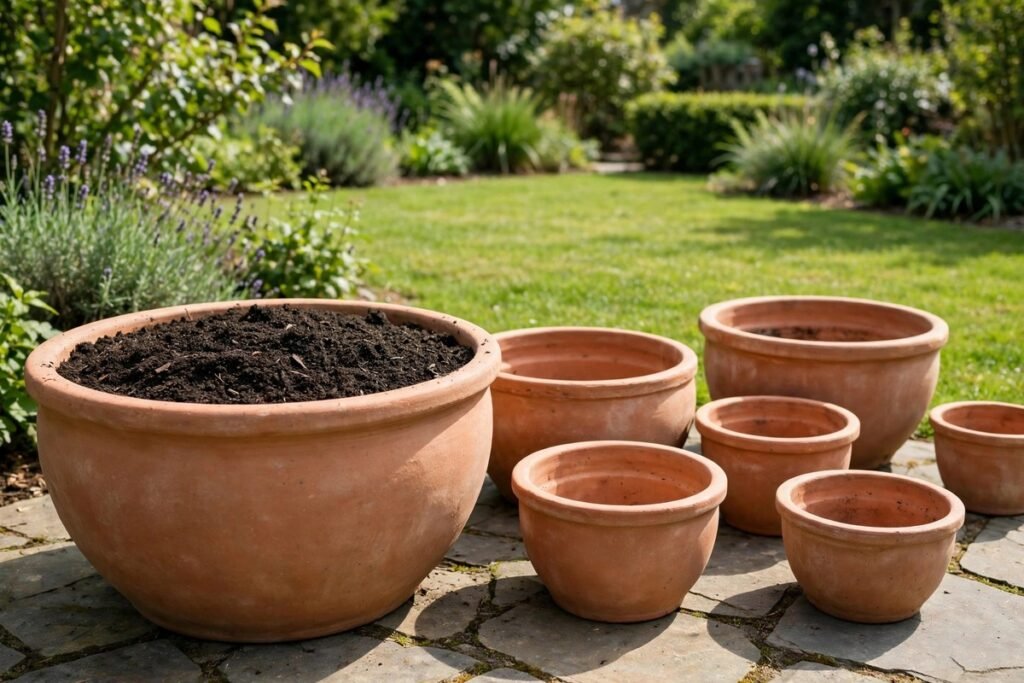
A round planter 60 cm across and 30 cm deep holds about 85 litres of soil, which is 3.0 cubic feet. Work it out with circle area times depth: pi times diameter squared divided by 4 times depth. Measure the inside diameter and depth, use the same unit for both, convert the result to litres, cubic feet or bags.
Why a round planter needs its own sum
A round planter does not fill like a rectangular bed. A rectangular bed uses length times width times depth. A round planter has no length and no width in that sense. It has a diameter, the distance straight across the circle through the centre, and a depth. If you use length times width for a round planter, you treat the circle as a square, and the result is too high. Volume grows with the square of the diameter, so two planters that look close in size can hold very different volumes.
How to measure a round planter
Measure the inside diameter and depth. The calculator page states this rule plainly: measure inside dimensions of planters. The outside size includes the wall thickness, and that thickness takes up space that soil cannot use. To measure the diameter, put a tape across the top, through the centre, from one inside wall to the other. To measure the depth, put the tape inside the planter, from the base to the level where the soil surface will sit. Do not measure to the rim if you plan to leave space below the rim for watering. That gap is not filled with soil.
Pots taper, so a tapered pot holds slightly less than a straight cylinder with the same top diameter and depth. This is a caution only, with no correction figure given here, because the taper varies from pot to pot. If your pot narrows a lot toward the base, treat the circle result as a close upper estimate.
How the circle formula works
The formula on the Garden Volume Calculator page is circle equals pi times diameter squared divided by 4 times depth. The page also gives the site FAQ rule in the same words: multiply pi by the diameter squared, divide by 4 and multiply by the depth. First, find the area with pi times diameter squared divided by 4. Second, multiply the area by the depth. Area times depth gives volume. If diameter and depth are both in metres, the result is in cubic metres. If both are in centimetres, change them to metres first, by dividing by 100. Third, convert the volume. The conversions are 1 cubic metre equals 1000 litres equals 35.3 cubic feet equals 1.31 cubic yards, and 1 cubic foot is about 28.3 litres.
Size table for common round planters
This table gives the volume for the four worked examples in this guide, in litres, cubic feet, and bags of 50 litres. Bag counts are rounded up. The bag counts here are for the exact volume, with no settling allowance added.
| Diameter | Depth | Volume in litres | Volume in cubic feet | Bags of 50 litres |
|---|---|---|---|---|
| 60 cm | 30 cm | 84.8 L | 3.0 cu ft | 2 bags |
| 1.2 m | 40 cm | 452 L | 16.0 cu ft | 10 bags |
| 30 cm | 25 cm | 17.7 L | 0.62 cu ft | 1 bag |
| 24 in | 12 in | 88.9 L | 3.14 cu ft | 2 bags |
Worked example 1: a 60 cm round planter, 30 cm deep
Diameter is 60 cm, which is 0.60 m. Depth is 30 cm, which is 0.30 m. Area is pi times 0.36 divided by 4, which is 0.2827 square metres. Volume is 0.2827 times 0.30, which is 0.0848 cubic metres. That is 84.8 litres, because 0.0848 times 1000 is 84.8. It is 3.0 cubic feet, because 0.0848 times 35.3 is 3.0. Bags are ceil of 84.8 divided by 50, which is ceil of 1.70, so 2 bags of 50 litres. Buy 2 bags, and expect a little soil left over.
Worked example 2: a 1.2 m circular bed, 40 cm deep
Diameter is 1.2 m. Depth is 40 cm, which is 0.40 m. Area is pi times 1.44 divided by 4, which is 1.131 square metres. Volume is 1.131 times 0.40, which is 0.452 cubic metres. That is 452 litres, because 0.452 times 1000 is 452. It is 16.0 cubic feet, because 0.452 times 35.3 is 16.0. Bags are ceil of 452 divided by 50, which is ceil of 9.04, so 10 bags of 50 litres. The diameter here is twice the diameter in example 1, yet the volume is more than five times as large.
Worked example 3: a 30 cm round planter, 25 cm deep
Diameter is 30 cm, which is 0.30 m. Depth is 25 cm, which is 0.25 m. Area is pi times 0.09 divided by 4, which is 0.0707 square metres. Volume is 0.0707 times 0.25, which is 0.0177 cubic metres. That is 17.7 litres, because 0.0177 times 1000 is 17.7. It is 0.62 cubic feet, because 0.0177 times 35.3 is 0.62. Bags are ceil of 17.7 divided by 50, which is ceil of 0.35, so 1 bag of 50 litres.
Worked example 4: a 24 in round planter, 12 in deep
Diameter is 24 in, and depth is 12 in. Area is pi times 576 divided by 4, which is 452.4 square inches. Volume is 452.4 times 12, which is 5429 cubic inches. Convert to cubic feet by dividing by 1728, because 1 cubic foot is 1728 cubic inches. That gives 3.14 cubic feet. Convert to litres by multiplying 3.14 by 28.3, which gives 88.9 litres. Bags are ceil of 88.9 divided by 50, which is ceil of 1.78, so 2 bags of 50 litres. This example uses inches and feet, for readers who measure in imperial units.
Settling and the soil level
The calculator page states that you should add 10 to 20 percent for settling when filling with loose soil. Loose soil settles after watering, and the surface drops below the level where you first filled it. The volumes in this guide are exact volumes, with no settling allowance added. Treat them as the volume of the space to fill, not as the final settled volume after a week.
Common mistakes
- Measuring the outside diameter. The outside includes the wall. Measure inside, through the centre.
- Using the radius as the diameter. Radius is half the diameter. Measure straight across the full circle.
- Mixing units in one sum. Do not put diameter in centimetres and depth in metres in the same calculation. Change both to the same unit first.
- Using length times width for a round planter. That sum treats the circle as a square, and it overstates the volume.
- Forgetting to convert cubic metres to litres. A result of 0.0848 cubic metres is 84.8 litres. Multiply cubic metres by 1000 to get litres.
- Rounding bags down. Bags are always rounded up. A result of 1.7 bags means 2 bags, and 9.04 bags means 10 bags.
- Measuring to the rim instead of the soil level. If you plan to leave a watering gap below the rim, that gap is not soil.
How to use the Garden Volume Calculator for a round planter
Use the Garden Volume Calculator for your own planter. Choose circle, enter the inside diameter and depth, enter the number of identical planters if you have more than one, and enter your bag size. The calculator gives litres, cubic feet, cubic yards, cubic metres, and the number of bags, all from the same volume. For soil to fill a rectangular raised bed, use the Raised Bed Soil Calculator. For general soil volume, use the Soil Calculator. For topsoil volume, use the Topsoil Calculator. For soil in pots, use the Potting Soil Calculator. For further reading, use the Guides.
Frequently asked questions
Q: How much soil does a round planter hold?
A: It depends on diameter and depth. A round planter 60 cm across and 30 cm deep holds about 85 litres, which is 3.0 cubic feet, or 2 bags of 50 litres. A round planter 30 cm across and 25 cm deep holds 17.7 litres, which is 0.62 cubic feet, or 1 bag of 50 litres.
Q: How do I calculate the volume of a round planter?
A: Multiply pi by the diameter squared, divide by 4 and multiply by the depth.
Q: Should I measure the outside or the inside of a round planter?
A: Measure the inside. The outside includes the wall thickness, and that space cannot hold soil. Measure across the inside through the centre for diameter, and from the base to the planned soil level for depth.
Q: Why does a tapered pot hold less than a straight cylinder?
A: A tapered pot narrows toward the base, so the lower part of the pot is smaller than the top. A straight cylinder has the same diameter from top to base, so it holds more for the same top diameter and depth.
Q: How many bags of soil do I need for a round planter?
A: Divide the volume in litres by the bag size in litres and round up. A 60 cm round planter 30 cm deep needs 84.8 litres, so 2 bags of 50 litres. A 1.2 m circular bed 40 cm deep needs 452 litres, so 10 bags of 50 litres.
Q: Can I use the Garden Volume Calculator for a round planter?
A: Yes. Choose circle on the Garden Volume Calculator, enter the inside diameter and depth, enter the number of identical planters if you have more than one, and enter your bag size. It gives litres, cubic feet, cubic yards, cubic metres, and the number of bags.
Measure the inside diameter and depth of your round planter, use pi times diameter squared divided by 4 times depth, and convert the result to litres, cubic feet, or bags. Put those numbers into the Garden Volume Calculator, buy the bags it gives, and fill to the planned soil level with room left below the rim for watering.
More guides
How Many Zones Does My Supply Need
If you are asking how many zones does my supply need, the answer comes from two numbers. Add up the flow of…
Read guide
Head to Head Coverage Explained: Spacing, Corners, Edges and Middle
Head to head coverage means each sprinkler head sprays far enough to reach the head next to it, so the distance between…
Read guide
How Many Sprinkler Heads Do I Need
How many sprinkler heads do I need depends on lawn size and throw radius. A 10 by 6 metre lawn with 4…
Read guide