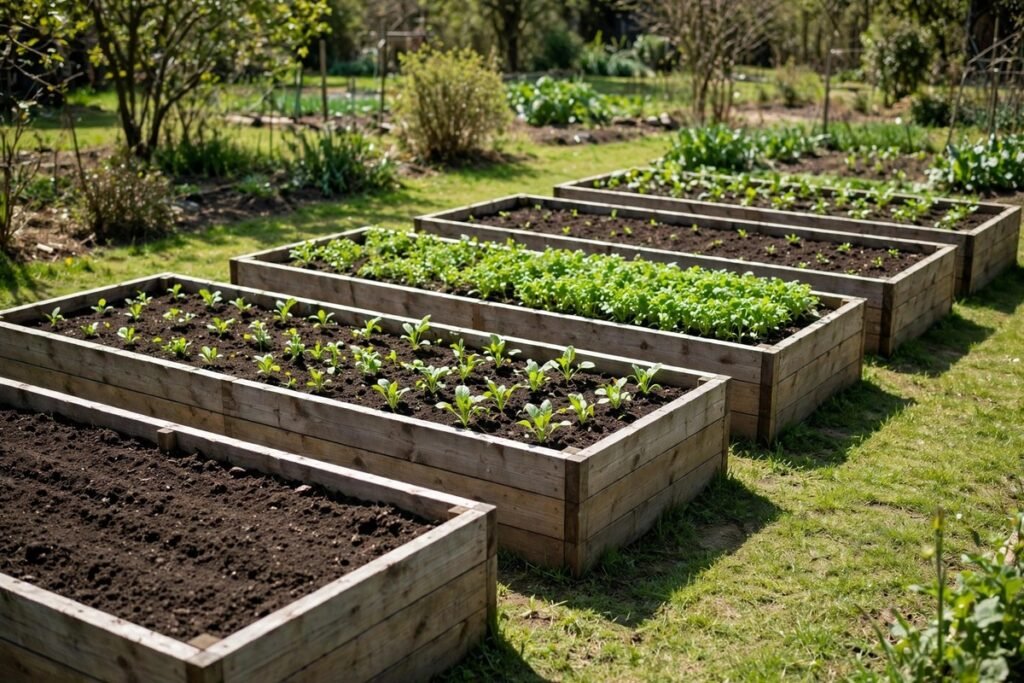
For multiple identical raised beds, work out the volume of one bed, multiply that volume by the number of beds, then add 10 to 20 percent for settling. Three beds at 2.4 by 1.2 metres and 30 cm deep need 2592 litres in total, which is 2.59 cubic metres, or 52 bags of 50 litres before settling is added.
Why one bed is not enough
Most guides work out soil for one bed. That helps for one bed, but many gardens have two, three or four beds of the same size. Guessing the total leaves room for error. A clear total, worked out before you order, lets you compare bagged soil and bulk soil on the same volume, and it stops a shortfall on the last bed.
Use the Garden Volume Calculator for your own beds. Enter length, width and depth for one bed, then use the steps below to multiply the result and add settling. Measure the inside dimensions, because soil fills the inside space, not the outside frame.
How the calculation works in three steps
Follow one order: one bed first, then multiply, then add settling.
- Work out one bed. For a rectangle, volume equals length x width x depth. Use the same unit for all three measures. A depth of 30 cm is 0.30 m. A depth of 20 cm is 0.20 m.
- Multiply by the number of identical beds. Total volume equals one bed volume x number of beds. This step only works when the beds are the same size and the same depth.
- Add settling. Add 10 to 20 percent for settling for loose soil, as stated on the calculator page. Multiply the total by 1.10 for 10 percent, or by 1.20 for 20 percent. Then find bags. Bags equals ceil of volume divided by bag size. Ceil means round up to the next whole bag.
Use these conversions where needed. 1 cubic metre equals 1000 litres, 35.3 cubic feet, and 1.31 cubic yards. Keep the total in one unit through the whole sum, and convert only at the end if you need a second unit.
Total soil for beds of 864 litres each
The table below uses the bed from the calculator page, 2.4 by 1.2 metres and 30 cm deep. Each bed needs 864 litres.
| Number of beds | Total litres | Total cubic metres | Bags of 50 litres before settling |
|---|---|---|---|
| 1 | 864 L | 0.864 m3 | 18 |
| 2 | 1728 L | 1.728 m3 | 35 |
| 3 | 2592 L | 2.592 m3 | 52 |
| 4 | 3456 L | 3.456 m3 | 70 |
| 5 | 4320 L | 4.32 m3 | 87 |
The bag counts use rounding up. Two beds need 1728 litres, which gives 34.56, so 35 bags are needed. Four beds need 3456 litres, which gives 69.12, so 70 bags are needed. Five beds need 4320 litres, which gives 86.4, so 87 bags are needed.
Worked example 1: three identical beds 2.4 by 1.2 metres 30 cm deep
Area of one bed is 2.4 m x 1.2 m, which is 2.88 square metres. Volume of one bed is 2.88 x 0.30, which is 0.864 cubic metres, or 864 litres. Total for three beds is 864 x 3, which is 2592 litres. That total is 2.592 cubic metres, shown as 2.59 cubic metres. Bags are ceil of 2592 divided by 50, which is ceil of 51.84, which is 52 bags of 50 litres before settling. Add settling to the total of 2592 litres before you divide by bag size.
Worked example 2: four beds 4 by 8 feet 12 inches deep
Area of one bed is 4 ft x 8 ft, which is 32 square feet. Depth is 12 in, which is 1 ft. Volume of one bed is 32 x 1, which is 32 cubic feet. Total for four beds is 32 x 4, which is 128 cubic feet. That total is 128 divided by 27, which is 4.74 cubic yards. With a settling allowance of 10 percent, the total becomes 128 x 1.10, which is 140.8 cubic feet. That settled total is 140.8 divided by 27, which is 5.21 cubic yards.
Worked example 3: two beds 5 by 2 metres 20 cm deep
Area of one bed is 5 m x 2 m, which is 10 square metres. Depth is 20 cm, which is 0.20 m. Volume of one bed is 10 x 0.20, which is 2 cubic metres, or 2000 litres. Total for two beds is 2 x 2, which is 4 cubic metres, or 4000 litres. Bags are ceil of 4000 divided by 50, which is 80 bags of 50 litres before settling.
Add settling to the total, not to a guess
Settling is an allowance, not an exact figure. Loose soil settles after filling, so the level in the bed falls below the top edge. The calculator page gives 10 to 20 percent for loose soil. Use 10 percent when the soil is already firm, and use 20 percent when the soil is loose and the fill is deep. The exact fall will vary with the soil and the depth, so treat the allowance as a planning range.
One bed of 864 litres with 10 percent added becomes 864 x 1.10, which is 950.4 litres. Bags are ceil of 950.4 divided by 50, which is ceil of 19.008, which is 20 bags of 50 litres. The same bed with 20 percent added becomes 864 x 1.20, which is 1036.8 litres. Bags are ceil of 1036.8 divided by 50, which is ceil of 20.736, which is 21 bags of 50 litres. Apply the allowance to the full total before you order.
What if the beds are different sizes
Beds of different sizes must be worked out separately and added, not averaged. Averaging gives the wrong total because volume grows with length, width and depth together. Work out each size group on its own. Find the volume of one bed in the first group, multiply by the number of beds in that group, and write the total down. Then do the same for each further group. Add the group totals together to get the full total, then add settling to that full total.
Common mistakes
- Multiplying length or depth instead of volume. Multiply the full volume of one bed by the number of beds.
- Forgetting settling. Ordering the exact loose volume leaves the beds low after the soil settles. Add 10 to 20 percent to the total.
- Averaging beds of different sizes. Work out each size separately and add the totals.
- Rounding bags down. Bags are always rounded up. A result of 51.84 bags means 52 bags.
- Measuring outside dimensions. Measure the inside length and inside width of each bed, and the depth from the base to the fill line.
- Mixing units without converting. Do not mix centimetres with metres, or inches with feet, in the same sum. Change depth to the same unit as length and width first.
How to order and fill
Measure every bed first, and write down length, width and depth for one bed in each size group, plus the number of beds in each group. Put those numbers into the Garden Volume Calculator to check the volume of one bed. Multiply by the number of beds, add settling, and divide by bag size with rounding up to get the bag count. Use that total in cubic metres or cubic yards when you ask a supplier for bulk soil, and use the bag count when you buy bagged soil.
Fill each bed in layers, level each layer, and fill to the planned depth. Check the level again after a few days, and top up from spare soil if the level has fallen below the top edge. For a single bed fill, the Raised Bed Soil Calculator gives the same volume method for one bed on its own.
Frequently asked questions
Q: How much soil do I need for multiple raised beds?
A: Work out the volume of one bed, multiply by the number of identical beds, then add 10 to 20 percent for settling. Three beds at 2.4 by 1.2 metres and 30 cm deep need 2592 litres in total, which is 2.59 cubic metres, or 52 bags of 50 litres before settling is added.
Q: How do I add settling for multiple beds?
A: Add settling to the total volume after multiplying, not to a guessed total. Multiply the total by 1.10 for 10 percent or by 1.20 for 20 percent, then divide by bag size and round up. Settling is an allowance, not an exact figure, so use the higher end when the soil is loose and the fill is deep.
Q: How many bags of soil do I need for 3 raised beds?
A: It depends on the size of each bed. For three beds at 2.4 by 1.2 metres and 30 cm deep, each bed needs 864 litres, the total is 2592 litres, and that is 52 bags of 50 litres before settling is added. Add settling to the total before you work out the final bag count.
Q: What if my raised beds are different sizes?
A: Work out each size separately and add the totals, do not average them. Find the volume of one bed in each size group, multiply by the number of beds in that group, add the group totals together, then add settling to the full total.
Q: Should I use bags or bulk soil for multiple beds?
A: Compare both options on the same total volume. Use the total in cubic metres or cubic yards to ask a supplier for bulk soil, and use the bag count for bagged soil.
Q: How much soil for 4 raised beds 4 by 8 feet?
A: Each bed at 4 by 8 feet and 12 inches deep needs 32 cubic feet. Four beds need 128 cubic feet in total, which is 4.74 cubic yards. With a settling allowance of 10 percent, the total becomes 140.8 cubic feet, which is 5.21 cubic yards.
Start with the inside measures of one bed, multiply across the beds that match it, add settling to the total, and order from that final figure.
More guides

Head to Head Coverage Explained: Spacing, Corners, Edges and Middle
Head to head coverage means each sprinkler head sprays far enough to reach the head next to it, so the distance between…
Read guide
How Many Sprinkler Heads Do I Need
How many sprinkler heads do I need depends on lawn size and throw radius. A 10 by 6 metre lawn with 4…
Read guide
Sprinkler Calculator: A Worked Guide
A sprinkler calculator gives a head count and a zone count from lawn size and spray distance. For a 10 by 6…
Read guide