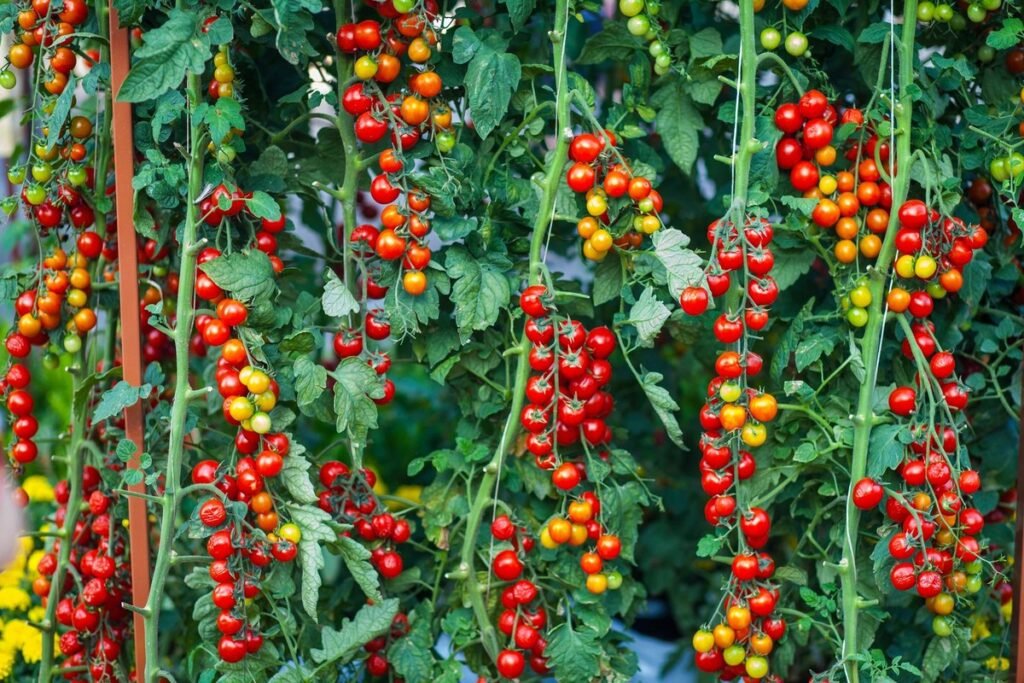
A tomato plant needs around 2 to 4 L of water per day in summer once established, which is about 0.5 to 1 gallon per day. That is the direct answer to how much water does a tomato plant need per day, and the rest of this page turns that amount into a timer setting you can use.
How much water does a tomato plant need per day
A tomato plant needs around 2 to 4 L per day in summer once established, or around 0.5 to 1 gallon per day. The figure comes from the Drip Emitter Calculator page, and it is the only daily water need for a crop that the page gives. This page gives a tomato figure only, so do not use it for a different plant.
Once established means the plant has roots that reach into the soil around it and growth that is steady and strong. A newly planted tomato has a smaller root system and a smaller leaf area, so it usually needs less water than a full size plant in full fruit. As the plant grows, the leaf area and the fruit load grow, and the daily need grows with them.
What changes the daily need
Plant size is the first thing that changes the need. A young plant with few leaves loses less water than a tall plant with a full canopy and fruit. As the plant grows, move your estimate up through the range, and check the size of the plant when you check the timer.
Heat is the second thing that changes the need. Hot air, strong sun, and wind all pull water from the leaves faster. A plant that needs 2 L on a mild summer day can need 3 L or 4 L on a hot day. The calculator page says to adjust the timer in heat waves, so watch the forecast and the plant, and be ready to add time when the heat rises.
Run time for 2, 3 and 4 L per day
The table below gives run times for the tomato range at 2 L, 3 L and 4 L per day, with 1 emitter and 2 emitters per plant, at 2 L/h and 4 L/h. Every run time comes from the same formula. Run time equals water per plant divided by emitters per plant times emitter flow.
| Water per plant per day | 1 emitter at 2 L/h | 2 emitters at 2 L/h | 1 emitter at 4 L/h | 2 emitters at 4 L/h |
|---|---|---|---|---|
| 2 L | 60 minutes | 30 minutes | 30 minutes | 15 minutes |
| 3 L | 90 minutes | 45 minutes | 45 minutes | 22.5 minutes |
| 4 L | 120 minutes | 60 minutes | 60 minutes | 30 minutes |
Read the table from left to right. Pick the daily amount for your plant, then read across to the column that matches your emitters and your emitter flow. At 4 L per day with two 2 L/h emitters, the run time is 60 minutes, because 4 divided by 2 times 2, that is 4 divided by 4, which is 1 hour. That case is the worked example on the calculator page.
Adding a second emitter cuts the run time in half, because the water arrives through two points at once. Moving from a 2 L/h emitter to a 4 L/h emitter also cuts the run time in half. Doing both cuts the run time to a quarter of the time for one 2 L/h emitter.
Daily bed water totals for 10 and 20 plants
A single plant run time tells you how long to run the system. A bed total tells you how much water the whole bed needs in one day. Daily bed total equals plants multiplied by water per plant per day.
| Plants | Water per plant per day | Daily bed water total |
|---|---|---|
| 10 | 2 L | 20 L per day |
| 10 | 3 L | 30 L per day |
| 10 | 4 L | 40 L per day |
| 20 | 2 L | 40 L per day |
| 20 | 3 L | 60 L per day |
| 20 | 4 L | 80 L per day |
The verified example on the calculator page uses 20 plants with two 2 L/h emitters per plant. Those 20 plants need 40 emitters, and the system flow is 80 L/h, because 20 multiplied by 2 is 40, and 40 multiplied by 2 is 80. That system flow is separate from the daily totals in the table above. If you use the Drip Emitter Calculator for your own numbers, check the run time against the tables in this page.
The table above works those totals out for the whole tomato range. Ten plants at 4 L per day need 40 L per day in total, and 20 plants at 4 L per day need 80 L per day in total. Those totals are not system flow. System flow is litres per hour while the system runs, and the daily total is litres per day for the whole bed.
The imperial example
The calculator page also gives an imperial worked example. A tomato needing 1 gallon a day from two 1 GPH emitters takes 30 minutes. The arithmetic is 1 divided by 2 times 1, which is 0.5 hour, and 0.5 hour is 30 minutes. The example stays in gallons and gallons per hour all the way through.
Two emitters share the work, so the run time is half the time for one emitter at the same flow. One gallon a day from one 1 GPH emitter would take 60 minutes. The tomato range in imperial units is 0.5 to 1 gallon per day, so 1 gallon a day is the top of the range.
Adjusting the timer in a heat wave
The calculator page says to adjust the timer in heat waves, and that advice matters most when a tomato plant is most likely to fall short. In a heat wave, the air is hotter, the sun is stronger, and the plant loses water faster. A daily amount that was right in mild summer weather can be too low when the temperature stays high for days.
To adjust, move up through the tomato range first. If you have been watering at 2 L per day, move to 3 L per day. If you have been watering at 3 L per day, move to 4 L per day. Then work out the new run time from the table. At two 2 L/h emitters, 2 L per day is 30 minutes, 3 L per day is 45 minutes, and 4 L per day is 60 minutes. For help with timing across the week, the Garden Watering Schedule Calculator and the Irrigation Scheduling Calculator can help you plan when to water.
Sandy soil and split runs
Sandy soil needs a note of its own, because water moves through it fast. The calculator page says to run drip in one session on sandy soil only if water does not drain past the roots, and to split it otherwise. If the water drains past the root zone before the plant can take it up, the plant gets less than the daily amount even though the timer ran for the right time.
A split run divides the same daily amount into two shorter runs with a gap between them. The total water stays the same, and the run time for each part is half the full run time. The gap lets the first part soak in before the second part arrives, so more of the water stays near the roots.
Choosing a 2 L/h emitter or a 4 L/h emitter
The calculator page gives clear guidance on emitter size. A 2 L/h emitter, which is 0.5 GPH, suits most vegetables. A 4 L/h emitter, which is 1 GPH, suits larger plants and clay soil. A young tomato plant will often do well with 2 L/h emitters. A large plant in hot weather may do better with 4 L/h emitters, because the water arrives faster and the run time is shorter.
The number of emitters per plant matters here too. The calculator page says 1 or 2 emitters per plant for vegetables, 2 to 4 for shrubs, and more for trees. For tomato, that means 1 or 2 emitters per plant is the range to work in. Two emitters spread the water around the root zone, and they give a backup if one clogs.
Common mistakes
The first common mistake is to set the timer by guesswork and never check the arithmetic. Thirty minutes with two 2 L/h emitters gives 2 L per plant. Thirty minutes with one 2 L/h emitter gives 1 L per plant. Thirty minutes with two 4 L/h emitters gives 4 L per plant.
The second common mistake is to mix metric and imperial units in one calculation. Litres with GPH, or gallons with L/h, will give a run time that looks right but is wrong. Check the print on your emitters, pick one set of units, and stay with it.
The third common mistake is to leave the timer at the same setting all summer. A plant grows, the weather changes, and a heat wave can lift the need by a full litre per day. Check the plant size and the forecast, move up or down through the 2 to 4 L range, and set the timer to the new run time.
The fourth common mistake is to run the full daily amount in one session on sandy soil when the water drains past the roots. The timer may be right and the total may be right, but the plant still gets less than it needs. Split the run into two shorter runs with a gap between them, keep the daily total the same, and let each part soak in before the next part arrives.
Frequently asked questions
Q: How much water does a tomato plant need per day in summer?
A: Around 2 to 4 L per day in summer once established, or around 0.5 to 1 gallon per day. A small plant in mild weather sits near 2 L per day, and a large plant in hot weather sits near 4 L per day.
Q: How long should I run drip irrigation for tomatoes?
A: It depends on your daily amount, your emitters per plant, and your emitter flow. For 4 L per day with two 2 L/h emitters, run for 60 minutes. For 2 L per day with the same setup, run for 30 minutes.
Q: Is one emitter enough for a tomato plant?
A: One emitter can be enough, and the calculator page gives 1 or 2 emitters per plant for vegetables. Two emitters spread water around the root zone and give a backup if one clogs.
Q: How do I adjust tomato watering in a heat wave?
A: Move up through the tomato range one step at a time. Move from 2 L per day to 3 L per day, or from 3 L per day to 4 L per day. Work out the new run time from the table, watch the plant and the soil, and move back down when the heat wave ends.
More guides
How to Choose a Fertilizer Rate: Meet Nitrogen or Cap Every Nutrient
Learning how to choose a fertilizer rate starts with one choice. You either meet a chosen nutrient target, usually nitrogen, and accept…
Read guide
Too Much Phosphorus From Fertilizer: Surplus, Signs and Fixes
Too much phosphorus from fertilizer is a surplus that appears when a balanced blend meets nitrogen and supplies twice the phosphate the…
Read guide
Fertilizer NPK Numbers Explained: What N, P2O5 and K2O Mean
Fertilizer npk numbers are the three percentages on a fertilizer bag, listed in the order nitrogen, phosphate and potash. They tell you…
Read guide