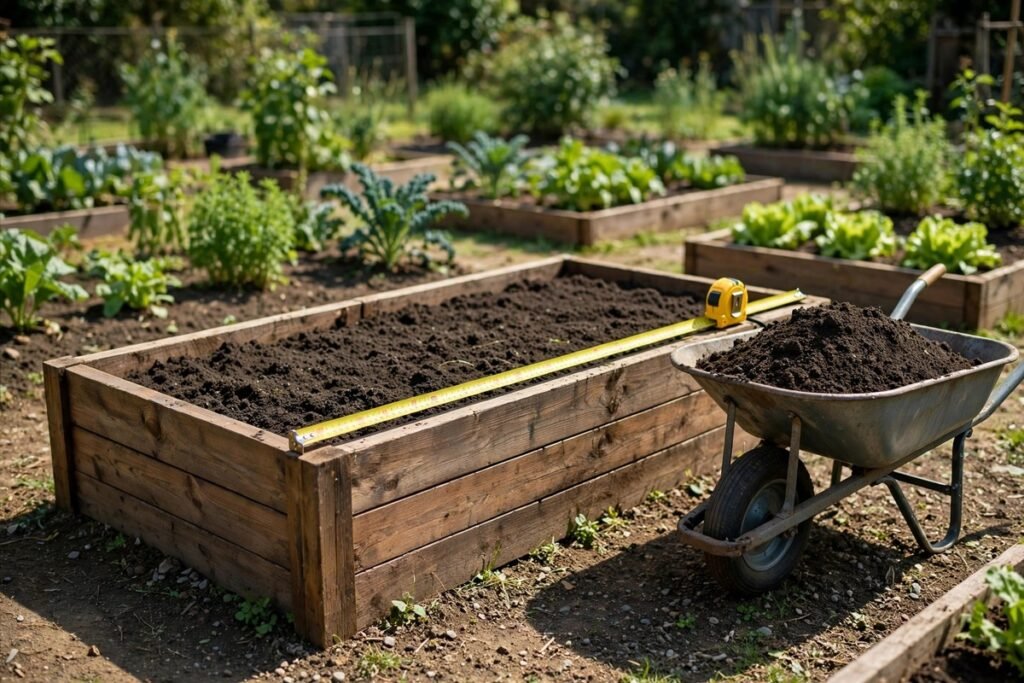
How to calculate garden bed volume for a rectangular bed is simple: multiply length by width by depth. Use the same unit for all three measurements. That gives cubic metres if you measure in metres, or cubic feet if you measure in feet. Convert the result to litres or cubic yards, then divide by bag size and round up.
Measure your bed first
Measure the inside of the bed, not the outside. The outside includes the timber or board thickness, and that extra width adds volume you do not need to fill. Measure length along the inside of the long side, width along the inside of the short side, and depth from the base to the soil line. Write the three numbers down before you start any sum.
Use one unit for all three measurements. A 30 cm depth is 0.3 m, a 20 cm depth is 0.2 m, and a 25 cm depth is 0.25 m. A 12 in depth is 1 ft, and a 6 in depth is 0.5 ft. Mixing metres and centimetres in one sum is the most common source of a wrong answer, so convert depth first. If the bed already holds some soil, measure only the depth you still need to fill.
The formula for a rectangular bed
Volume equals length x width x depth. That is the whole formula for a rectangular bed. A rectangular bed is a box, and the volume of a box is its length times its width times its height. There is no extra factor and no shape correction for a rectangle. In metres, the result is cubic metres. In feet, the result is cubic feet. Convert centimetres to metres first, and convert inches to feet first by dividing by 12.
Use the Garden Volume Calculator for your own bed. Enter length, width, and depth, and it gives volume in the units you need, plus a bag count. The worked examples below show the same arithmetic by hand, so you can check the calculator result.
Convert the volume to the unit you need
Soil is sold in different units. Bags are often sold in litres, bulk soil is often sold in cubic metres or cubic yards, and small bags in some shops are sold in cubic feet. 1 cubic metre equals 1000 litres, 35.3 cubic feet, and 1.31 cubic yards. 1 cubic foot is about 28.3 litres. 1 cubic yard equals 27 cubic feet.
| From | To | Multiply or divide by |
|---|---|---|
| Cubic metres | Litres | Multiply by 1000 |
| Cubic metres | Cubic feet | Multiply by 35.3 |
| Cubic metres | Cubic yards | Multiply by 1.31 |
| Cubic feet | Litres | Multiply by 28.3 |
| Cubic feet | Cubic yards | Divide by 27 |
| Cubic yards | Cubic feet | Multiply by 27 |
Keep the full result until the last step, then round for buying. A volume of 0.864 cubic metres is 864 litres, 30.5 cubic feet, and 1.13 cubic yards. Use litres for bags and cubic yards for a bulk order.
Worked example 1: a 2.4 by 1.2 metre bed 30 cm deep
Length is 2.4 m, width is 1.2 m, and depth is 30 cm, which is 0.3 m.
Area is 2.4 x 1.2, which is 2.88 square metres. Volume is 2.88 x 0.3, which is 0.864 cubic metres. To get litres, multiply 0.864 by 1000, which is 864 litres. To get cubic feet, multiply 0.864 by 35.3, which is 30.5 cubic feet. To get cubic yards, divide 30.5 by 27, which is 1.13 cubic yards.
For bags, divide litres by bag size. With bags of 50 litres, bags are 864 divided by 50, which is 17.28, so buy 18 bags of 50 litres. Always round bags up, because 17 bags would leave part of the bed short.
Worked example 2: a 4 by 8 foot bed 12 in deep
Length is 8 ft, width is 4 ft, and depth is 12 in, which is 1 ft.
Area is 8 x 4, which is 32 square feet. Volume is 32 x 1, which is 32 cubic feet. To get cubic yards, divide 32 by 27, which is 1.19 cubic yards. To get litres, multiply 32 by 28.3, which is about 906 litres. To get cubic metres, divide 32 by 35.3, which is about 0.91 cubic metres.
This bed needs just over 1 cubic yard if you order in bulk. If you buy in bags, work from cubic feet or litres, because bag sizes are given in litres or cubic feet.
Worked example 3: three small beds
The three beds below use depths of 20 cm, 25 cm, and 30 cm.
First, a 3 by 1 metre bed 20 cm deep. Depth is 0.2 m. Area is 3 x 1, which is 3 square metres. Volume is 3 x 0.2, which is 0.6 cubic metres, or 600 litres. In cubic feet, 0.6 x 35.3 is 21.2 cubic feet. Bags are 600 divided by 50, which is 12 bags of 50 litres.
Second, a 2 by 1 metre bed 25 cm deep. Depth is 0.25 m. Area is 2 x 1, which is 2 square metres. Volume is 2 x 0.25, which is 0.5 cubic metres, or 500 litres. In cubic feet, 0.5 x 35.3 is 17.7 cubic feet. Bags are 500 divided by 50, which is 10 bags of 50 litres.
Third, a 1 by 1 metre bed 30 cm deep. Depth is 0.3 m. Area is 1 x 1, which is 1 square metre. Volume is 1 x 0.3, which is 0.3 cubic metres, or 300 litres. In cubic feet, 0.3 x 35.3 is 10.6 cubic feet. Bags are 300 divided by 50, which is 6 bags of 50 litres.
The 2 by 1 metre bed at 25 cm needs 500 litres, while the 1 by 1 metre bed at 30 cm needs only 300 litres, even though the second bed is deeper. Area matters as much as depth.
How many bags to buy
Bags equal volume divided by bag size, rounded up. Use litres for both numbers if the bag size is in litres, and cubic feet for both numbers if the bag size is in cubic feet.
For the 2.4 by 1.2 metre bed, volume is 864 litres, so 18 bags of 50 litres are needed. For the 3 by 1 metre bed, volume is 600 litres, so 12 bags are needed. For the 2 by 1 metre bed, volume is 500 litres, so 10 bags are needed. For the 1 by 1 metre bed, volume is 300 litres, so 6 bags are needed. If a bag size is different, divide the same litre volume by the new bag size and round up again.
Add a small margin only if you plan to top up the bed after the soil settles. Soil settles after watering, so the surface will sit lower than it did on filling day. Buy one extra bag for a small bed if you want a full bed after settling.
Common mistakes
- Measuring the outside of the bed. The outside includes the boards, so the volume comes out too high. Measure the inside length and inside width.
- Mixing units in one sum. A length in metres with a depth in centimetres gives a wrong volume. Convert depth to metres first.
- Using depth to the top of the boards when you plan a lower soil line. Measure to the soil line you will actually fill to, not to the top edge of the bed.
- Forgetting the conversion from cubic metres to litres. A result of 0.864 cubic metres is 864 litres. Multiply by 1000 before you divide by bag size.
- Dividing cubic feet by 27 in the wrong direction. Divide cubic feet by 27 to get cubic yards, because cubic yards are larger than cubic feet.
- Rounding bags down. A result of 17.28 bags means 18 bags. Rounding down leaves part of the bed unfilled.
- Counting soil already in the bed as soil still to buy. Measure only the depth you still need to fill.
Use the calculator for your own bed
Put your own measurements into the Garden Volume Calculator and check the result against the method in this guide. Enter the inside length, inside width, and depth to the soil line, in one unit. The calculator gives volume and bags, so you can order with confidence. If you also need soil for a raised bed fill with a mix, use the Raised Bed Soil Calculator next, and if you need compost volume for the same bed, use the Compost Calculator.
Frequently asked questions
Q: How do I calculate garden bed volume in litres?
A: Multiply length by width by depth in metres to get cubic metres, then multiply by 1000 to get litres. A 2.4 by 1.2 metre bed 30 cm deep is 0.864 cubic metres, which is 864 litres.
Q: How many cubic feet are in a 4 by 8 foot raised bed?
A: A 4 by 8 foot bed 12 in deep holds 32 cubic feet, or about 1.19 cubic yards. Area is 32 square feet and depth is 1 foot.
Q: How many bags of soil do I need for a raised bed?
A: Divide the volume in litres by the bag size in litres and round up. A bed with 864 litres needs 18 bags of 50 litres, a bed with 600 litres needs 12 bags, and a bed with 500 litres needs 10 bags.
Q: How do I convert cubic feet to cubic yards for garden soil?
A: Divide cubic feet by 27 to get cubic yards. A volume of 32 cubic feet is 1.19 cubic yards, and a volume of 30.5 cubic feet is 1.13 cubic yards.
Q: How deep should I fill a raised garden bed?
A: Fill to the soil line you plan to use, and measure that depth for the sum. Common depths here are 20 cm, 25 cm, and 30 cm.
Q: What is the formula for garden bed volume?
A: Volume equals length x width x depth, with all three measurements in the same unit. In metres the result is cubic metres, and in feet the result is cubic feet.
Measure the inside of your rectangular bed, multiply length by width by depth in one unit, convert the result to the unit your seller uses, and divide by bag size and round up. Put those numbers into the Garden Volume Calculator, buy the bags it gives, and fill to the soil line you measured.
More guides
How to Choose a Fertilizer Rate: Meet Nitrogen or Cap Every Nutrient
Learning how to choose a fertilizer rate starts with one choice. You either meet a chosen nutrient target, usually nitrogen, and accept…
Read guide
Too Much Phosphorus From Fertilizer: Surplus, Signs and Fixes
Too much phosphorus from fertilizer is a surplus that appears when a balanced blend meets nitrogen and supplies twice the phosphate the…
Read guide
Fertilizer NPK Numbers Explained: What N, P2O5 and K2O Mean
Fertilizer npk numbers are the three percentages on a fertilizer bag, listed in the order nitrogen, phosphate and potash. They tell you…
Read guide