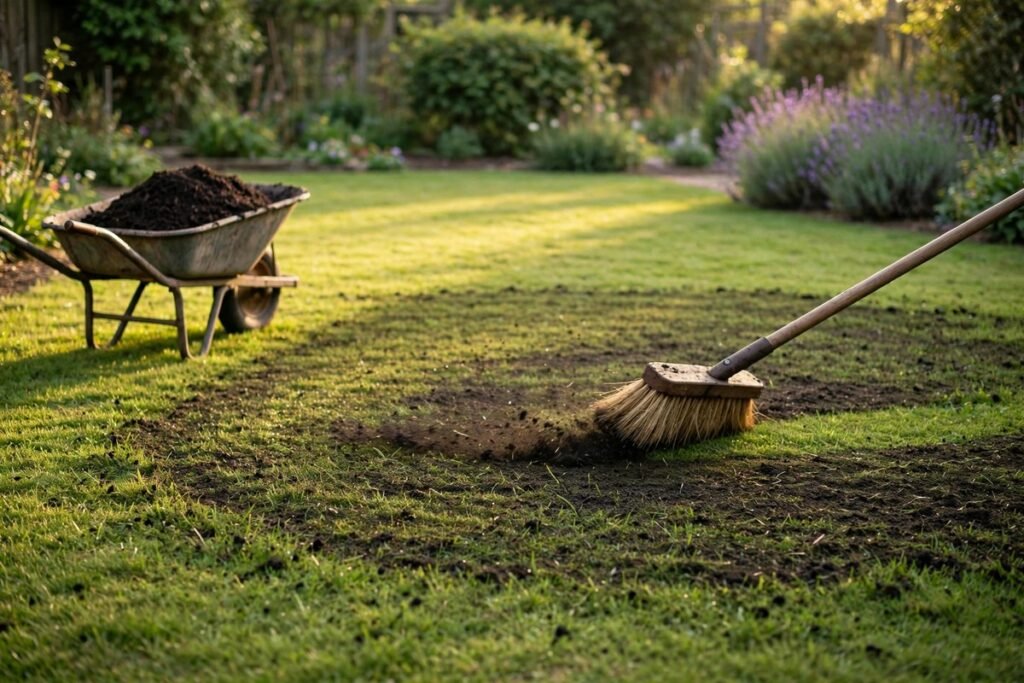
How to Top Dress a Lawn With Compost
Top dress a lawn with compost by spreading a thin 1/4 inch layer of fine screened compost over mown grass, then brushing it in after core aeration. A 1,000 square foot lawn needs about 0.77 cubic yards, or 14 bags of 1.5 cubic feet. Do it in late spring or early fall, when grass is growing and soil is moist.
Why a thin layer works
Top dressing is not a new lawn. It is a thin skin of compost over living grass, so the grass blades must still show through when you finish. That thin layer feeds soil life, adds organic matter, and helps water soak in, without burying the turf.
How much compost you need
Use the calculator formula for every lawn size. Measure the lawn in square feet, choose a depth in inches, and work out the volume first. Then turn that volume into bags or bulk.
area = length x width x areas
volume = area x depth
bags = ceil(volume / bag size)
weight approx = volume x 0.6 t/m3
In imperial units, cubic yards equals square feet times depth in inches divided by 324. Use the Compost Calculator to run your exact lawn size. Enter the length and width, choose top dressing as the job, enter 1/4 inch as the depth, and enter your bag size.
Compost for a lawn at 1/4 inch
This table is for a single pass at 1/4 inch, the standard depth used through this article. Bag counts are rounded up.
| Lawn area | Cubic feet | Cubic yards | Litres | 1.5 cu ft bags | 2 cu ft bags | 50 L bags | Weight approx |
|---|---|---|---|---|---|---|---|
| 1,000 sq ft | 20.83 | 0.77 | 590 | 14 | 11 | 12 | 354 kg |
| 2,000 sq ft | 41.67 | 1.54 | 1,180 | 28 | 21 | 24 | 708 kg |
| 5,000 sq ft | 104.17 | 3.86 | 2,950 | 70 | 53 | 59 | 1,770 kg |
| 10,000 sq ft | 208.33 | 7.72 | 5,899 | 139 | 105 | 118 | 3,540 kg |
How the amount changes with depth
At 1/8 inch, a 1,000 square foot lawn needs 10.42 cubic feet, or 0.39 cubic yards, which is 7 bags of 1.5 cubic feet. At 1/4 inch, it needs 20.83 cubic feet, or 0.77 cubic yards, which is 14 bags. At 1/2 inch, it needs 41.67 cubic feet, or 1.54 cubic yards, which is 28 bags.
Use 1/8 inch for a light annual pass, or when overseeding. Use 1/4 inch for a standard annual pass, or after aerating a tired lawn. Use 1/2 inch only for a problem lawn, and only if grass blades still show through after brushing in. Do not use 1 inch or more as a top dressing. That is a bed depth, not a lawn depth.
In metric, at 6 mm, a 100 square metre lawn needs 0.6 cubic metres, or 600 litres, which is 12 bags of 50 litres and about 360 kg. A 200 square metre lawn needs 1.2 cubic metres, or 24 bags and about 720 kg. A 500 square metre lawn needs 3.0 cubic metres, or 60 bags and about 1,800 kg. The calculator uses about 600 kg per cubic metre as a guide. Wet compost can be much heavier.
What compost to use
Use fine screened compost, with pieces small enough to fall between grass blades. A screen size of about 3/8 inch is a good target. Coarse compost with sticks, stones and large lumps will sit on top of the grass, look untidy, and catch in the mower. Home made compost is often lumpier than bagged compost, so screen it first.
Use finished compost only. Finished compost is dark, crumbly, and smells like soil. Fresh compost, or material still hot in the pile, can tie up nitrogen while it breaks down, and it can stress grass in warm weather.
Do not use compost with weed seed, diseased plant material, or kitchen waste with meat, dairy or cooked food.
When to top dress a lawn
Late spring and early fall are the best times. Oregon State University Extension gives those two windows, and notes that new seed sprouts quickly when soil temperature is above 60 degrees Fahrenheit. Fall is often best, because rain helps move compost into the soil. Avoid the heat of summer, when grass is stressed, and late fall, when growth has stopped.
Do the work when the soil is moist, not wet and not dry. Moist soil takes aeration plugs cleanly, and the compost brushes in easily. Wet soil compacts underfoot and under a wheelbarrow. Dry soil resists the aerator and the compost stays dusty on the surface. Water the lawn the day before if the ground is dry.
Top dress a lawn step by step
Mow the lawn short, and collect the clippings with a bagging mower or a rake. Dethatch if the thatch layer is thick, so the compost can reach the soil.
Core aerate the lawn, if the soil is compacted or the lawn is tired. A core aerator pulls out plugs of soil and leaves them on the surface. Break up the plugs with a rake. Aeration holes give the compost a place to go, and they let air and water reach the roots. On clay soil, the RHS notes that hollow tined aeration is best, every three to four years.
Spread the compost in small piles across one section at a time. Spread them with a stiff rake, a leaf rake, or a drag mat, in a thin, even layer. Keep checking that grass blades still show through.
Brush the compost in with the back of a rake, a stiff broom, or a drag mat. Work it down between the blades until it reaches the soil surface. If you cannot see green, you have spread too thick in that spot. Rake the excess to a thinner area.
Compost, sand, or a mix
Pure compost is the right choice for most lawns. It adds organic matter and nutrients, and it improves soil structure over time. It is also the simplest choice, because you only need to order one material and work out one volume.
A sand mix is useful on heavy clay, where sand helps water drain away, and when you want to level small bumps, because sand settles into hollows. The RHS mix is three parts sandy loam, six parts sharp sand and one part well rotted compost or soil improver, applied at 2 to 3 kg per square metre. That rate is for the mixed dressing, not for pure compost, so do not use it to work out a pure compost order.
A 100 square metre lawn needs 200 to 300 kg of that mix, which is less than the 360 kg of pure compost for the same area at 6 mm. Use the RHS mix when your goal is aeration holes and soil texture. Use pure compost when your goal is organic matter and feeding the soil.
Bags or bulk
For a small lawn, bags are simpler. A 1,000 square foot lawn at 1/4 inch needs 14 bags of 1.5 cubic feet, or 12 bags of 50 litres. You can buy exactly what you need, carry the bags to the lawn, and store any spare bags under cover.
For a larger lawn, bulk is usually easier, once you allow for delivery. A 5,000 square foot lawn at 1/4 inch needs 3.86 cubic yards, which is 70 bags of 1.5 cubic feet. Moving 70 bags by hand is a long job. A bulk delivery tipped on a hard surface near the lawn, moved by wheelbarrow in the same session, is faster.
Common mistakes
Spreading too thick. A layer thicker than 1/2 inch can smother grass and block light. Keep each pass to 1/4 inch, and let the grass show through.
Using coarse or unfinished compost. Large lumps sit on the surface and catch in the mower. Fresh compost can tie up nitrogen. Use fine screened compost that is dark, crumbly and finished.
Skipping aeration on compacted soil. Compost on a sealed surface stays on top and dries out. Core aeration opens holes for the compost to fall into.
Top dressing in the heat of summer. Grass under stress recovers slowly. Wait for late spring or early fall, when the grass is growing and the soil is moist.
Overdoing it every year. Very heavy, repeated applications can build up excess nutrients, especially phosphorus. A moderate yearly top up is best, and a soil test will tell you if phosphorus is already high.
Frequently asked questions
Q: How much compost do I need to top dress a 1000 square foot lawn?
A: At 1/4 inch, you need 20.83 cubic feet, or 0.77 cubic yards, which is about 590 litres. That is 14 bags of 1.5 cubic feet, 11 bags of 2 cubic feet, or 12 bags of 50 litres. The load weighs about 354 kg.
Q: How thick should compost be when top dressing a lawn?
A: Use 1/4 inch for a standard pass. Use 1/8 inch for a light annual pass or when overseeding. Use 1/2 inch only for a problem lawn, and only if grass blades still show through after brushing in. Do not use 1 inch or more as a top dressing.
Q: Should I aerate before top dressing a lawn with compost?
A: Yes, if the soil is compacted or the lawn is tired. Core aerate first, break up the plugs, then spread the compost so it falls into the holes.
Q: When is the best time to top dress a lawn with compost?
A: Late spring or early fall, when grass is growing and soil is moist. Fall is often best, because rain helps move compost into the soil. Avoid the heat of summer and late fall, when growth has stopped.
Q: Can I top dress a lawn with compost and overseed at the same time?
A: Yes. Spread seed before or after the compost, so the seed has soil contact either way. Keep the seedbed evenly moist until the seed sprouts.
Q: Is compost or sand better for top dressing a lawn?
A: Compost is better for most lawns, because it adds organic matter, microbes and nutrients. Sand helps drainage on heavy clay, and it helps level small bumps. The RHS mix uses three parts sandy loam, six parts sharp sand and one part compost, at 2 to 3 kg per square metre.
More guides

How to Choose a Fertilizer Rate: Meet Nitrogen or Cap Every Nutrient
Learning how to choose a fertilizer rate starts with one choice. You either meet a chosen nutrient target, usually nitrogen, and accept…
Read guide
Too Much Phosphorus From Fertilizer: Surplus, Signs and Fixes
Too much phosphorus from fertilizer is a surplus that appears when a balanced blend meets nitrogen and supplies twice the phosphate the…
Read guide
Fertilizer NPK Numbers Explained: What N, P2O5 and K2O Mean
Fertilizer npk numbers are the three percentages on a fertilizer bag, listed in the order nitrogen, phosphate and potash. They tell you…
Read guide