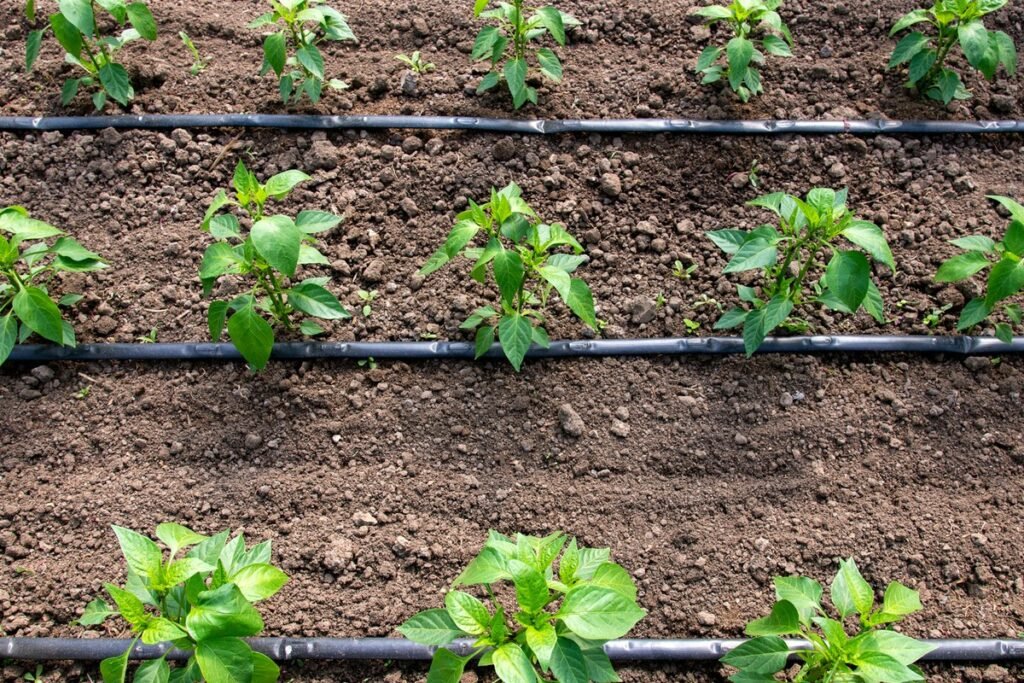
Irrigation scheduling tables give the interval between waterings and the depth to apply each time, for a named soil, root depth and daily ET. For loam with 30 cm roots at 5 mm a day, the tables give net depth 25.5 mm, interval about 5 days and gross depth 31.9 mm at 80 percent efficiency.
Find the row that matches your soil, root depth and daily ET, and read the two outputs that matter on the day: how many days to wait, and how much water to apply when that day comes.
How irrigation scheduling tables work
Soil in the root zone holds a known amount of water that plants can use. Plants use water each day at a rate called ET, short for evapotranspiration. When plants have used a set share of that water, it is time to refill it. The days that takes is the interval. The amount plants can use before that point is the net depth. The amount you must apply to put that net depth into the soil, allowing for losses, is the gross depth. Three inputs decide every row: soil, root depth and daily ET.
The formula behind every row
Every number below comes from four steps, worked in the same order each time. First, root zone water equals available water percent multiplied by root depth. Second, net depth equals root zone water multiplied by allowable depletion. Third, interval in days equals net depth divided by daily ET. Fourth, gross depth equals net depth divided by efficiency. The verified available water values are sand about 7 percent, loam 17 percent and silt loam 20 percent. All tables use 50 percent depletion and 80 percent efficiency, the default and the efficiency in the verified worked example.
Net depth by soil and root depth
Net depth is the amount of water you can let plants use before you water again. It depends only on soil and root depth at a fixed depletion, not on ET. ET decides how fast that net depth is used, but it does not change how large it is. Table 1 shows root zone water and net depth at 50 percent depletion for sand, loam and silt loam at 20 cm, 30 cm and 45 cm roots. At 20 cm roots, sand gives 7.0 mm and silt loam gives 20.0 mm. In loam, net depth rises from 17.0 mm at 20 cm to 38.3 mm at 45 cm.
| Soil | Available water | Root depth | Root zone water | Net depth at 50 percent depletion |
|---|---|---|---|---|
| Sand | 7 percent | 20 cm | 14.0 mm | 7.0 mm |
| Sand | 7 percent | 30 cm | 21.0 mm | 10.5 mm |
| Sand | 7 percent | 45 cm | 31.5 mm | 15.8 mm |
| Loam | 17 percent | 20 cm | 34.0 mm | 17.0 mm |
| Loam | 17 percent | 30 cm | 51.0 mm | 25.5 mm |
| Loam | 17 percent | 45 cm | 76.5 mm | 38.3 mm |
| Silt loam | 20 percent | 20 cm | 40.0 mm | 20.0 mm |
| Silt loam | 20 percent | 30 cm | 60.0 mm | 30.0 mm |
| Silt loam | 20 percent | 45 cm | 90.0 mm | 45.0 mm |
Anchor row from the calculator page
The anchor row is the one row that comes straight from the calculator page, with no example input added. It is loam, 30 cm roots, 50 percent depletion, 5 mm a day ET and 80 percent efficiency. Table 2 shows it in full. Root zone water is 51.0 mm. Net depth is 25.5 mm. Interval is 5.1 days, shown as about 5 days on the page. Gross depth is 31.9 mm. If your garden differs in any one input, use the tables for 20 cm roots or 45 cm roots below.
| Soil | Root depth | ET | Net depth | Interval | Gross depth at 80 percent efficiency |
|---|---|---|---|---|---|
| Loam | 30 cm | 5 mm a day | 25.5 mm | 5.1 days | 31.9 mm |
Irrigation tables for 20 cm roots
Table 3 covers shallow roots of 20 cm, for sand, loam and silt loam, at daily ET values of 3, 4, 6 and 7 mm a day. Those ET values are clearly labelled example inputs, worked through the same formula as the anchor row. They are not page figures. The only verified daily ET on the calculator page is 5 mm a day, in the anchor row above. Gross depth does not change with ET, because it depends only on net depth and efficiency. At higher ET, the interval gets shorter.
| Soil | ET | Net depth | Interval | Gross depth at 80 percent efficiency |
|---|---|---|---|---|
| Sand | 3 mm a day | 7.0 mm | 2.3 days | 8.8 mm |
| Sand | 4 mm a day | 7.0 mm | 1.8 days | 8.8 mm |
| Sand | 6 mm a day | 7.0 mm | 1.2 days | 8.8 mm |
| Sand | 7 mm a day | 7.0 mm | 1.0 days | 8.8 mm |
| Loam | 3 mm a day | 17.0 mm | 5.7 days | 21.3 mm |
| Loam | 4 mm a day | 17.0 mm | 4.3 days | 21.3 mm |
| Loam | 6 mm a day | 17.0 mm | 2.8 days | 21.3 mm |
| Loam | 7 mm a day | 17.0 mm | 2.4 days | 21.3 mm |
| Silt loam | 3 mm a day | 20.0 mm | 6.7 days | 25.0 mm |
| Silt loam | 4 mm a day | 20.0 mm | 5.0 days | 25.0 mm |
| Silt loam | 6 mm a day | 20.0 mm | 3.3 days | 25.0 mm |
| Silt loam | 7 mm a day | 20.0 mm | 2.9 days | 25.0 mm |
Irrigation tables for 45 cm roots
Table 4 covers deeper roots of 45 cm, for the same three soils and the same four example ET values. Net depth is much larger here, because a 45 cm root zone holds more than twice the water of a 20 cm root zone. Interval is therefore much longer, and gross depth is much larger. Sand at 3 mm a day moves from 2.3 days at 20 cm roots to 5.3 days at 45 cm roots. Loam at 4 mm a day moves from 4.3 days to 9.6 days. Silt loam at 6 mm a day moves from 3.3 days to 7.5 days.
| Soil | ET | Net depth | Interval | Gross depth at 80 percent efficiency |
|---|---|---|---|---|
| Sand | 3 mm a day | 15.8 mm | 5.3 days | 19.7 mm |
| Sand | 4 mm a day | 15.8 mm | 3.9 days | 19.7 mm |
| Sand | 6 mm a day | 15.8 mm | 2.6 days | 19.7 mm |
| Sand | 7 mm a day | 15.8 mm | 2.3 days | 19.7 mm |
| Loam | 3 mm a day | 38.3 mm | 12.8 days | 47.8 mm |
| Loam | 4 mm a day | 38.3 mm | 9.6 days | 47.8 mm |
| Loam | 6 mm a day | 38.3 mm | 6.4 days | 47.8 mm |
| Loam | 7 mm a day | 38.3 mm | 5.5 days | 47.8 mm |
| Silt loam | 3 mm a day | 45.0 mm | 15.0 days | 56.3 mm |
| Silt loam | 4 mm a day | 45.0 mm | 11.3 days | 56.3 mm |
| Silt loam | 6 mm a day | 45.0 mm | 7.5 days | 56.3 mm |
| Silt loam | 7 mm a day | 45.0 mm | 6.4 days | 56.3 mm |
How to read one row, worked in full
Take loam, 20 cm roots, ET of 6 mm a day as the example input. Root depth is 200 mm. Root zone water is 0.17 multiplied by 200, which is 34.0 mm. Net depth at 50 percent is 34.0 multiplied by 0.50, which is 17.0 mm. Interval is 17.0 divided by 6, which is 2.83 days, shown as 2.8 days. Gross depth is 17.0 divided by 0.80, which is 21.25 mm, shown as 21.3 mm. The Irrigation Scheduling Calculator will do the same calculation for your exact inputs, and the Crop Water Requirement Calculator can help you find daily crop water use from reference ET and a crop coefficient.
What changes when ET rises or falls
ET follows the weather. On a cool cloudy day it may be near 3 mm a day. On a warm sunny day it may be near 6 or 7 mm a day. As ET rises, interval falls in direct proportion, while net depth and gross depth stay the same. Double the ET and the interval halves. Take loam with 20 cm roots. At 3 mm a day the interval is 5.7 days. At 6 mm a day it is 2.8 days, about half as long. The gross depth is 21.3 mm in both cases.
Adjusting after rain
Rain changes the plan, because effective rain adds water to the root zone and replaces part of the next irrigation. The calculator page states this plainly: subtract effective rainfall from the next irrigation. Table 5 shows the adjustment for the anchor case, loam with 30 cm roots, net depth 25.5 mm, ET 5 mm a day, at 80 percent efficiency.
| Effective rain | Remaining net depth | Interval from rain day | Gross depth to apply |
|---|---|---|---|
| 0 mm | 25.5 mm | 5.1 days | 31.9 mm |
| 5 mm | 20.5 mm | 4.1 days | 25.6 mm |
| 10 mm | 15.5 mm | 3.1 days | 19.4 mm |
| 15 mm | 10.5 mm | 2.1 days | 13.1 mm |
If 10 mm of effective rain falls, remaining net depth is 15.5 mm, gross depth is 19.4 mm, and interval is 3.1 days. Do not subtract the same rain twice. The Garden Watering Schedule Calculator uses the same idea in a weekly form, and the Rain Barrel Calculator can help you see how much of a storm your roof can catch.
Young plants with small root systems
Young plants need shorter intervals, because their roots are shallow and their root zone holds little water. Table 6 shows net depth, interval and gross depth for young plants with roots of 10 cm and 15 cm, at an ET of 5 mm a day as a clearly labelled example input, at 50 percent depletion and 80 percent efficiency.
| Soil | Root depth | Net depth | Interval at 5 mm a day | Gross depth at 80 percent efficiency |
|---|---|---|---|---|
| Sand | 10 cm | 3.5 mm | 0.7 days | 4.4 mm |
| Sand | 15 cm | 5.3 mm | 1.1 days | 6.6 mm |
| Loam | 10 cm | 8.5 mm | 1.7 days | 10.6 mm |
| Loam | 15 cm | 12.8 mm | 2.6 days | 15.9 mm |
| Silt loam | 10 cm | 10.0 mm | 2.0 days | 12.5 mm |
| Silt loam | 15 cm | 15.0 mm | 3.0 days | 18.8 mm |
Check one row. Loam at 10 cm roots gives root zone water 17.0 mm, net depth 8.5 mm, interval 1.7 days at 5 mm a day, and gross depth 10.6 mm. Sand at 10 cm roots gives 0.7 days, which means watering daily until roots grow deeper.
Imperial rounded equivalent
The tables above are metric, as the calculator page worked example is metric only. This section gives one separate imperial example, worked through the same formula, and labelled as a rounded equivalent, not an exact conversion. It uses roots 12 inches deep, a rounded equivalent of 30 cm, and daily ET of 0.20 inches a day, a rounded equivalent of 5 mm a day. For loam, root zone water is 0.17 multiplied by 12 inches, which is 2.04 inches. Net depth is 1.02 inches. Interval is 1.02 divided by 0.20, which is 5.1 days. Gross depth is 1.02 divided by 0.80, which is 1.275 inches, shown as 1.28 inches. Sand gives net depth 0.42 inches, interval 2.1 days and gross depth 0.53 inches.
| Soil | Root depth | ET | Net depth | Interval | Gross depth at 80 percent efficiency |
|---|---|---|---|---|---|
| Loam | 12 inches | 0.20 inches a day | 1.02 inches | 5.1 days | 1.28 inches |
| Sand | 12 inches | 0.20 inches a day | 0.42 inches | 2.1 days | 0.53 inches |
Loam gives 5.1 days in both systems, which is a useful check.
Common mistakes
First, do not use gross depth as if it were net depth, or net depth as if it were the amount to apply. Net depth is the amount plants can use. Gross depth is the amount to apply, allowing for losses. Second, do not use the wrong root depth. Using 45 cm roots for a shallow rooted crop will underwater it. Third, do not use a single ET value for the whole season. ET changes with the weather, so update the ET input when the weather changes. Fourth, do not ignore rain, or count it twice. Subtract effective rain from the next net depth, as Table 5 shows. Fifth, do not apply a large gross depth too fast. A gross depth of 47.8 mm or 56.3 mm will run off if applied too fast, so apply large depths slowly, or split them. Sixth, do not treat the interval as a fixed date. Use the interval to plan, and check the soil with a finger test. If it is still moist, wait a day. If it is dry early, water early.
How to use these tables with the calculator
Start with the tables to learn the pattern, then use the calculator for your exact garden. Find your soil texture, estimate your root depth, and find your daily ET from a local weather service or from the crop water calculator. Enter those three inputs in the calculator, keep 50 percent depletion unless your crop is sensitive, and read the interval and gross depth it gives.
Frequently asked questions
Q: What is the fastest way to use irrigation scheduling tables?
A: Find your soil, root depth and daily ET, and read across that row.
Q: Why is gross depth always larger than net depth?
A: Gross depth allows for losses. Net depth is the water plants can use. Gross depth is net depth divided by efficiency, so it is larger.
Q: How do I choose a daily ET value for the tables?
A: Use daily ET from a local weather service, or crop water use from the crop water calculator on this site. The values 3, 4, 6 and 7 mm a day are example inputs.
Q: What should I do after rain falls?
A: Subtract effective rain from the next net depth, then work out the new gross depth and interval, as Table 5 shows. Do not subtract the same rain twice.
Q: Why do young plants need watering more often?
A: Young plants have shallow roots, so their root zone holds less water. In loam at 5 mm a day, 10 cm roots give 1.7 days and 20 cm roots give 3.4 days.
Q: Can I use the tables if my soil is not sand, loam or silt loam?
A: The tables cover only sand, loam and silt loam, the only soils with a verified available water value on the calculator page.
More guides

How Many Zones Does My Supply Need
If you are asking how many zones does my supply need, the answer comes from two numbers. Add up the flow of…
Read guide
Head to Head Coverage Explained: Spacing, Corners, Edges and Middle
Head to head coverage means each sprinkler head sprays far enough to reach the head next to it, so the distance between…
Read guide
How Many Sprinkler Heads Do I Need
How many sprinkler heads do I need depends on lawn size and throw radius. A 10 by 6 metre lawn with 4…
Read guide