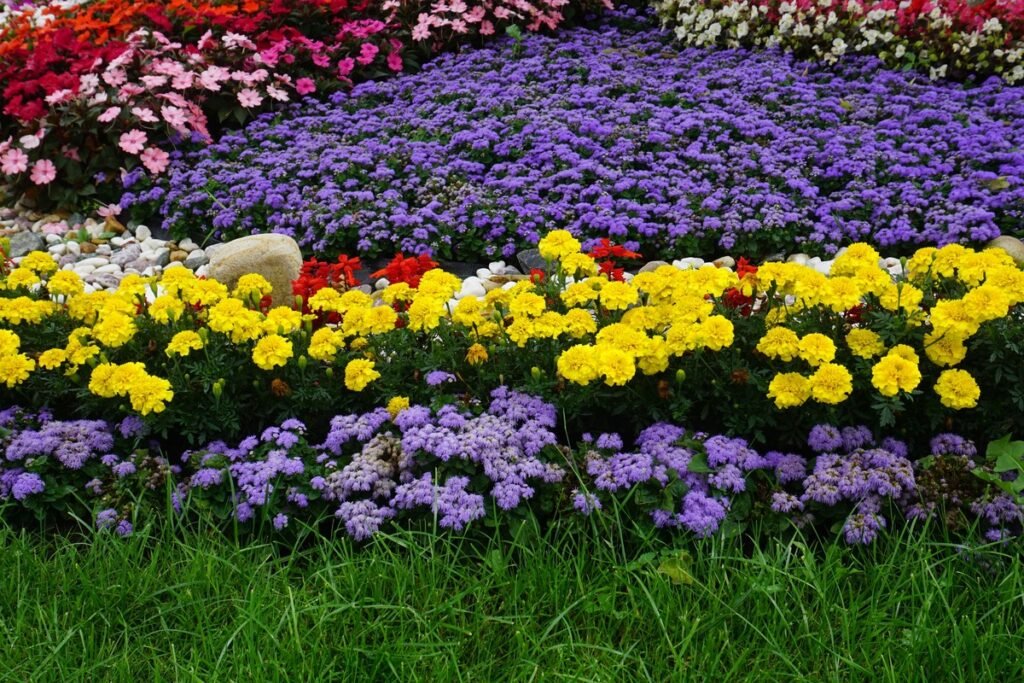
An island flower bed uses the same three zones as a border, with tall plants in the middle and medium and edging plants grading down to the edges on every side. The calculator models that layout by moving the tall zone to the centre, so the shares and spacings give the plant count. Curved and corner beds are not modelled.
What the calculator models
The Flower Bed Calculator works with a rectangular bed. Enter the bed length and depth from front to back, set a share of the depth for tall, medium and edging zones, and set a spacing for each zone from plant labels. The shares must total 100 percent. The calculator gives plants per zone and the total. Buy in odd number groups of the same plant for a natural look.
Zone area = bed area × zone share. Plants in a zone = ceil(zone area divided by spacing squared). Total = sum of zones. Each zone is a block at square spacing, which suits informal borders. In a border, tall plants sit at the back, medium in the middle and low edging at the front. In an island flower bed, put the tall zone in the middle instead, with medium and edging zones grading down to the edges on every side. The count stays the same; only the position changes. The Plants per Square Foot Calculator checks a density for one spacing on its own.
What the calculator does not model
The calculator does not model curved designs or corner beds: no circle, oval, kidney shape, triangle or corner bed that turns through a right angle. It draws a rectangle and treats each zone as a rectangular block, so a curved edge or a pointed corner falls outside it.
It gives plant count only, plus a plan view drawing. It gives no soil volume, bag count, plant cost, seed weight, fertiliser rate, bulb count or cost. Do not invent one of those figures from a plant count. Use a soil or mulch tool for that job instead. The sections below show how to use the calculator for an island bed, and how to adapt it with an honest estimate for a curved bed or a corner bed.
Worked example 1: the calculator example as an island bed
The calculator worked example is a border 4 m long and 1.5 m deep, split 30:40:30. As a border it needs 9 tall plants at 45 cm, 27 medium at 30 cm and 80 edging at 15 cm: 116 plants in total. As an island flower bed the size, shares and spacings stay the same, so the count stays the same. Only the layout changes: tall in the middle, medium and edging on each side.
Bed area: 4 × 1.5 = 6 sq m. In feet, 4 m = 13.12 ft and 1.5 m = 4.92 ft, so the bed covers 64.58 sq ft.
Tall: zone area 6 × 0.30 = 1.8 sq m. Spacing 0.45 m, spacing squared 0.2025 sq m. 1.8 ÷ 0.2025 = 8.888, ceil 9 plants.
Medium: zone area 6 × 0.40 = 2.4 sq m. Spacing 0.30 m, spacing squared 0.09 sq m. 2.4 ÷ 0.09 = 26.666, ceil 27 plants.
Edging: zone area 6 × 0.30 = 1.8 sq m. Spacing 0.15 m, spacing squared 0.0225 sq m. 1.8 ÷ 0.0225 = 80 exactly, ceil 80 plants.
Total: 9 + 27 + 80 = 116 plants.
In the island layout the tall zone is a central band 0.45 m deep, 30 percent of 1.5 m. The medium zone splits into two bands of 0.30 m, one on each side of the tall zone. The edging zone splits into two strips of 0.225 m along the outer edges. Depths in order: 0.225 + 0.30 + 0.45 + 0.30 + 0.225 = 1.5 m. Edging splits evenly, 40 plants on each side. Medium totals 27, which does not split evenly, so treat 27 as the zone total and place 13 on one side and 14 on the other. The calculator gives the zone total, not a total for each side. Spacings in inches are 45 cm as 18 in, 30 cm as 12 in and 15 cm as 6 in. Densities are 4.94 plants per sq m for tall, 11.11 for medium and 44.44 for edging, which is why edging gives 80 of the 116 plants from only 30 percent of the area.
| Zone | Share | Zone area | Spacing | Plants |
|---|---|---|---|---|
| Tall in the middle | 30 percent | 1.8 sq m | 45 cm, 18 in | 9 |
| Medium on both sides | 40 percent | 2.4 sq m | 30 cm, 12 in | 27 |
| Edging on both sides | 30 percent | 1.8 sq m | 15 cm, 6 in | 80 |
| Total | 100 percent | 6 sq m | See rows above | 116 |
Worked example 2: a larger island bed
A larger island bed uses the same method, shares and spacings. Take a bed 7.2 m long and 2.4 m wide. Length is 3 times width, the island bed rule that a bed be 3 times as long as it is wide. In feet, 7.2 m = 23.62 ft and 2.4 m = 7.87 ft.
Bed area: 7.2 × 2.4 = 17.28 sq m, about 186.00 sq ft.
Tall: 17.28 × 0.30 = 5.184 sq m. 5.184 ÷ 0.2025 = 25.6, ceil 26 plants.
Medium: 17.28 × 0.40 = 6.912 sq m. 6.912 ÷ 0.09 = 76.8, ceil 77 plants.
Edging: 17.28 × 0.30 = 5.184 sq m. 5.184 ÷ 0.0225 = 230.4, ceil 231 plants.
Total: 26 + 77 + 231 = 334 plants.
Zone depths from one edge to the other are 0.36 m edging, 0.48 m medium, 0.72 m tall, 0.48 m medium and 0.36 m edging, adding to 2.4 m. The tall centre is 1.2 m from either edge, so check your reach before you choose this width. If you cannot reach the centre, plan a way in, such as stepping stones, or choose a narrower bed.
Worked example 3: an oval bed as an estimate
An oval bed has no straight sides, so the calculator cannot model it. Adapt by working out the true oval area, applying the zone formulas to that area, and labelling the result as an estimate, not a calculator result. Use the Garden Area Calculator for the area step: oval area = pi × length × width ÷ 4.
Take an oval 5 m long and 2.5 m wide. A rectangle with the same maximum length and width covers 5 × 2.5 = 12.5 sq m. The oval covers pi × 5 × 2.5 ÷ 4 = 9.82 sq m, about 79 percent of the rectangle, so a rectangle count would overstate the plants. In feet, 5 m = 16.40 ft, 2.5 m = 8.20 ft, and 9.82 sq m = 105.70 sq ft.
Apply the same shares, 30:40:30, and spacings to 9.82 sq m, as an estimate.
Tall: 9.82 × 0.30 = 2.946 sq m. 2.946 ÷ 0.2025 = 14.548, ceil 15 plants.
Medium: 9.82 × 0.40 = 3.928 sq m. 3.928 ÷ 0.09 = 43.644, ceil 44 plants.
Edging: 9.82 × 0.30 = 2.946 sq m. 2.946 ÷ 0.0225 = 130.933, ceil 131 plants.
Total estimate: 15 + 44 + 131 = 190 plants.
For comparison, the 12.5 sq m rectangle gives tall 3.75 ÷ 0.2025 = 18.518, ceil 19; medium 5.0 ÷ 0.09 = 55.556, ceil 56; edging 3.75 ÷ 0.0225 = 166.667, ceil 167; total 242 plants, 52 higher than the oval estimate. Do not use the rectangle total for an oval bed. The same check works in feet: an 8 by 4 ft rectangle covers 32 sq ft, while a true ellipse with the same maximum dimensions covers about 25 sq ft, since pi × 4 × 2 = 25.13 sq ft.
| Bed shape | Area | Tall | Medium | Edging | Total |
|---|---|---|---|---|---|
| Rectangle 5 by 2.5 m | 12.5 sq m | 19 | 56 | 167 | 242 |
| Oval 5 by 2.5 m, estimate | 9.82 sq m | 15 | 44 | 131 | 190 |
Worked example 4: a triangular corner bed as an estimate
A corner bed that turns through a right angle is also outside the calculator. A triangular corner is the simplest corner shape to count, because its area uses one clear formula. Treat the result as an estimate, and state the triangle area you used.
Take a triangular corner with a base of 3 m and a height of 2 m. Triangle area = base × height ÷ 2, so 3 × 2 ÷ 2 = 3 sq m. In feet, 3 m = 9.84 ft and 2 m = 6.56 ft.
Apply the same shares, 30:40:30, and spacings to 3 sq m, as an estimate.
Tall: 3 × 0.30 = 0.9 sq m. 0.9 ÷ 0.2025 = 4.444, ceil 5 plants.
Medium: 3 × 0.40 = 1.2 sq m. 1.2 ÷ 0.09 = 13.333, ceil 14 plants.
Edging: 3 × 0.30 = 0.9 sq m. 0.9 ÷ 0.0225 = 40 exactly, ceil 40 plants.
Total estimate: 5 + 14 + 40 = 59 plants.
Place the tall zone at the back point of the triangle, medium next and edging along the front edge, so height grades down toward the open side. For a different corner shape, split the bed into rectangles and triangles that do not overlap, add the areas, and apply the zone shares to the total as an estimate. Do not count an overlapping part twice.
Choosing the size and shape of an island bed
Start with width, because width sets how many zones fit. A border 1.5 m deep holds three zones at 30:40:30, with depths of 0.45 m, 0.60 m and 0.45 m. An island bed needs the same three zones on both sides of the centre, so it needs more width than a border. Kansas State Extension gives 8 ft as a minimum width for a full island bed with layers on both sides. That minimum does not apply to a border reached from one side only, where the worked example uses a depth of 1.5 m, or 4.92 ft.
A bed reached from one side only works best at about 60 cm wide, and a bed reached from both sides at about 1.2 m wide. Do not present 4 ft as a width for a bed reached from one side only, because that puts the far edge twice as far away as a comfortable reach. Keep length about 3 times width, so a bed 2.4 m wide is about 7.2 m long. Use the Garden Bed and Path Layout Calculator to test how a bed of that size sits in the plot, with paths all round it, before you mark out the ground.
Common mistakes to avoid
First, do not enter a curved bed as a rectangle and read the result as a calculator total. Measure the longest length and widest depth, or split the bed into rectangles, and label the figure as an estimate. Second, do not use one spacing for the whole bed. Each zone needs its own spacing, and edging at 15 cm needs far more plants per sq m than tall plants at 45 cm. Third, do not let the zone shares add to more or less than 100 percent. Fourth, do not put tall plants at the edge of an island bed. They belong in the middle, so the bed reads well from every side. Fifth, do not expect young plants to fill the bed at once. Spacing guides assume plants at their mature spread, so young plants look sparse at first, and perennials often fill in over two to three seasons. Use the Plant Spacing Calculator to check a single spacing count on its own, apart from a zone total.
Frequently Asked Questions
Q: Can I use the Flower Bed Calculator for an island flower bed?
A: Yes. Use the same bed length, depth, zone shares and spacings, and put the tall zone in the middle instead of at the back.
Q: How many plants do I need for an island flower bed 4 by 1.5 metres?
A: 116 plants in total: 9 tall plants at 45 cm, 27 medium plants at 30 cm and 80 edging plants at 15 cm, with the tall zone in the middle.
Q: Does the calculator model a curved flower bed?
A: No. Curved designs are not modelled. Use the largest rectangle that fits inside the bed, or split the bed into simple shapes, and label the result as an estimate.
Q: How do I count plants for a triangular corner bed?
A: Work out the triangle area as base times height divided by 2, then apply the zone shares and spacings to that area, and label the total as an estimate.
Q: How wide should an island flower bed be?
A: Wide enough to hold a tall centre zone with medium and edging zones on both sides. Check that you can reach the centre before you choose the width.
Q: What does the Flower Bed Calculator give?
A: It gives plants per zone and the total only, plus a plan view drawing. It gives no soil volume, bag count, plant cost, seed weight, fertiliser rate, bulb count or cost.
More guides

How to Choose a Fertilizer Rate: Meet Nitrogen or Cap Every Nutrient
Learning how to choose a fertilizer rate starts with one choice. You either meet a chosen nutrient target, usually nitrogen, and accept…
Read guide
Too Much Phosphorus From Fertilizer: Surplus, Signs and Fixes
Too much phosphorus from fertilizer is a surplus that appears when a balanced blend meets nitrogen and supplies twice the phosphate the…
Read guide
Fertilizer NPK Numbers Explained: What N, P2O5 and K2O Mean
Fertilizer npk numbers are the three percentages on a fertilizer bag, listed in the order nitrogen, phosphate and potash. They tell you…
Read guide