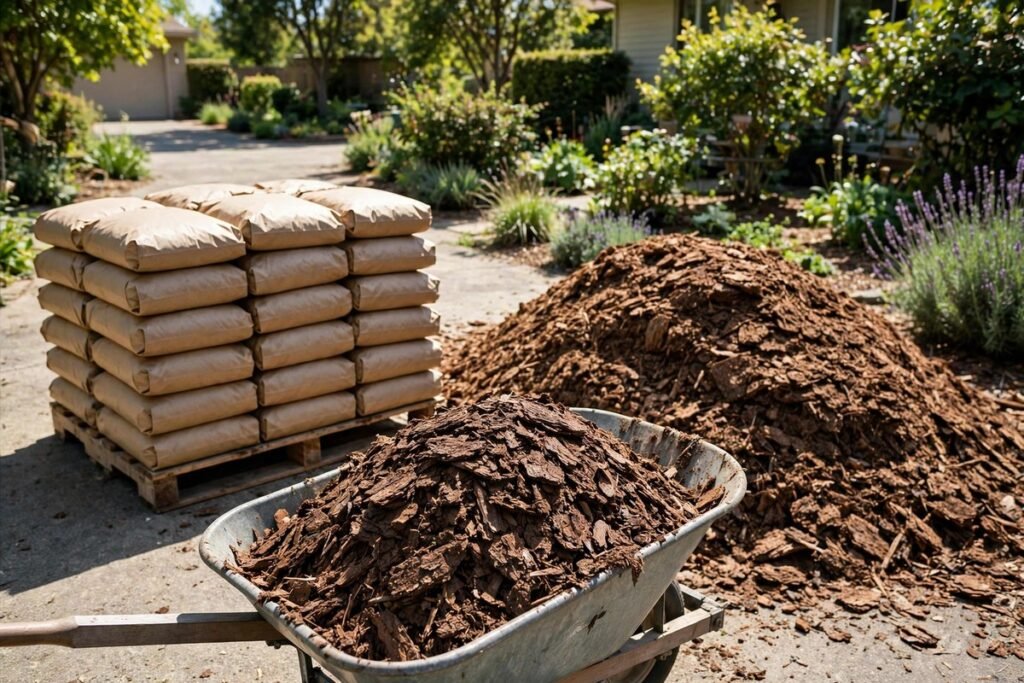
Mulch Bags vs Bulk: Which Is Cheaper?
Mulch bags win for a small job and bulk wins for a large job. One cubic yard needs 14 bags of 2 cubic feet, rounded up. Three cubic yards need 41 bags. Ten cubic yards need 135 bags. To compare them, multiply the bag price by 14 for one yard, add delivery to bulk, then divide by the yards.
Use the Mulch Calculator to work out your exact volume first, then use the bag counts below to price it both ways.
How the mulch maths works
Mulch is sold by volume, so no weight conversion is needed. Bulk mulch is sold by the cubic metre or cubic yard, and bagged mulch is sold by the cubic foot or litre size printed on the bag.
The calculator uses this formula:
area = length x width x beds x (1 minus covered %)
volume = area x depth
bags = ceil(volume / bag size)
coverage per bag = bag size / depth
Covered % is the share already covered by large plants or paths. Ceil means round up to the next whole bag.
The site worked example is metric. A 10 x 1.5 m border is 15 square metres. At 7.5 cm deep, that is 1.125 cubic metres, shown as 1.13 cubic metres, or 15 bags of 75 litres. Each bag covers 1 square metre.
In imperial units, volume in cubic feet is area in square feet x depth in inches / 12. Divide cubic feet by 27 for cubic yards. A 10 x 20 ft bed is 200 square feet. At 3 inches deep, that is 50 cubic feet, or 1.85 cubic yards, or 25 bags of 2 cubic feet.
Bag counts for 1, 3 and 10 cubic yards
One cubic yard is 27 cubic feet. Divide 27 by the bag size to get the exact bag count, then round up to buy whole bags. A 2 cubic foot bag gives 14 bags per yard, rounded up. A 1.5 cubic foot bag gives 27 / 1.5 = 18 bags per yard. A 3 cubic foot bag gives 27 / 3 = 9 bags per yard.
| Volume | Cubic feet | 1.5 cu ft bags | 2 cu ft bags | 3 cu ft bags | 50 litre bags | 75 litre bags |
|---|---|---|---|---|---|---|
| 1 cu yd | 27 | 18 | 14 | 9 | 16 | 11 |
| 3 cu yd | 81 | 54 | 41 | 27 | 46 | 31 |
| 10 cu yd | 270 | 180 | 135 | 90 | 153 | 102 |
Metric counts use 1 cubic yard = 764.6 litres. For 3 yards, that gives 46 bags of 50 litres and 31 bags of 75 litres. For 10 yards, it gives 153 bags of 50 litres and 102 bags of 75 litres.
If your total is not a whole number of yards, round up from the exact cubic feet. A 1.85 yard job is 50 cubic feet, so 50 / 2 = 25 bags, not 28 bags from 2 yards x 14.
How far one bag and one yard go
Coverage per bag is bag size / depth. A 2 cubic foot bag covers 8 square feet at 3 inches deep and 12 square feet at 2 inches deep.
| Depth | 1 cu yd covers | One 2 cu ft bag covers | One 3 cu ft bag covers |
|---|---|---|---|
| 1 inch | 324 sq ft | 24 sq ft | 36 sq ft |
| 2 inches | 162 sq ft | 12 sq ft | 18 sq ft |
| 3 inches | 108 sq ft | 8 sq ft | 12 sq ft |
| 4 inches | 81 sq ft | 6 sq ft | 9 sq ft |
In metric, 1 cubic metre covers 13.3 square metres at 7.5 cm deep, and a 50 litre bag covers about 0.67 square metres at that depth.
Use 3 inches for most shrub and perennial beds, and 2 inches for a top up over old mulch. University of Illinois Extension recommends 2 to 4 inches, with composted materials at 2 to 3 inches and coarse mulches at 3 to 4 inches.
How to compare bags and bulk per cubic yard
Compare the two on a per cubic yard basis, not per bag and not per load. The method below uses your own local quotes, because prices change by place, by season and by mulch type, and no single price fits every reader.
Work out the volume with the Mulch Calculator and write down the exact cubic feet. For bags, multiply one bag price by the bag count and divide by the cubic yards. For one yard, that is bag price x 14 for 2 cubic foot bags. For bulk, add the delivery fee to the bulk price, then divide by the cubic yards. Compare the two per yard figures. The lower figure wins on material cost alone.
Call the bag price B, the bulk price per yard P, and the delivery fee D. For 1 yard, bags cost 14 x B and bulk costs P plus D. For 10 yards, bags cost 135 x B and bulk costs 10 x P plus D. As the yards rise, D is spread over more yards, so bulk gets cheaper per yard and the crossover sits near 2 to 3 cubic yards.
Ask each supplier the same questions, so the quotes match. Ask whether the bulk price includes delivery, whether there is a minimum order, and whether the bag price is for the bag size you counted. Check the bag label for the volume.
When bags win, and when bulk wins
Bags win for a small job, for a job in stages, and for a place that is hard to reach with a truck. One cubic yard is 14 bags of 2 cubic feet, which fit in a car boot or a small trailer, and they can be stored dry until you need them.
Bags also win when you have no place for a bulk pile. A bulk load needs a drive or a tarp on flat ground, and it needs to be moved soon after. Bags can sit stacked against a wall. If the job is under about 2 cubic yards, expect bags to win once delivery is added.
Bulk wins for a large job and for one big spread. Ten cubic yards is 135 bags to load, carry, open and empty, plus 135 empty bags to clear away. One bulk pile is one delivery, moved by wheelbarrow from one place.
Bulk wins when the per yard saving covers delivery. At 3 yards, the fee is spread over 3 yards, not 1. At 10 yards, it adds little per yard, so the crossover sits near 2 to 3 cubic yards.
Delivery, storage and handling
Ask before you buy whether delivery is included, what the fee is, and where the load will be tipped. Ask whether the truck can reach the spot you want. A pile on grass can kill the grass underneath if it sits for days, and a pile on a slope can wash away in rain.
Bags are sealed, so they stay dry until opened. A bulk pile is open to rain, so it can get heavier and harder to move. Cover it with a tarp if it will sit for more than a day.
Handling is the cost that does not appear on a quote. Count the lifts for bags: each bag is picked up, loaded, unloaded, carried, opened and emptied. Count the wheelbarrow trips for bulk: each trip is loaded, pushed, tipped and raked out. If you work alone, or if the beds are far from the drive, handling time can decide the choice.
Common mistakes with mulch bags vs bulk
Comparing a bag price with a bulk price. A bag price is for 2 cubic feet. A bulk price is for 27 cubic feet. Multiply the bag price by 14 to get the bag cost for one yard.
Forgetting delivery. A bulk quote without delivery looks cheap. Add the delivery fee before you divide by the yards.
Using the wrong depth. A yard at 2 inches covers 162 square feet. At 4 inches, it covers 81 square feet. If you price a 2 inch job and spread at 4 inches, you will run out halfway.
Ordering no extra for uneven ground. Add about 5 to 10 percent for uneven ground and settling. For 3 cubic yards, 10 percent is 5 more bags of 2 cubic feet, taking the total from 41 to 46 bags.
Piling mulch against trunks and stems. Keep mulch at least 4 inches away from a trunk, and do not pile it in a mound against the bark. Spread it flat, and leave a clear ring at the trunk.
Frequently asked questions
Q: How many bags of mulch are in a cubic yard?
A: One cubic yard is 27 cubic feet. That is 14 bags of 2 cubic feet rounded up, 18 bags of 1.5 cubic feet, or 9 bags of 3 cubic feet.
Q: How many bags of mulch do I need for 3 cubic yards?
A: Three cubic yards are 81 cubic feet. That is 41 bags of 2 cubic feet, 54 bags of 1.5 cubic feet, or 27 bags of 3 cubic feet.
Q: How many bags of mulch do I need for 10 cubic yards?
A: Ten cubic yards are 270 cubic feet. That is 135 bags of 2 cubic feet, 180 bags of 1.5 cubic feet, or 90 bags of 3 cubic feet.
Q: Is bulk mulch cheaper than bagged mulch?
A: Bulk is usually cheaper per cubic yard once you need about 2 to 3 cubic yards, after delivery is added. For a small job under about 2 cubic yards, bags often win.
Q: How much area does one cubic yard of mulch cover?
A: At 3 inches deep, one cubic yard covers 108 square feet. At 2 inches deep, it covers 162 square feet.
Q: How deep should mulch be?
A: For most beds, 2 to 3 inches is the planning depth, and 2 to 4 inches is the range given by University of Illinois Extension and Iowa State University Extension.
Work out your volume first, count the bags from the exact cubic feet, and price both forms per cubic yard with local quotes. For most gardens, bags win under 2 cubic yards and bulk wins from 3 cubic yards up. Run your bed size through the Mulch Calculator.
More guides

How Many Zones Does My Supply Need
If you are asking how many zones does my supply need, the answer comes from two numbers. Add up the flow of…
Read guide
Head to Head Coverage Explained: Spacing, Corners, Edges and Middle
Head to head coverage means each sprinkler head sprays far enough to reach the head next to it, so the distance between…
Read guide
How Many Sprinkler Heads Do I Need
How many sprinkler heads do I need depends on lawn size and throw radius. A 10 by 6 metre lawn with 4…
Read guide