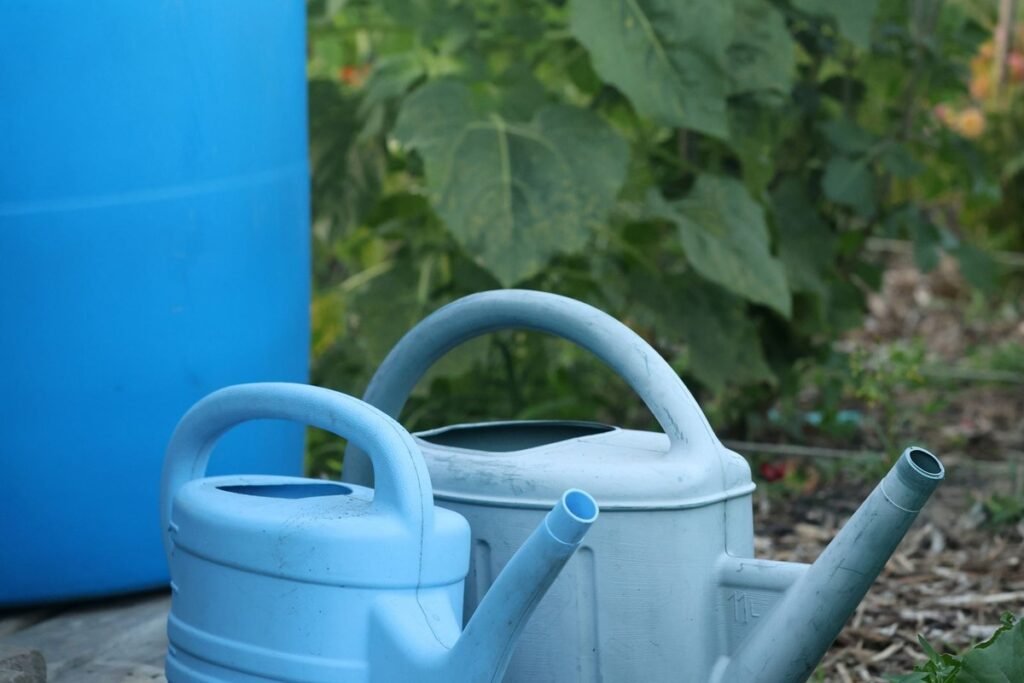
Rain barrel drip irrigation without pump works only for low pressure drip kits, not for standard drip emitters. A barrel on the ground gives no useful pressure, and a barrel raised 4 metres gives only 0.4 bar, far below the 1 bar in the worked example. Gravity can move water, but it cannot give standard emitters the pressure they need.
A full barrel looks like a large store of water, and a drip line looks like a gentle way to use it, so the pairing seems natural. The pressure question decides whether it works. Water in a barrel has weight, and that weight can push water along a pipe, but the push is small unless the water surface sits well above the emitters.
Rain barrel drip irrigation without pump: what gravity gives at 1 to 4 metres
The calculator page states the key figure in one line. Gravity gives only about 0.1 bar per metre of height. The same line gives the imperial form as 1.4 psi per metre, and the height as 3.3 feet per metre. Measure the height from the water surface to the highest emitter and multiply by 0.1 bar.
At 1 metre, gravity gives about 0.1 bar. At 2 metres, it gives about 0.2 bar. At 3 metres, it gives about 0.3 bar. At 4 metres, it gives about 0.4 bar. Each extra metre adds the same small amount, so the gain from raising a barrel is steady but slow.
| Height from water surface to emitter | Gravity pressure in bar | Gravity pressure in psi |
|---|---|---|
| 1 metre | 0.1 bar | 1.4 psi |
| 2 metres | 0.2 bar | 2.8 psi |
| 3 metres | 0.3 bar | 4.2 psi |
| 4 metres | 0.4 bar | 5.6 psi |
The table uses the page figure of 0.1 bar per metre and 1.4 psi per metre, so each row is a simple multiplication. No allowance for pipe friction has been taken off yet. Friction will reduce the pressure further, and small pipes and many fittings add more friction. As the barrel empties, the water surface falls, and the gravity pressure falls with it.
Why 0.4 bar is still far from 1 bar
The worked example on the calculator page uses 1 bar as the emitter pressure. At that pressure, the pressure head alone is 10.2 metres, because the page formula is pressure head equals pressure times 10.2 metres per bar. A barrel raised 4 metres gives only 0.4 bar, less than half of 1 bar.
To reach 1 bar from gravity alone, the water surface would need to sit about 10 metres above the emitters, because 10 metres times 0.1 bar per metre equals 1.0 bar. That height is about 33.5 feet of head, the page figure for 1 bar in feet. A barrel on a 10 metre tower is not a garden setup.
Why a barrel on the ground cannot run standard drip emitters
A barrel on the ground gives almost no height difference between the water surface and the emitters in the beds. If the emitters sit at the same level as the water surface, the height is zero, and the gravity pressure is zero. Water may flow out of an open hose at a small pressure, but standard drip emitters are not open hoses. They are small outlets made to pass a controlled flow at a set pressure.
When pressure is too low, the emitters nearest the barrel may pass some water while emitters further along the line pass little or none. Some plants get water and others stay dry. Slope can change the picture in one direction only. If the beds sit downhill from the barrel, the height difference grows, and the gravity pressure grows with it. Use the highest emitter, not the lowest, because the highest emitter gets the least pressure and sets the limit for even watering.
The imperial view, with rounded equivalents
Metric and imperial examples are kept separate here, and the imperial figures are rounded equivalents of the metric figures, not exact conversions. The calculator page gives 1 bar as about 10.2 metres, or 33.5 feet, of head. It also gives 1 psi as 2.31 feet of head, so psi times 2.31 gives feet of head. A water surface 3.3 feet above an emitter gives about 0.1 bar, or 1.4 psi, and each extra 3.3 feet adds about 0.1 bar.
| Height from water surface to emitter | Gravity pressure in bar | Gravity pressure in psi |
|---|---|---|
| 3.3 feet | 0.1 bar | 1.4 psi |
| 6.6 feet | 0.2 bar | 2.8 psi |
| 9.9 feet | 0.3 bar | 4.2 psi |
| 13.2 feet | 0.4 bar | 5.6 psi |
To reach 1 bar, the water surface would need to sit about 33.5 feet above the emitters. A barrel raised 13.2 feet is already far above a normal stand, yet it still gives only 0.4 bar, less than half the pressure needed.
Low pressure drip kits: the gravity option the calculator page points to
The calculator page gives two options for a rain barrel, and the first is to use low pressure drip kits. A low pressure kit is made to work at the low pressure that gravity gives, rather than at the 1 bar in the worked example. A kit of this type does not need the barrel to sit 10 metres up, because it is designed for the small push that a barrel on a stand can actually give.
A low pressure kit still needs height, and the same gravity calculation still applies. A barrel on the ground gives almost no pressure, so even a low pressure kit needs the barrel raised enough to give a useful height difference to the highest emitter. Keep the pipe run short and the number of fittings low, because friction takes pressure away. A low pressure kit suits a small area close to the barrel, with flow that will be gentle and will change as the barrel empties. It does not turn a standard system into a gravity system by itself.
When a small pump is the answer
The second option on the calculator page is a small pump. A pump adds the pressure that gravity cannot give, and it lets a rain barrel feed a standard drip system. The pump does not need to be large, because drip irrigation uses a modest flow, but it does need to be sized for the flow and the total head of the system, not for its maximum head alone. The page warns that pump curves vary and that the flow at your head must be checked, not the maximum head.
How to size that small pump with the calculator
Sizing starts with the flow of the largest zone, the pressure the drip line needs, the height from the water surface to the highest emitter, and the supply pipe length with a friction allowance. The Drip Irrigation Pump Calculator takes those inputs and gives the head and the power to look for on a pump curve. Total head is height plus pressure plus friction combined. Power equals 9.81 times flow in litres per second times head in metres divided by efficiency.
The worked example shows the full calculation in one place. The flow is 600 litres per hour at 1 bar, the lift is 3 metres, and the pipe is 50 metres with a 5 percent loss. Pressure head is 1 bar times 10.2, which is 10.2 metres. Friction is 50 metres times 5 percent, which is 2.5 metres. Total head is 3 plus 10.2 plus 2.5, which is 15.7 metres. Power is 9.81 times 0.1667 times 15.7 divided by 0.5, which is 51.3 watts, stated on the page as about 51 watts at 50 percent efficiency. The pump choice is at least 720 litres per hour at 19 metres.
| Worked example step | Calculation | Result |
|---|---|---|
| Pressure head | 1 bar times 10.2 | 10.2 metres |
| Friction | 50 metres times 5 percent | 2.5 metres |
| Total head | 3 plus 10.2 plus 2.5 | 15.7 metres |
| Power at 50 percent efficiency | 9.81 times 0.1667 times 15.7 divided by 0.5 | About 51 watts |
| Pump choice | At least 720 litres per hour at 19 metres | Page choice |
That example is a guide to the method, not a size for every garden. Your flow, lift and pipe length will differ, so your total head and power will differ too. The Drip Flow Rate Calculator can help with the flow side, and the Drip Emitter Calculator can help with the emitter side, but the pump size itself comes from the pump calculator and the pump curve. Check the flow at the total head shown, not the maximum head.
What to check before you choose gravity or a pump
Before you choose, measure the height from the water surface in the barrel to the highest emitter, and work out the gravity pressure with the 0.1 bar per metre figure. If that pressure is far below 1 bar, a standard drip system will not run evenly on gravity alone, and the choice is between a low pressure kit and a small pump. Next, look at the pipe run. A long supply pipe will take pressure away, and small pipes and many fittings add more friction, so a short and simple run keeps more pressure at the emitters. A low pressure kit suits a small and simple gravity setup, while a small pump suits a standard drip system using the 1 bar emitter pressure in the worked example.
A simple decision path
If the emitters are standard emitters and the barrel sits at ground level or on a low stand, gravity alone will not run them, and a small pump is the answer. If the emitters are part of a low pressure kit and the barrel is raised enough to give a useful height to the highest emitter, gravity can work, with gentle flow that changes as the barrel empties. Measure the height, multiply by 0.1 bar per metre, and compare with 1 bar.
Frequently asked questions
Q: Can a rain barrel run drip irrigation without a pump?
A: Yes, only with a low pressure drip kit. The worked example uses 1 bar as the emitter pressure, and a barrel raised 4 metres gives only 0.4 bar, so standard emitters will not run evenly without a pump.
Q: How much pressure does gravity give at 1 metre?
A: About 0.1 bar, or 1.4 psi. At 2 metres it is about 0.2 bar, at 3 metres about 0.3 bar, and at 4 metres about 0.4 bar.
Q: How high would a barrel need to be to give 1 bar?
A: About 10 metres, because gravity gives about 0.1 bar per metre. That height is about 33.5 feet of head for 1 bar, so a normal garden stand cannot reach it.
Q: What is a low pressure drip kit?
A: A kit made to work at the low pressure gravity gives, rather than at the 1 bar in the worked example.
Q: How do I size a small pump for a rain barrel drip system?
A: Enter your flow, emitter pressure, lift and pipe length in the Drip Irrigation Pump Calculator, then pick a pump that gives that flow at the total head shown. For the worked example, 600 litres per hour at 1 bar, 3 metres of lift and 50 metres of pipe needs 15.7 metres of total head and about 51 watts at 50 percent efficiency.
More guides
Hargreaves vs Penman Monteith: When the Simple Estimate Is Enough
Hargreaves vs penman monteith is a choice between a simple estimate from temperature alone and a fuller calculation from complete weather data.…
Read guide
Daily ET0 vs Monthly Average ET0: Planning vs Scheduling
Daily ET0 vs monthly ET0 is a choice between one day and a month. Use a monthly average to plan a season,…
Read guide
How Latitude and Date Change Your ET0
Latitude and ET0 are linked through Ra, the extraterrestrial radiation that reaches the top of the atmosphere. When latitude or date changes,…
Read guide