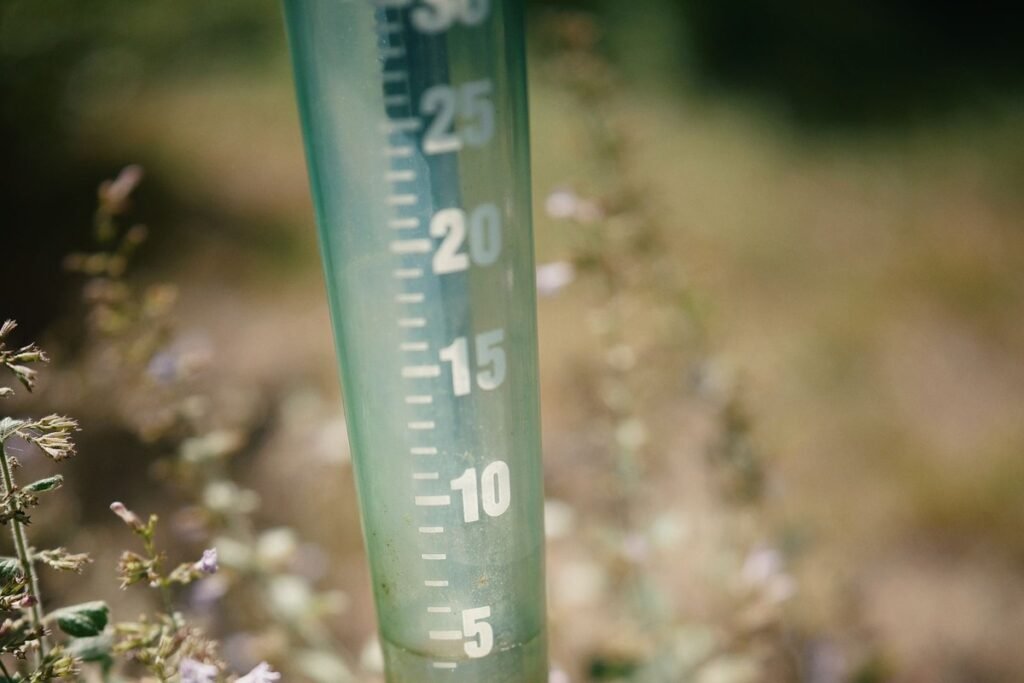
Rainwater collected per storm from an 80 m2 roof in a 25 mm storm at 90 percent runoff is 1,800 L. The same roof at 800 mm a year collects 57,600 L a year, if barrels are emptied between storms, which rarely happens, so real capture is lower. This blog gives storm and annual tables by roof size and rainfall.
What one storm gives you
One storm gives you a volume you can picture in barrels. It is the water that falls on your roof in that storm, minus the share lost to runoff. The storm figure is the useful figure for storage, because barrels hold water from one storm at a time.
Read the storm figure first. If it is larger than the barrels you own, the rest overflows. If it is smaller, the barrels stay partly empty. A 200 L barrel on an 80 m2 roof fills with less than 3 mm of rain, so a single barrel overflows in most storms.
The formula in plain words
Water in litres equals roof area in m2 times rainfall in mm times runoff share. The calculator default is 90 percent, which suits most pitched roofs. Use 0.90 in the arithmetic. The other 10 percent is lost to splash, absorption, and evaporation.
One mm of rain on 1 m2 is 1 litre before runoff share. A roof of 80 m2 in 1 mm of rain gives 80 litres, and 72 litres at 90 percent runoff. Use the roof footprint, not the sloping roof area.
Barrels equal storm water divided by barrel size, rounded up. The tables use 200 L barrels, which the calculator page states as 55 gal. A storm volume of 1,800 L divided by 200 L is exactly 9 barrels.
Worked example: 80 m2 roof in a 25 mm storm
The page worked example uses a roof 10 x 8 m, which is 80 m2, in a 25 mm storm at 90 percent runoff. Area times rainfall times runoff share is 80 x 25 x 0.90, which is 1,800 L. Barrels for that storm are 1,800 divided by 200, which is 9 barrels.
Nine barrels hold the whole storm. One barrel holds only a small share of the storm. Four barrels hold 800 L, which is less than half the storm. The same roof at 800 mm a year gives 57,600 L, if barrels are emptied between storms, which rarely happens, so real capture is lower.
Table 1: storm water by roof size and storm size
Table 1 gives storm water in litres and barrel count for five roof sizes and three storm sizes, at 90 percent runoff with 200 L barrels. Read the row for your roof size, then read across for your storm size.
| Roof area | 10 mm storm | 25 mm storm | 50 mm storm |
|---|---|---|---|
| 50 m2 | 450 L, 3 barrels | 1,125 L, 6 barrels | 2,250 L, 12 barrels |
| 80 m2 | 720 L, 4 barrels | 1,800 L, 9 barrels | 3,600 L, 18 barrels |
| 100 m2 | 900 L, 5 barrels | 2,250 L, 12 barrels | 4,500 L, 23 barrels |
| 120 m2 | 1,080 L, 6 barrels | 2,700 L, 14 barrels | 5,400 L, 27 barrels |
| 150 m2 | 1,350 L, 7 barrels | 3,375 L, 17 barrels | 6,750 L, 34 barrels |
Storm water rises with roof size and with storm size. A 50 m2 roof in a 10 mm storm gives 450 L, which is 3 barrels. The same roof in a 50 mm storm gives 2,250 L, which is 12 barrels. A 150 m2 roof in a 25 mm storm gives 3,375 L, which is 17 barrels.
A 100 m2 roof in a 50 mm storm gives 4,500 L, which is 23 barrels. The arithmetic is 4,500 divided by 200, which is 22.5, rounded up to 23 barrels. Plan for the rounded up count, not the exact division.
What the storm table means for storage
Most readers own far fewer barrels than a full storm needs. A single 200 L barrel on an 80 m2 roof holds 200 L of a 1,800 L storm, and the other 1,600 L overflows. Four barrels hold 800 L of that storm, and 1,000 L overflows.
A bigger storm changes the result fast. An 80 m2 roof in a 10 mm storm gives 720 L, which is 4 barrels. The same roof in a 50 mm storm gives 3,600 L, which is 18 barrels. One downpipe serves only the roof area draining to it, so split the roof area between downpipes.
Table 2: annual water by roof size at 800 mm a year
Table 2 gives annual water in litres for five roof sizes at 800 mm a year, at 90 percent runoff. Every figure in Table 2 assumes barrels are emptied between storms, which rarely happens, so real capture is lower.
| Roof area | Annual water at 800 mm a year |
|---|---|
| 50 m2 | 36,000 L |
| 80 m2 | 57,600 L |
| 100 m2 | 72,000 L |
| 120 m2 | 86,400 L |
| 150 m2 | 108,000 L |
At 800 mm a year, a 50 m2 roof collects 36,000 L a year, an 80 m2 roof collects 57,600 L a year, a 100 m2 roof collects 72,000 L a year, and a 150 m2 roof collects 108,000 L a year, if barrels are emptied between storms, which rarely happens, so real capture is lower.
Table 3: annual water by annual rainfall for an 80 m2 roof
Table 3 gives annual water in litres for one roof size, 80 m2, at three annual rainfall totals, at 90 percent runoff. Every figure in Table 3 assumes barrels are emptied between storms, which rarely happens, so real capture is lower.
| Annual rainfall | Annual water for 80 m2 |
|---|---|
| 600 mm | 43,200 L |
| 800 mm | 57,600 L |
| 1,000 mm | 72,000 L |
An 80 m2 roof at 600 mm a year collects 43,200 L a year, at 800 mm a year collects 57,600 L a year, and at 1,000 mm a year collects 72,000 L a year, if barrels are emptied between storms, which rarely happens, so real capture is lower. Rainfall figures in these tables are calculator inputs, not claims about any real place.
Why the annual figure is not stored water
The annual figure is a total, not a tank size. It adds up every storm in the year as if each storm found empty barrels waiting for it. In real use, barrels are often still full from the last storm when the next storm arrives, so the new rain overflows.
Rain that falls while barrels are full is lost to overflow. Rain that falls after you have used stored water is captured. Use the annual figure to compare roof sizes and rainfall totals, not to size a tank. A year of water from an 80 m2 roof at 800 mm a year is 57,600 L, if barrels are emptied between storms, which rarely happens, so real capture is lower.
What the water can be used for
Collected rainwater is for garden use. Use it to water plants in the garden, and to fill watering cans for garden beds. That is the use the calculator gives, and it is the use these tables support.
Do not use untreated rainwater for drinking. That rule comes from the calculator page, and it applies to every volume in this blog. Check local rules on rainwater harvesting before you set up barrels. Plan use around the storm figure, not the annual figure.
Overflow that directs excess away from foundations
Overflow is part of the plan, not a failure of the plan. Every storm larger than your barrel count produces overflow, and every storm that arrives while barrels are full produces overflow. Fit an overflow that directs excess water away from foundations.
Route overflow to a garden bed, lawn, or drain, never toward the foundation. Water that pools beside a foundation can cause damp and damage over time. Linking barrels near the base helps storage, but it does not remove overflow.
How to use the calculator
The Rain Barrel Calculator gives storm water, annual water, and barrel count from your roof footprint, storm rainfall, annual rainfall, runoff share, and barrel size. Enter the footprint for the part of the roof that drains to one downpipe. Set runoff share to 90 percent for most pitched roofs. Enter a typical storm, your annual rainfall total, and your barrel size.
Use the tables in this blog to check the calculator result. Find your roof size and storm size in Table 1, and your roof size in Table 2 or your annual rainfall in Table 3. If the figures differ, check the footprint first. The Garden Watering Schedule Calculator plans weekly watering after rain, and the Crop Water Requirement Calculator gives daily and weekly water use of a crop.
Common mistakes
Using the sloping roof area instead of the footprint is the first mistake. The sloping area is larger than the footprint, so it gives a storm volume that is too large. Measure the ground area under the roof for the part that drains to one downpipe.
Using the whole roof area for one downpipe is the second mistake. One downpipe serves only the roof area draining to it. Split the roof by downpipe, and work out each set on its own.
Reading the annual figure as stored water is the third mistake. The annual figure assumes barrels are emptied between storms, which rarely happens, so real capture is lower. Size storage from the storm figure, not the annual figure.
Forgetting overflow is the fourth mistake. A barrel set without a clear overflow route sends excess water where it falls, which can be beside the foundation. Fit an overflow that directs excess water away from foundations.
Using stored rainwater for drinking without treatment is the fifth mistake. Do not use untreated rainwater for drinking. Keep stored rainwater for garden use, and check local rules on rainwater harvesting before you set up barrels.
Frequently asked questions
Q: How much rainwater is collected per storm from an 80 m2 roof in a 25 mm storm?
A: 1,800 L at 90 percent runoff, which is nine 200 L barrels.
Q: How much rainwater does an 80 m2 roof collect in a year at 800 mm a year?
A: 57,600 L a year, if barrels are emptied between storms, which rarely happens, so real capture is lower.
Q: How much rainwater does a 50 m2 roof collect in a year at 800 mm a year?
A: 36,000 L a year, if barrels are emptied between storms, which rarely happens, so real capture is lower.
Q: How much rainwater does a 100 m2 roof collect in a year at 800 mm a year?
A: 72,000 L a year, if barrels are emptied between storms, which rarely happens, so real capture is lower.
Q: How many barrels does a 100 m2 roof need in a 50 mm storm?
A: 23 barrels of 200 L, because the storm gives 4,500 L, and 4,500 divided by 200 is 22.5, rounded up to 23 barrels.
Q: Can I use collected rainwater for drinking?
A: Do not use untreated rainwater for drinking. Collected rainwater in this blog is for garden use. Check local rules on rainwater harvesting.
More guides

How to Choose a Fertilizer Rate: Meet Nitrogen or Cap Every Nutrient
Learning how to choose a fertilizer rate starts with one choice. You either meet a chosen nutrient target, usually nitrogen, and accept…
Read guide
Too Much Phosphorus From Fertilizer: Surplus, Signs and Fixes
Too much phosphorus from fertilizer is a surplus that appears when a balanced blend meets nitrogen and supplies twice the phosphate the…
Read guide
Fertilizer NPK Numbers Explained: What N, P2O5 and K2O Mean
Fertilizer npk numbers are the three percentages on a fertilizer bag, listed in the order nitrogen, phosphate and potash. They tell you…
Read guide