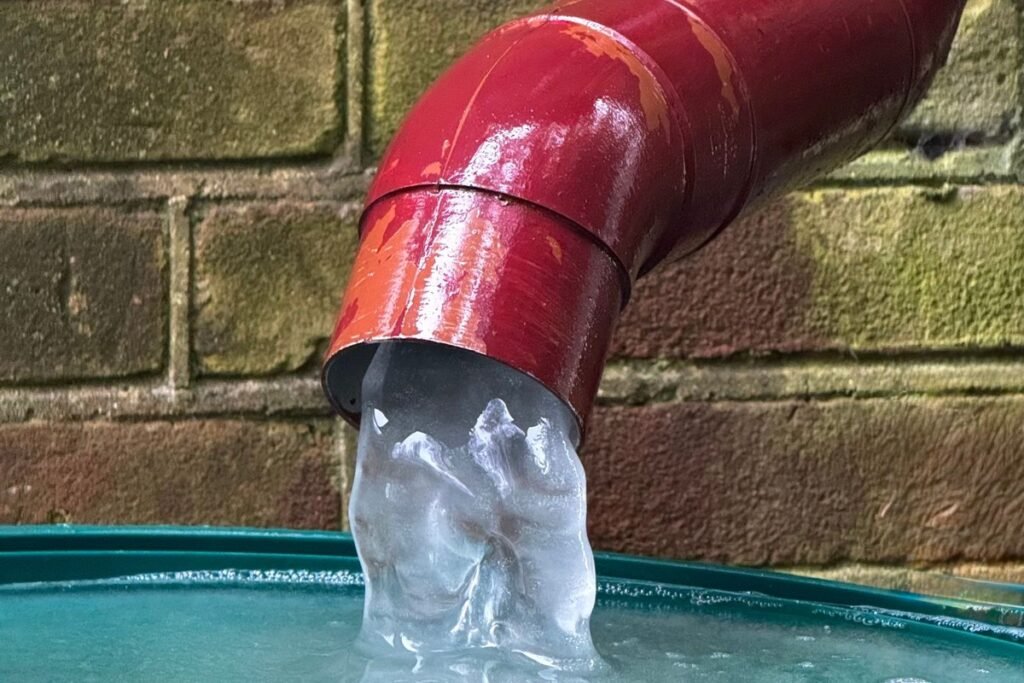
Rainwater in gallons is easy to read from the tables in this blog. A 1,000 sq ft roof catches 561 gal from a 1 in storm at 90 percent runoff, which needs 11 barrels of 55 gal. A 500 sq ft roof catches 280 gal from the same storm, which needs 6 barrels.
How to read the tables
Table 1 gives gallons and barrel counts by roof area and storm size, all at 90 percent runoff, with 55 gal barrels beside every volume. Roof areas are 500, 1,000 and 2,000 sq ft. Storms are 0.5, 1 and 2 in. Table 2 gives the rain needed to fill one 55 gal barrel on each roof area. Read across a row for your roof area, then down the column for your storm. Barrel counts always round up.
Where the 0.623 factor comes from
One inch of rain on 1 sq ft is about 0.623 US gallons. One square foot is 144 square inches, because 12 times 12 equals 144. One inch of rain over that area is 144 cubic inches of water. One US gallon is 231 cubic inches. Divide 144 by 231 and the result is 0.6233766, rounded to 0.623. That is the gross water before losses. At 90 percent runoff, collectible water from 1 sq ft in 1 in of rain is 0.623 times 0.90, which equals 0.5607 gal. From 1,000 sq ft it is 1,000 times 0.5607, which equals 560.7 gal, shown as 561 gal. The page FAQ states the same factor as about 0.62.
The formula in imperial units
The Rain Barrel Calculator uses one formula for gallons. Gallons equals roof area in sq ft times rainfall in inches times 0.623 times runoff share. Barrels equals storm water divided by barrel size, rounded up to the next whole barrel. The default runoff share is 90 percent, which suits most pitched roofs. Roof area is the roof footprint, the ground area under the roof, not the sloping roof area. The Garden Area Calculator can work out the area if the footprint is made of more than one simple shape.
Worked example: 1,000 sq ft roof, 1 in storm
Roof area is 1,000 sq ft, storm is 1 in, runoff is 90 percent, and barrel size is 55 gal. Gross water equals 1,000 times 1 times 0.623, which equals 623 gal. Collectible water equals 623 times 0.90, which equals 560.7 gal, shown as 561 gal. Barrels equals 560.7 divided by 55, which equals 10.19, rounded up to 11 barrels. Ten barrels hold 550 gal, leaving 10.7 gal for the eleventh barrel. One barrel catches 55 gal and leaves 505.7 gal to overflow.
Worked example: 500 sq ft roof, 1 in storm
A 500 sq ft roof catches half the water of a 1,000 sq ft roof from the same storm. Gross water equals 500 times 1 times 0.623, which equals 311.5 gal. Collectible water equals 311.5 times 0.90, which equals 280.35 gal, shown as 280 gal. Barrels equals 280.35 divided by 55, which equals 5.09, rounded up to 6 barrels. Five barrels hold 275 gal, leaving 5.35 gal for the sixth barrel. In a 0.5 in storm the same roof catches 140 gal and needs 3 barrels.
Worked example: 2,000 sq ft roof, 1 in storm
A 2,000 sq ft roof catches twice the water of a 1,000 sq ft roof from the same storm. Gross water equals 2,000 times 1 times 0.623, which equals 1,246 gal. Collectible water equals 1,246 times 0.90, which equals 1,121.4 gal, shown as 1,121 gal. Barrels equals 1,121.4 divided by 55, which equals 20.38, rounded up to 21 barrels. Twenty barrels hold 1,100 gal, leaving 21.4 gal for the twenty first barrel. A 1,000 sq ft roof in a 2 in storm gives the same 1,121 gal and 21 barrels.
Table 1: rainwater in gallons by roof area and storm, at 90 percent runoff, with 55 gal barrels
| Roof area | 0.5 in storm gallons | 0.5 in storm barrels | 1 in storm gallons | 1 in storm barrels | 2 in storm gallons | 2 in storm barrels |
|---|---|---|---|---|---|---|
| 500 sq ft | 140 gal | 3 | 280 gal | 6 | 561 gal | 11 |
| 1,000 sq ft | 280 gal | 6 | 561 gal | 11 | 1,121 gal | 21 |
| 2,000 sq ft | 561 gal | 11 | 1,121 gal | 21 | 2,243 gal | 41 |
How to use Table 1
Start with your roof area, then read across to your storm size. At 1,000 sq ft and 0.5 in, the table gives 280 gal and 6 barrels. At 500 sq ft and 1 in, it gives the same figures, because halving the area has the same effect as halving the storm. If your area or storm falls between the table rows or columns, use the formula for your exact figures rather than guessing between them.
How fast one barrel fills
One 55 gal barrel fills fast, because a roof gathers water from a large area into one downpipe. On a 1,000 sq ft roof at 90 percent runoff, the rain needed is 55 divided by 560.7, which equals 0.098 in, shown as about 0.1 in. That matches the calculator page FAQ, which says a 200 L barrel stated as 55 gal on the page fills with less than 3 mm of rain, about 0.1 in, on a 10 x 8 m roof stated as 1,000 sq ft on the page. On a 500 sq ft roof the same barrel needs about 0.2 in, and on a 2,000 sq ft roof it needs about 0.05 in.
Table 2: rain needed to fill one 55 gal barrel, at 90 percent runoff
| Roof area | Rain to fill one 55 gal barrel |
|---|---|
| 500 sq ft | 0.20 in |
| 1,000 sq ft | 0.10 in |
| 2,000 sq ft | 0.05 in |
How to use Table 2
Table 2 answers one question, which is how much rain fills a barrel. It does not answer how much water a whole storm gives, because that question needs Table 1. Four linked barrels on a 1,000 sq ft roof hold 220 gal. A 1 in storm gives 561 gal, so 341 gal still overflows after the four barrels are full.
Roof footprint and one downpipe
The tables use the roof area that drains to one downpipe, not always the whole roof. Each downpipe serves only the part of the roof that drains to it. If a 2,000 sq ft roof drains half to one downpipe and half to another, each downpipe serves 1,000 sq ft, so use the 1,000 sq ft row for each set of barrels. The Rain Barrel Calculator asks for that footprint, not the sloping area.
Metric and imperial examples kept separate
The metric example on the calculator page and the imperial examples in this blog are rounded equivalents, not exact conversions. The page metric example is a roof 10 x 8 m, which is 80 m2, in a 25 mm storm at 90 percent runoff, which gives 1,800 L, which is nine 200 L barrels. The page states the same roof as 1,000 sq ft and the same barrel as 55 gal. The exact area of 80 m2 is about 861 sq ft, not 1,000 sq ft, so 1,000 sq ft is the rounded imperial equivalent the page uses. Do not mix the two systems in one calculation.
How to use the calculator
First, measure the roof footprint that drains to your downpipe and work out the area in sq ft. Second, choose a typical storm in inches, using Table 1 as a starting point. Third, set runoff share to 90 percent. Fourth, enter your barrel size, using 55 gal if you use the barrel size in this blog. Fifth, read gallons and barrels from the calculator, and check the result against Table 1. If the two differ by more than a few gallons, check that you entered the footprint and not the sloping area. Sixth, plan overflow before you add barrels. Fit an overflow that directs excess water away from foundations, as the calculator page states. For a yearly figure, use the Rainwater Harvesting Calculator.
What the calculator does not give
The calculator gives gallons per storm, gallons per year, and barrel count, from roof area, rainfall, runoff share, and barrel size. It gives no cost figure, no pump or pressure figure, no water treatment or quality guidance, no garden water demand figure, and no storage sizing beyond the barrel count. The calculator uses runoff share only to allow for losses. It does not set a first flush amount, so this blog gives no first flush amount. Rainfall figures in the tables are calculator inputs, not claims about any real place.
Common mistakes
One mistake is to use the sloping roof area instead of the footprint, which gives a volume that is too high. A second mistake is to use the whole roof area for one downpipe when only part of the roof drains to it. A third mistake is to forget runoff share and use the gross figure of 0.623 gal per sq ft per inch as the collectible figure. At 1,000 sq ft and 1 in, the gross figure is 623 gal and the collectible figure is 561 gal. A fourth mistake is to divide storm water by barrel size and round down instead of rounding up. A fifth mistake is to expect one barrel to catch a whole storm, when Table 1 shows that a 1 in storm on a 1,000 sq ft roof needs 11 barrels. A sixth mistake is to mix metric and imperial inputs in one calculation. A seventh mistake is to read an annual figure as water you can store, when annual figures assume barrels are emptied between storms, which rarely happens.
Frequently asked questions
Q: How much rainwater in gallons does a 1,000 sq ft roof collect from a 1 in storm?
A: 561 gal at 90 percent runoff, which needs 11 barrels of 55 gal.
Q: Where does the 0.623 factor come from?
A: One square foot is 144 square inches, and one US gallon is 231 cubic inches. Divide 144 by 231 and the result is 0.6233766, rounded to 0.623.
Q: How much rain fills a 55 gal barrel on a 1,000 sq ft roof?
A: About 0.1 in of rain at 90 percent runoff. The exact figure is 0.098 in.
Q: How many 55 gal barrels do I need for a 2,000 sq ft roof in a 1 in storm?
A: 21 barrels. The storm gives 1,121 gal at 90 percent runoff, and 1,121 divided by 55 equals 20.38, rounded up to 21 barrels.
Q: Why does the barrel count round up?
A: Because a part filled barrel still needs a whole barrel to hold the rest of the water. At 1,000 sq ft and 1 in, 10 barrels hold 550 gal and 10.7 gal remains, so an eleventh barrel is needed.
Q: Is 1,000 sq ft the exact imperial size of a 10 x 8 m roof?
A: No. A 10 x 8 m roof is 80 m2, which is about 861 sq ft. The page uses 1,000 sq ft as the rounded imperial equivalent. Metric and imperial examples are rounded equivalents, not exact conversions.
More guides

How to Choose a Fertilizer Rate: Meet Nitrogen or Cap Every Nutrient
Learning how to choose a fertilizer rate starts with one choice. You either meet a chosen nutrient target, usually nitrogen, and accept…
Read guide
Too Much Phosphorus From Fertilizer: Surplus, Signs and Fixes
Too much phosphorus from fertilizer is a surplus that appears when a balanced blend meets nitrogen and supplies twice the phosphate the…
Read guide
Fertilizer NPK Numbers Explained: What N, P2O5 and K2O Mean
Fertilizer npk numbers are the three percentages on a fertilizer bag, listed in the order nitrogen, phosphate and potash. They tell you…
Read guide