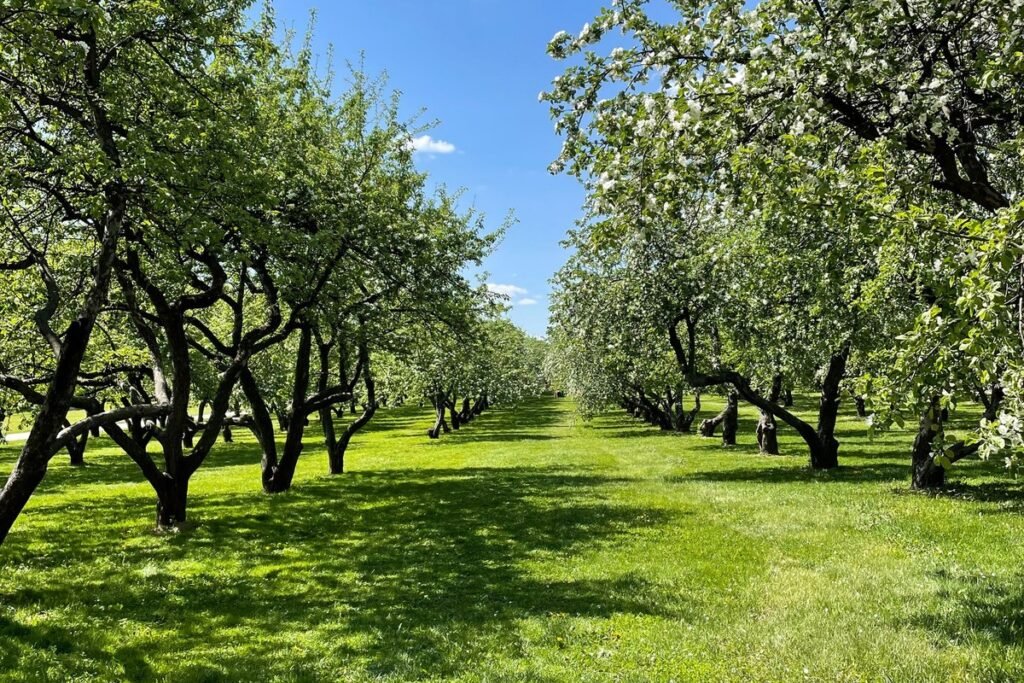
Square vs triangular spacing is a layout choice, not a spacing choice alone. With the same distance between neighbours, the number of plants on one acre changes by about 15 percent, because the rows sit in a different pattern. That matters for an orchard, a shelterbelt or a berry patch.
The Plants per Acre Calculator lets you pick square, rectangular or triangular layout, enter a spacing and a row spacing where needed, and enter your area to get a total for your area.
The three layouts in plain terms
Square layout puts every plant on a square grid. Spacing between plants in a row equals row spacing, so one number describes the whole grid. Rectangular layout keeps straight rows but lets row spacing differ from spacing between plants in the row. Triangular layout offsets every second row by half a space, so each plant sits the same distance from its neighbours, and the rows sit closer together.
All three use the same area method: area per plant is spacing times row spacing, and plants per sq m is 1 divided by area per plant. Multiply plants per sq m by 10,000 for per hectare and by 4,047 for per acre.
Square layout
Square layout is the simplest to mark out, with one spacing in both directions. At 3 m spacing, area per plant is 3 times 3, which is 9 sq m. Plants per sq m is 1 divided by 9, which is 0.1111. Per hectare is 1,111 plants and per acre is 450 plants.
At 10 ft spacing, area per plant is 100 sq ft. Plants per acre is 43,560 divided by 100, which is 435.6, shown as 436.
Rectangular layout
Rectangular layout suits a planting where rows must be wider than the spacing between plants in the row. You enter spacing between plants and a separate row spacing. Plants per sq m is 1 divided by spacing times row spacing. If spacing is 2 m and row spacing is 3 m, area per plant is 6 sq m. Plants per sq m is 1 divided by 6, which is 0.1667. Per hectare is 1,667 plants and per acre is 675 plants.
Wider rows give room for access or machinery between rows while plants sit closer together in the row.
The Plant Spacing Calculator uses the same area method.
Triangular layout
Triangular layout offsets every second row by half a space, so each plant sits the same distance from its neighbours in its own row and in the rows on either side. Row spacing is spacing times 0.866.
At 3 m spacing, row spacing is 3 times 0.866, which is 2.598 m. Area per plant is 3 times 2.598, which is 7.794 sq m. Plants per sq m is 1 divided by 7.794, which is 0.1283. Per hectare is 1,283 plants and per acre is 519 plants. The gain over square layout is 1 divided by 0.866 minus 1, which is 15.47 percent in exact arithmetic, described on the page as about 15 percent.
The page says only that closer spacing raises early yield per area but increases competition, with no yield figure, so this blog gives none either.
Square versus triangular gain
The table below keeps spacing the same and changes layout only:
| Spacing | Square per acre | Triangular per acre | Extra plants | Gain |
|---|---|---|---|---|
| 10 ft | 436 | 503 | 67 | 15.4 percent |
| 12 ft | 303 | 349 | 46 | 15.2 percent |
| 15 ft | 194 | 224 | 30 | 15.5 percent |
| 20 ft | 109 | 126 | 17 | 15.6 percent |
| 3 m | 450 | 519 | 69 | 15.3 percent |
At 10 ft, triangular layout gives 503 plants per acre against 436 in a square layout, or 67 extra plants per acre.
Rectangular spacing at common sizes
Rectangular layout does not pack plants more tightly at the same neighbour distance. It trades density in the row against width between rows. The table below shows five common rectangular spacings:
| Spacing | Row spacing | Plants per hectare | Plants per acre |
|---|---|---|---|
| 2 m | 3 m | 1,667 | 675 |
| 3 m | 4 m | 833 | 337 |
| 2 m | 4 m | 1,250 | 506 |
| 1.5 m | 3 m | 2,222 | 899 |
| 4 m | 5 m | 500 | 202 |
The Plants per Square Foot Calculator gives the same area method at a smaller scale.
Worked choice at 3 m
Hold 3 m fixed as the neighbour distance and compare the three layouts. Square layout at 3 m by 3 m gives 1,111 plants per hectare and 450 plants per acre. Triangular layout at 3 m gives 1,283 plants per hectare and 519 plants per acre. Rectangular layout at 3 m spacing and 4 m row spacing gives 833 plants per hectare and 337 plants per acre.
The gap between the highest and lowest result is 450 plants per hectare, from 833 to 1,283, from layout alone at the same neighbour distance. Per acre, the gap is 182 plants, from 337 to 519.
Before you pick, ask how wide the lane must be, how close plants can sit in the row, and whether density matters more than straight access. If the lane must be wide, choose rectangular layout. If density matters most, choose triangular layout. If you need even access in both directions, choose square layout.
When each layout fits best
Square layout fits best where an even grid helps the work, such as an orchard on a regular grid, with rows straight both ways.
Rectangular layout fits best when rows must be wider than the spacing between plants in the row, often for equipment. A vehicle, a mower, or a sprayer needs a lane of a set width, and row spacing must match that width.
The Garden Bed and Path Layout Calculator uses the same thinking at bed scale.
Triangular layout fits best when every plant should sit the same distance from its neighbours and density matters most, for trees, shrubs, orchard planting, shelterbelt planting and a berry patch. On 10 acres at 10 ft spacing, square layout gives 4,360 plants and triangular layout gives 5,030 plants, a difference of 670 plants.
The costs of triangular layout
Triangular layout is harder to mark out than a square grid. Every second row sits half a space to one side, so the marks do not line up in a simple cross pattern, so check the offset early.
It is also harder to drive straight down a triangular planting. The rows run straight, but plants in the next row sit in the gaps, so a straight run passes close to plants offset beside it. Square layout keeps a clear straight line in both directions, and rectangular layout keeps a clear straight lane between wide rows. Triangular layout trades some of that access for density, so the gain is only worth it where density matters more than straight access.
Paths, headlands and edge effects
The Plants per Acre Calculator excludes paths, headlands and access lanes. Its figure is for the planted area only, so subtract any path, headland or access lane from the area you enter, or the total will be too high.
Edge effects mean small plots hold slightly fewer plants than the area method gives, because a plant near the edge still needs its full share of ground, but part of that share may fall outside the plot.
Ordering extra
The page advises ordering 5 to 10 percent extra to replace losses, for losses only. The calculator gives no seed count, emergence adjustment, plant cost, seed cost, yield figure, fertiliser rate, or replant decision, so this blog gives none either.
Work the allowance with the triangular figure at 10 ft. At 503 plants per acre, 10 acres holds 5,030 plants. Order 5,282 plants at 5 percent extra, because 5,030 times 1.05 is 5,281.5, shown as 5,282. Order 5,533 plants at 10 percent extra, because 5,030 times 1.10 is 5,533.
Common mistakes to avoid
First, do not enter one spacing when the layout needs two. Rectangular layout needs spacing and row spacing, and one number gives a square layout result, not the rectangular result you meant to test.
Second, do not use square row spacing for a triangular sum. Triangular row spacing is spacing times 0.866, not spacing itself. At 3 m, it is 2.598 m, not 3 m.
Third, do not mix units inside one sum. Pick metres or feet at the start, and convert each spacing to that unit first.
Fourth, do not treat the triangular gain as a yield gain on its own. The page says only that closer spacing raises early yield per area but increases competition, with no yield figure. The gain here is a plant count gain, about 15 percent more plants at the same neighbour distance.
Fifth, do not include paths, headlands and access lanes in the area you enter. The calculator excludes them, so enter the planted area only.
How to use your figure
Write down the layout, both spacings, and the unit beside each spacing, every time, with the plants per acre or per hectare beside them. A figure without its layout is easy to misread, because the same spacing gives a different count in each layout. A note that says 3 m triangular, 1,283 per hectare, 519 per acre is clear, while a note that says only 3 m is not.
Check the layout against the work you will do before you order. The Ground Cover Calculator serves a different purpose, and its figure is not a plants per acre figure, so do not carry it into a plan that needs a plants per acre figure.
Frequently Asked Questions
Q: What is square vs triangular spacing?
A: Square grid, where spacing equals row spacing, against triangular layout, where rows are offset by half a space and row spacing is spacing times 0.866. Triangular spacing fits about 15 percent more plants at the same neighbour distance.
Q: How many plants per acre does triangular spacing add at 10 ft?
A: Square layout gives 436 plants per acre and triangular layout gives 503, or 67 extra plants per acre, a gain of 15.4 percent.
Q: When should I choose rectangular spacing?
A: Choose it when rows must be wider than the spacing between plants in the row, for access or machinery.
Q: What is the triangular row spacing formula?
A: Triangular row spacing is spacing times 0.866. At 3 m, row spacing is 2.598 m, giving 1,283 plants per hectare and 519 plants per acre.
Q: Does the Plants per Acre Calculator include paths and headlands?
A: No. The calculator excludes paths, headlands and access lanes, so enter the planted area only. Edge effects mean small plots hold slightly fewer plants.
Q: How many extra plants should I order?
A: Order 5 to 10 percent extra to replace losses. At 503 plants per acre, 10 acres holds 5,030 plants, so order 5,282 plants at 5 percent extra and 5,533 plants at 10 percent extra.
More guides

Head to Head Coverage Explained: Spacing, Corners, Edges and Middle
Head to head coverage means each sprinkler head sprays far enough to reach the head next to it, so the distance between…
Read guide
How Many Sprinkler Heads Do I Need
How many sprinkler heads do I need depends on lawn size and throw radius. A 10 by 6 metre lawn with 4…
Read guide
Sprinkler Calculator: A Worked Guide
A sprinkler calculator gives a head count and a zone count from lawn size and spray distance. For a 10 by 6…
Read guide