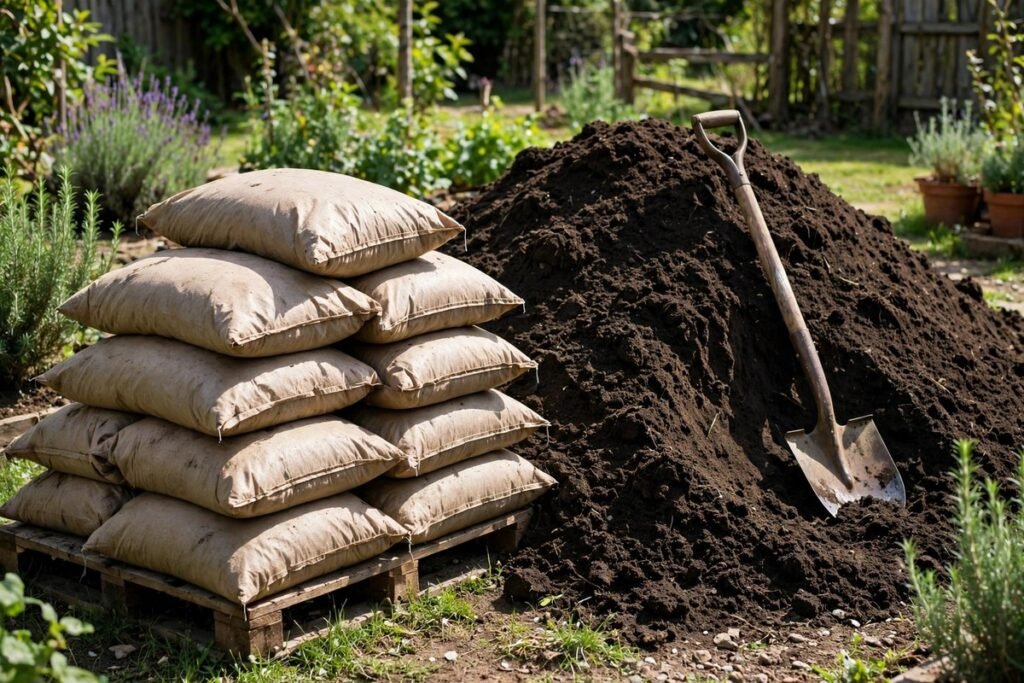
Topsoil Bags vs Bulk: Which Should You Buy?
Buy bags for a small top up and order bulk once the job passes about 1 m3, which is 1.3 cubic yards. Start from volume, turn volume into weight, turn weight into a bag count, then compare a bulk quote per cubic yard with a bag quote per bag for that same volume.
Use the Topsoil Calculator to run your exact area.
The calculation in four steps
Measure the area. Turn area and depth into volume, with extra for settling. Turn volume into weight. Turn weight into bags. Only then compare bags with bulk, because the comparison needs the same volume on both sides.
The formulas are:
area = length x width
volume = area x depth x (1 + settling %)
weight = volume x bulk density
bags = ceil(weight / bag weight)
Ceil means round up to the next whole number. You cannot buy part of a bag, so 11.96 bags means 12 bags.
Step 1: measure the area
Measure length and width in the same unit and multiply them. A lawn 10 m long and 5 m wide covers 50 square metres, because 10 x 5 = 50.
Measure to the edge of the area you plan to cover. If the area is not a single rectangle, split it into rectangles, work out each one, and add the areas together.
Step 2: turn area and depth into volume
Multiply area by depth, using the same unit for both. A depth of 10 cm is 0.10 m. Keep the depth honest, because a small change over a large area adds a large volume.
Add extra for settling. The calculator page says to keep 10 to 20 percent extra for settling. This article uses 15 percent in its worked examples. Multiply the base volume by 1.15. A base volume of 5 m3 becomes 5.75 m3, because 5 x 1.15 = 5.75.
For a new lawn, the depth is 10 to 15 cm, which is 4 to 6 in, from the calculator page and from Penn State Extension. Use the deeper end where the ground underneath is poor. One cubic yard covers about 162 sq ft at 2 in deep, and about 81 sq ft at 4 in deep.
Step 3: turn volume into weight and bags
Weight follows from volume and density. The calculator page gives a typical bulk density of 1.2 to 1.5 t/m3, which is 75 to 95 lb/ft3. This article uses 1.3 t/m3 in its metric examples.
Density varies with moisture, so check bulk density with the supplier, and use the supplier figure if it differs.
Bags follow from weight and bag weight. Divide the total weight by the bag weight, then round up. A total of 299 kg in 25 kg bags gives ceil(299 / 25) = 12 bags, because 299 / 25 = 11.96. A 40 lb bag holds about 0.75 cubic feet. One cubic yard is 27 cubic feet, so 27 / 0.75 = 36 bags per cubic yard.
Step 4: compare bags with bulk for the same volume
Compare both quotes for the volume you just worked out, with the settling extra included.
Write down four numbers from your own suppliers: the bulk quote per cubic yard, the delivery quote if any, the bag quote per bag, and the bag volume or bag weight printed on the bag.
Then work out two totals for the same volume. Bulk total equals volume in cubic yards times the bulk quote per cubic yard, plus the delivery quote if any. Bag total equals bag count times the bag quote per bag. If the bulk supplier quotes by the cubic metre, use that volume in the same way.
The crossover is about 1 m3, which is 1.3 cubic yards, from the calculator page. Below that volume, bags often win on simplicity. Above that volume, bulk often wins, because the bag count grows fast. Your own quotes decide the exact point, so run the two totals.
Worked example 1: a small top up in bags
Area 2 m by 1 m, depth 10 cm, settling 15 percent, density 1.3 t/m3, bags 25 kg each.
Area: 2 x 1 = 2 square metres. Base volume: 2 x 0.10 = 0.20 m3. Volume with settling: 0.20 x 1.15 = 0.23 m3. Weight: 0.23 x 1.3 = 0.299 tonnes, which is 299 kg. Bags: 299 / 25 = 11.96, and ceil(11.96) = 12 bags.
Twelve bags fit in a car boot and open one at a time. A bulk delivery for 0.23 m3 would still need a truck, a drop point and a pile to move.
Worked example 2: a new lawn that suits bulk
Area 10 m by 5 m, depth 10 cm, settling 15 percent, density 1.3 t/m3, bags 25 kg each. This is the worked example from the calculator page.
Area: 10 x 5 = 50 square metres. Base volume: 50 x 0.10 = 5 m3. Volume with settling: 5 x 1.15 = 5.75 m3. Weight: 5.75 x 1.3 = 7.475 tonnes, about 7.5 tonnes. Bags: 7475 / 25 = 299 bags.
Two hundred and ninety nine bags means 299 bags to load, carry, open and spread. A bulk delivery drops 5.75 m3 in one pile, moved with a wheelbarrow and a rake.
Worked example 3: one cubic yard in bags
One cubic yard is 27 cubic feet. A 40 lb bag holds about 0.75 cubic feet. Bags per cubic yard: 27 / 0.75 = 36 bags.
Weight for one cubic yard is about 2,000 to 2,700 lb, depending on moisture. Coverage is about 162 sq ft at 2 in deep, and about 81 sq ft at 4 in deep.
Bags vs bulk at a glance
| Volume with settling | Bags of 25 kg | Bulk order | Handling |
|---|---|---|---|
| 0.23 m3 | 12 bags | Small bulk load | Carry by hand |
| 1.15 m3 | 60 bags | About 1.5 cubic yards | Wheelbarrow from a pile |
| 5.75 m3 | 299 bags | 5.75 m3 bulk | Wheelbarrow from a large pile |
The middle row shows the crossover. A volume of 1 m3 becomes 1.15 m3 with 15 percent extra. Weight is 1.15 x 1.3 = 1.495 tonnes, which is 1495 kg. Bags are 1495 / 25 = 59.8, and ceil(59.8) = 60 bags.
When bags win and when bulk wins
Bags win for a small top up, for a patch repair, for a bed that a truck cannot reach, and for a job where you want to work in stages. Bags let you buy the exact count and stop when the area is level, and they suit a site with no place to drop a pile.
Bulk wins once the volume passes about 1 m3, which is 1.3 cubic yards, for a new lawn, for levelling a large area, and for any job where the bag count passes 60 bags. Bulk needs clear access for a truck and a clear place to drop the pile. Cover the pile if rain is forecast, and move it promptly.
Quality and access checks before you order
Ask for screened topsoil free of weed roots and debris. Look at the soil if you can. It should be dark, crumbly and free of large stones, roots and rubble. Ask for the bulk density, because density changes the weight.
Check truck access before you order bulk. A truck needs a clear route and a drop point that is level and firm. If the truck cannot reach the bed, bags may be your only option.
Prepare the ground before the soil arrives. Penn State Extension says to measure the area and test the soil. The RHS says to dig or rotovate the soil to a depth of 20 to 25 cm, which is 8 to 10 in, and to leave the ground to settle for at least a few days.
Common mistakes in a bags vs bulk decision
Ordering to the base volume with no settling extra. Fresh topsoil settles when watered. Order with 10 to 20 percent extra.
Comparing different volumes. A bag total for 12 bags cannot be compared with a bulk total for 5.75 m3. Work out one volume, then work out both totals for that volume.
Using bag weight to work out volume. A 40 lb bag is a weight, not a volume. Use the volume printed on the bag, about 0.75 cubic feet.
Rounding the bag count down. A result of 11.96 bags means 12 bags, not 11, because 11 bags give only 275 kg. Always round up.
Ordering bulk with no place to drop it. A bulk pile needs a clear, firm drop point. If there is no drop point, bags are the practical choice.
Frequently asked questions
Q: How many bags of topsoil do I need?
A: Work out area times depth, add 10 to 20 percent for settling, multiply by density, then divide by bag weight and round up. A 2 by 1 m area at 10 cm deep needs 12 bags of 25 kg.
Q: How many 40 lb bags of topsoil are in a cubic yard?
A: About 36 bags. One cubic yard is 27 cubic feet, and a 40 lb bag holds about 0.75 cubic feet, so 27 divided by 0.75 equals 36 bags.
Q: How much does a cubic yard of topsoil weigh?
A: About 2,000 to 2,700 lb, depending on moisture.
Q: Is bulk topsoil better than bagged topsoil?
A: Bulk suits large jobs and bags suit small jobs. The crossover is about 1 m3, which is 1.3 cubic yards. Above that volume, bulk avoids a large bag count, such as 299 bags for a 10 by 5 m lawn at 10 cm deep.
Q: How do I compare a bulk quote with a bag quote?
A: Use the same volume for both. Bulk total equals volume times the bulk quote per cubic yard, plus delivery if any. Bag total equals bag count times the bag quote per bag. Fill in your own supplier quotes.
Q: What depth of topsoil do I need for a new lawn?
A: The calculator page gives 10 to 15 cm, which is 4 to 6 in, for a new lawn. Penn State Extension gives the same range at firmed or settled depth. Use the deeper end where the ground underneath is poor.
Run your exact area through the Topsoil Calculator. For more guides, browse the garden guides.
More guides

How Many Zones Does My Supply Need
If you are asking how many zones does my supply need, the answer comes from two numbers. Add up the flow of…
Read guide
Head to Head Coverage Explained: Spacing, Corners, Edges and Middle
Head to head coverage means each sprinkler head sprays far enough to reach the head next to it, so the distance between…
Read guide
How Many Sprinkler Heads Do I Need
How many sprinkler heads do I need depends on lawn size and throw radius. A 10 by 6 metre lawn with 4…
Read guide