Total dynamic head drip irrigation is the total resistance a pump works against, stated in metres or feet of water. It adds three parts: lift, pressure head and friction. If you know those three parts, you can read a pump curve with confidence and pick a pump that gives your zone flow at your head.
Total dynamic head drip irrigation in three parts
Total dynamic head is one number built from three jobs. First, the pump must lift water from the water surface to the highest emitter. Second, it must give the drip line the pressure the emitters need. Third, it must push water through the supply pipe, and that push is lost to friction. The formula is total head equals lift plus pressure head plus friction.
Pressure head equals pressure times 10.2, in metres per bar. Friction equals pipe length times loss percent. Power equals 9.81 times flow in litres per second times head in metres divided by efficiency. Each part behaves in its own way, and a small change in one part can move the total by several metres.
The Drip Irrigation Pump Calculator uses the same three parts. Enter flow, pressure, lift, and pipe length with a friction allowance. The result is the head and power to look for on a pump curve.
Lift: the height part
Lift is the vertical distance from the water surface to the highest emitter. One metre of lift adds one metre of head, no more and no less. If the highest emitter sits 3 metres above the water surface, lift adds 3 metres to total head. If it sits 5 metres above, lift adds 5 metres.
The table below holds pressure at 1 bar and friction at 2.5 metres, and varies lift only.
| Lift in metres | Pressure head in metres | Friction in metres | Total head in metres |
|---|---|---|---|
| 0 | 10.2 | 2.5 | 12.7 |
| 1 | 10.2 | 2.5 | 13.7 |
| 2 | 10.2 | 2.5 | 14.7 |
| 3 | 10.2 | 2.5 | 15.7 |
| 5 | 10.2 | 2.5 | 17.7 |
Measure lift from the water surface, not from the ground beside the tank. Gravity gives only about 0.1 bar per metre of height, which is about 1.4 psi per metre. A rain barrel 3 metres above the emitters gives only about 0.3 bar.
Pressure head: the emitter pressure part
Pressure head turns emitter pressure into metres of head, so it can be added to lift and friction. Multiply pressure in bar by 10.2. At 1 bar, pressure head is 10.2 metres. At 0.5 bar, it is 5.1 metres. At 2 bar, it is 20.4 metres. Pressure is often the largest part of total head.
The table below holds lift at 3 metres and friction at 2.5 metres, and varies pressure only.
| Pressure in bar | Pressure head in metres | Lift plus friction in metres | Total head in metres |
|---|---|---|---|
| 0.5 | 5.1 | 5.5 | 10.6 |
| 1 | 10.2 | 5.5 | 15.7 |
| 1.5 | 15.3 | 5.5 | 20.8 |
| 2 | 20.4 | 5.5 | 25.9 |
A rise from 1 bar to 1.5 bar adds 5.1 metres to total head. A rise from 1 bar to 2 bar adds 10.2 metres. Enter the pressure the drip line needs, not a guess. Too high a figure gives a larger pump than needed. Too low a figure may leave emitters short of pressure.
Flow sits beside pressure head. The calculator asks for the flow of the largest zone first, because the pump must give that flow at the total head. The Drip Flow Rate Calculator can help you work out zone flow before you start on head.
Friction: the pipe allowance part
Friction is the head lost as water moves through the supply pipe. The calculator treats it as an allowance: friction equals pipe length times loss percent. At 5 percent loss, 50 metres of pipe gives 2.5 metres of friction. At the same loss, 100 metres gives 5.0 metres.
The table below holds lift at 3 metres and pressure head at 10.2 metres, and varies pipe length at 5 percent loss.
| Pipe length in metres | Loss percent | Friction in metres | Total head in metres |
|---|---|---|---|
| 25 | 5 | 1.25 | 14.45 |
| 50 | 5 | 2.5 | 15.7 |
| 75 | 5 | 3.75 | 16.95 |
| 100 | 5 | 5.0 | 18.2 |
Double the pipe length and friction doubles. Add a long run to a far bed and total head rises by the extra friction, even if lift and pressure stay the same.
Friction is the part with the most uncertainty. It is an allowance, and small pipes and many fittings add more. The calculator gives no pipe diameter friction table, so this article gives none either. The Drip Emitter Calculator can help plan the emitter side of the layout.
A combined worked example
The worked example is 600 litres per hour at 1 bar, with 3 metres of lift and 50 metres of pipe at 5 percent loss. Pressure head is 1 times 10.2, which is 10.2 metres. Friction is 50 times 5 percent, which is 2.5 metres. Total head is 3 plus 10.2 plus 2.5, which is 15.7 metres.
The table below shows each part, its value and its share of the total.
| Part | Value in metres | Share of total head |
|---|---|---|
| Lift | 3 | 19.1 percent |
| Pressure head | 10.2 | 65.0 percent |
| Friction | 2.5 | 15.9 percent |
| Total head | 15.7 | 100.0 percent |
Pressure head is the largest part here, at 65.0 percent. Lift is 19.1 percent and friction is 15.9 percent. That split will change in other gardens. A high bed will raise the lift share. A long run will raise the friction share. A low pressure kit will cut the pressure head share.
Power follows from the same example. Flow is 600 divided by 3600, which is 0.1667 litres per second. Power is 9.81 times 0.1667 times 15.7 divided by 0.50, which is 51.3 watts, stated as about 51 watts at 50 percent efficiency. That 50 percent figure is used only in this example. The calculator gives no default efficiency figure.
The page gives the pump choice as at least 720 litres per hour at 19 metres. That is about 20 percent more flow and about 20 percent more head than the worked example, since 15.7 times 1.2 is 18.84 metres, rounded to 19 metres.
Total dynamic head in feet and psi
The metric example above is the worked example on the calculator page. The imperial side is kept separate here, and every figure below is a rounded equivalent, not an exact conversion. The page gives 1 bar as about 33.5 feet of head, 1 psi as 2.31 feet of head, and gravity as about 0.1 bar per metre, which is about 1.4 psi per metre, or 3.3 feet per metre.
The table below gives rounded equivalents in feet, using 33.5 feet per bar and 2.31 feet per psi.
| Pressure value | Rounded equivalent in feet of head |
|---|---|
| 0.5 bar | 16.75 |
| 1 bar | 33.5 |
| 1.5 bar | 50.25 |
| 2 bar | 67.0 |
| 10 psi | 23.1 |
| 15 psi | 34.65 |
| 20 psi | 46.2 |
To convert psi to feet of head, multiply psi by 2.31. A pressure of 10 psi gives 23.1 feet of head. A pressure of 20 psi gives 46.2 feet of head. The step is steep, just as it is in metres.
One metre of height is 3.3 feet, so 3 metres of lift is 9.9 feet. Gravity from that height gives about 0.3 bar, which is about 4.2 psi. Work the total in one unit set, then use these factors only to read a gauge or curve stated in the other unit set.
Why total head is not maximum head
A pump curve shows the flow a pump gives at each head, and the curve falls as head rises. Maximum head is the head at which flow falls to zero. It is the top of the curve, not a working point. Total dynamic head is the working point: the head at which you need your zone flow.
The page states the limit in plain terms: always check flow at your head, not the maximum head. A pump with a maximum head of 30 metres may give only a small flow at 19 metres.
In the worked example, check the curve at 19 metres and look for at least 720 litres per hour. If the curve gives that flow at that head, the pump fits. If it gives that flow only at a lower head, it does not fit, whatever its maximum head says.
How to use your total head number
Start with the three parts in order. Measure lift from the water surface to the highest emitter. Multiply pressure in bar by 10.2 to get pressure head. Multiply pipe length by loss percent to get friction. Add the three parts. That sum is your total dynamic head.
Check the result against the garden. If the highest emitter is higher than first measured, lift rises. If the supply run is longer, friction rises. If the line needs more pressure, pressure head rises by 10.2 metres for each extra bar. Each part can be rechecked on its own. Wells need a pump rated for the water depth below ground.
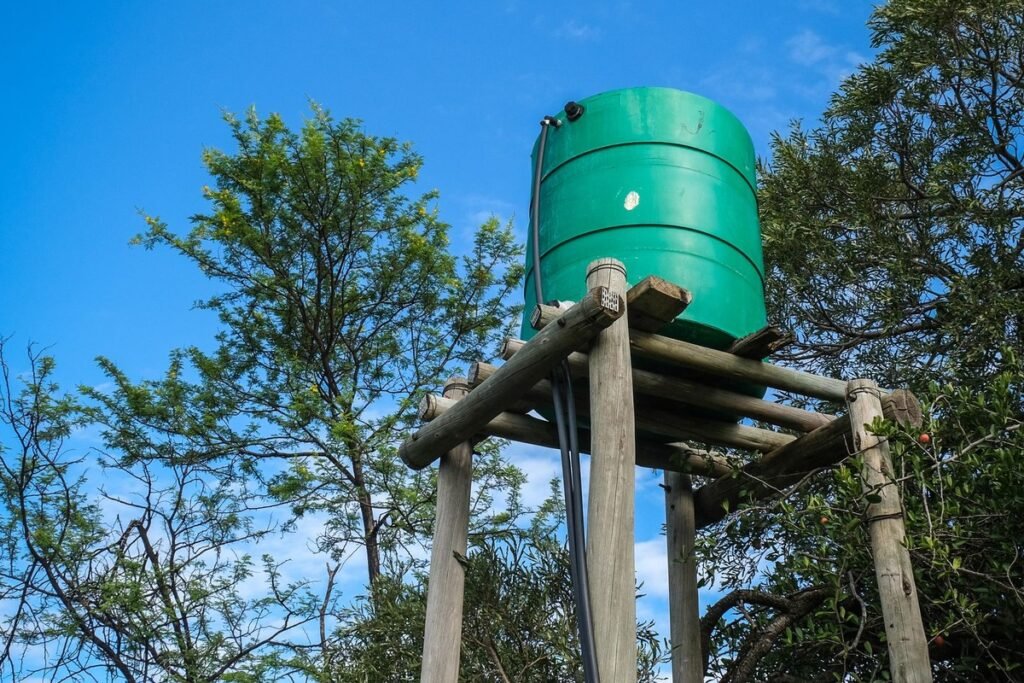
A rain barrel is a good test. Measure height from the barrel water surface to the highest emitter, and multiply by 0.1 bar per metre. A barrel 1 metre above the emitters gives about 0.1 bar, far below the 1 bar in the worked example. The Rain Barrel Calculator can help plan the barrel side.
Frequently asked questions
Q: What is total dynamic head drip irrigation?
A: Total dynamic head drip irrigation is the total resistance a pump works against, stated in metres or feet of water. It is lift plus pressure head plus friction. Lift is the height from the water surface to the highest emitter. Pressure head is emitter pressure stated in metres of head. Friction is the head lost in the supply pipe.
Q: How do I work out total dynamic head for drip irrigation?
A: Add lift plus pressure head plus friction. Pressure head is pressure in bar times 10.2. Friction is pipe length times loss percent. In the worked example, 600 litres per hour at 1 bar, with 3 metres of lift and 50 metres of pipe at 5 percent loss, gives 10.2 metres of pressure head plus 2.5 metres of friction plus 3 metres of lift, which is 15.7 metres of total head.
Q: How do I convert psi to feet of head?
A: Multiply psi by 2.31 to get feet of water. A pressure of 10 psi gives 23.1 feet of head. A pressure of 20 psi gives 46.2 feet of head. The page also gives 1 bar as about 33.5 feet of head, so 1 bar gives about 33.5 feet and 2 bar gives about 67.0 feet.
Q: Can a rain barrel run drip irrigation without a pump?
A: Gravity gives only about 0.1 bar per metre of height, which is about 1.4 psi per metre. A barrel 3 metres above the emitters gives only about 0.3 bar. That is why the page says to use low pressure drip kits or a small pump with a rain barrel, rather than expecting gravity alone to run a standard drip line.
Q: Why should I not use maximum head to pick a pump?
A: Maximum head is the head at which flow falls to zero. It is not a working point. Always check flow at your head on the pump curve. A pump can have a high maximum head and still give too little flow at your total head, so the curve at your head is the only check that counts.
More guides
Hargreaves vs Penman Monteith: When the Simple Estimate Is Enough
Hargreaves vs penman monteith is a choice between a simple estimate from temperature alone and a fuller calculation from complete weather data.…
Read guide
Daily ET0 vs Monthly Average ET0: Planning vs Scheduling
Daily ET0 vs monthly ET0 is a choice between one day and a month. Use a monthly average to plan a season,…
Read guide
How Latitude and Date Change Your ET0
Latitude and ET0 are linked through Ra, the extraterrestrial radiation that reaches the top of the atmosphere. When latitude or date changes,…
Read guide