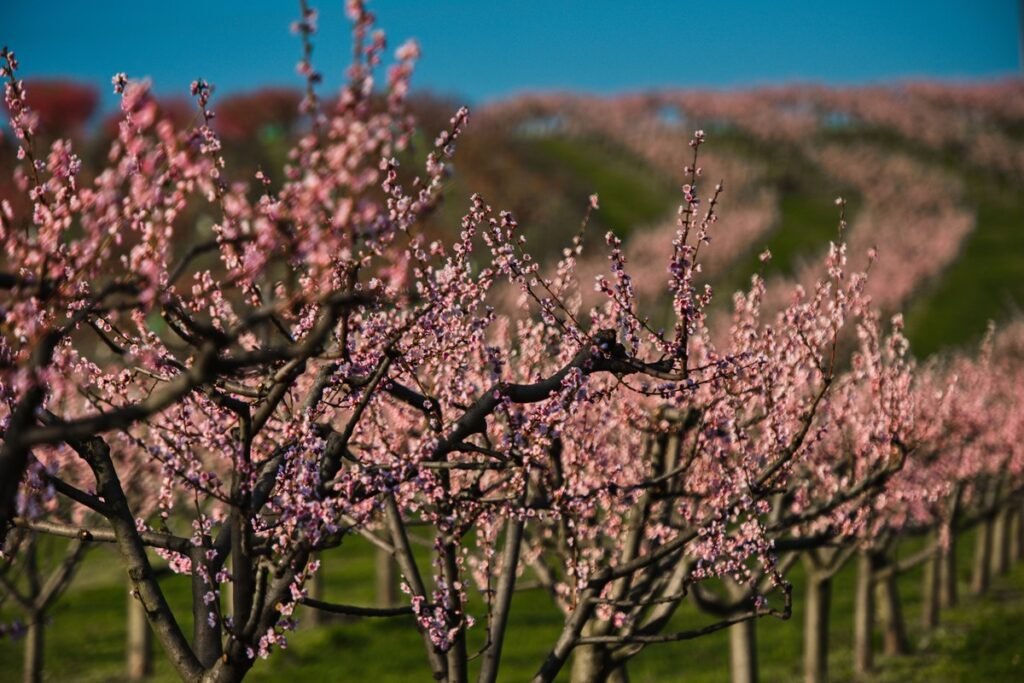
Triangular spacing plants per acre is the count you get when rows are offset so every plant stands the same distance from its neighbours. It is a layout choice on the Plants per Acre Calculator, and it fits about 15 percent more plants than square spacing at the same distance between neighbours. This blog explains the 0.866 factor, works the 3 m example in full, gives metric and imperial tables, and works field totals for ordering.
What triangular spacing is
Triangular spacing is an offset row layout. Start a row at your chosen spacing, then start the next row half a space along, so each plant in the second row stands between two plants in the first row. Three close plants form an equilateral triangle, with each side equal to the spacing, and that shape gives the 0.866 factor. At 3 m, rows stand 2.598 m apart, not 3 m apart, and that shorter row distance is where the extra plants come from.
Where the 0.866 factor comes from
The 0.866 factor is the height of an equilateral triangle as a share of its side. Drop a line from the top corner straight down to the middle of the base, and that line is the row spacing. For a triangle with side 1 it is 0.866, so at 3 m it is 2.598 m and at 10 ft it is 8.66 ft. The factor stays the same at every spacing. Triangular row spacing equals spacing times 0.866. Plants per sq m equals 1 divided by spacing times row spacing. Per hectare equals plants per sq m times 10,000, and per acre equals plants per sq m times 4,047. Divide 1 by 0.866 and you get 1.1547, a gain of 15.47 percent, which the page states as about 15 percent.
The worked example: triangular spacing at 3 m
First, row spacing is 3 times 0.866, which is 2.598 m. Second, area per plant is 3 times 2.598, which is 7.794 sq m, against 9 sq m in a square layout. Third, plants per sq m is 1 divided by 7.794, which is 0.1283. Fourth, plants per hectare is 0.1283 times 10,000, which is 1,283. Fifth, plants per acre is 0.1283 times 4,047, which is 519. 1,283 divided by 2.47105 acres per hectare is also 519.
Square spacing at the same 3 m gives 9 sq m per plant, 0.1111 plants per sq m, 1,111 per hectare and 450 per acre. Triangular spacing gives 1,283 against 1,111 per hectare and 519 against 450 per acre, gains of 172 and 69. The gain is 15.3 percent here, close to the exact 15.47 percent, with the small difference coming from whole plant rounding.
Triangular spacing at metric spacings
Density falls fast as spacing grows. Doubling spacing from 2 m to 4 m cuts the count to about a quarter.
| Spacing | Row spacing | Plants per sq m | Plants per hectare | Plants per acre |
|---|---|---|---|---|
| 1 m | 0.866 m | 1.1547 | 11,547 | 4,673 |
| 2 m | 1.732 m | 0.2887 | 2,887 | 1,168 |
| 3 m | 2.598 m | 0.1283 | 1,283 | 519 |
| 4 m | 3.464 m | 0.0722 | 722 | 292 |
| 5 m | 4.330 m | 0.0462 | 462 | 187 |
At 1 m the density is 1.1547 plants per sq m, which is 11,547 per hectare and 4,673 per acre, a tight spacing for shrubs and a dense berry patch. At 5 m it is 0.0462 plants per sq m, which is 462 per hectare and 187 per acre, for orchard trees. The Plant Spacing Calculator uses the same area method for a single spacing, and the Plants per Square Foot Calculator gives the same kind of density for a small bed in square feet.
Triangular spacing at imperial spacings
One acre equals 43,560 sq ft. Plants per acre equals 43,560 divided by spacing times row spacing, both in feet. At 10 ft, row spacing is 8.66 ft, area per plant is 86.6 sq ft, and plants per acre is 43,560 divided by 86.6, which is 503. At 12 ft the same method gives 349, at 15 ft 224, and at 20 ft 126, from row spacings of 10.39 ft, 12.99 ft and 17.32 ft and areas per plant of 124.68 sq ft, 194.85 sq ft and 346.4 sq ft.
Square against triangular: the gain at the same spacing
The gain is about 15 percent at every spacing, because it comes from the 0.866 factor alone.
| Spacing | Square per acre | Triangular per acre | Extra plants | Gain |
|---|---|---|---|---|
| 10 ft | 436 | 503 | 67 | 15.4 percent |
| 12 ft | 303 | 349 | 46 | 15.2 percent |
| 15 ft | 194 | 224 | 30 | 15.5 percent |
| 20 ft | 109 | 126 | 17 | 15.6 percent |
| 3 m | 450 | 519 | 69 | 15.3 percent |
The exact gain is 1 divided by 0.866 minus 1, which is 15.47 percent. The table rows sit between 15.2 percent and 15.6 percent because whole plant rounding moves each row a little. At 10 ft, 67 extra plants per acre is a real number of trees to buy, plant and tend, so multiply the per acre gain by your area before you decide.
Field totals and ordering extra
Multiply a per acre figure by your area to get a field total. The page advises ordering 5 to 10 percent extra to replace plants that fail after planting.
At 10 ft triangular spacing the density is 503 plants per acre, so 10 acres holds 5,030 plants. With 5 percent extra that is 5,282 plants, and with 10 percent extra it is 5,533 plants. At 3 m triangular spacing the density is 1,283 plants per hectare, so 1 hectare holds 1,283 plants. With 5 percent extra that is 1,347 plants, and with 10 percent extra it is 1,411 plants. The Garden Area Calculator helps you measure the area to multiply, and the Ground Cover Calculator uses the same area method for low planting.
When triangular spacing fits, and when it does not
Triangular spacing fits when every plant needs the same neighbour distance and no machine must pass straight down every row. It fits an orchard, a shelterbelt or a berry patch. It does not fit row crops with tractor passes, or rectangular beds where straight rows matter more than density.
Ask two questions before you choose. Will a machine need a straight pass down every row. If yes, keep square or rectangular rows. Will the plants stay in place for years with no regular pass between rows. If yes, triangular spacing is worth marking out. Marking out takes more care, because each row is offset by half a space. Set a straight base line, mark the first row, mark the second row from the gaps in the first row, and check the row spacing with a tape before the third row.
What the calculator assumes, and what it does not give
The calculator assumes even spacing across a clean area. It gives plants per acre or per hectare and a total for your area, from one spacing and a layout choice of square, rectangular or triangular. It excludes paths, headlands and access lanes, so subtract them from your area before you multiply. Triangular spacing belongs to this calculator, not to the Plant Population Calculator, which offers no triangular layout and works from two spacings for row crops, with seeds to sow from an entered emergence figure. The calculator gives no seed weight, bag count, plant cost, seed cost, yield figure, fertiliser rate, or replant decision. Closer spacing raises early yield per area but increases competition between plants, as the page states.
Common mistakes to avoid
First, do not use the spacing as the row spacing. Row spacing is spacing times 0.866, so at 3 m it is 2.598 m, not 3 m. Using 3 m as row spacing gives the square count of 1,111 per hectare, not 1,283. Second, do not mix metres and feet inside one sum. A 3 m spacing is 9.84 ft, not 10 ft. Third, do not mix per hectare and per acre figures. At 3 m triangular spacing they are 1,283 per hectare and 519 per acre. Fourth, do not add paths, headlands and access lanes to the planted area. Fifth, do not treat the ordering allowance as a seed or emergence figure. Sixth, do not round too early. Work with 0.1283 plants per sq m and 2.598 m row spacing, and round only at the end.
How to use your figure when you plan a planting
Write down the spacing, the layout, the row spacing, and the per acre or per hectare figure together, with the unit beside each number.
Order the base total first, then add the ordering allowance as a separate line. For 10 acres at 10 ft triangular spacing, that is 5,030 plants plus 252 extra at 5 percent, or 503 extra at 10 percent. For 1 hectare at 3 m triangular spacing, that is 1,283 plants plus 64 extra at 5 percent, or 128 extra at 10 percent.
Frequently Asked Questions
Q: What is triangular spacing plants per acre?
A: It is the number of plants on one acre when rows are offset by half a space so every plant stands the same distance from its neighbours. At 10 ft triangular spacing it is 503 plants per acre, against 436 in a square layout.
Q: What is the 0.866 factor in triangular spacing?
A: It is the height of an equilateral triangle as a share of its side. Triangular row spacing equals spacing times 0.866, so at 3 m row spacing is 2.598 m and at 10 ft it is 8.66 ft.
Q: How many plants per acre at 3 m triangular spacing?
A: At 3 m triangular spacing, plants per sq m is 1 divided by 7.794, which is 0.1283. That is 1,283 plants per hectare and 519 plants per acre, against 1,111 and 450 in a square layout.
Q: How much more does triangular spacing fit than square spacing?
A: About 15 percent more at the same spacing. The exact gain is 1 divided by 0.866 minus 1, which is 15.47 percent, so the page states it as about 15 percent. At 10 ft the gain is 67 extra plants per acre.
Q: When should I use triangular spacing?
A: Use it for trees, shrubs, an orchard, a shelterbelt or a berry patch, where every plant needs the same neighbour distance and no machine must pass straight down every row. Avoid it for row crops with tractor passes and rectangular beds where straight rows matter more than density.
Q: What does the Plants per Acre Calculator give?
A: It gives plants per acre or per hectare and a total for your area, from one spacing and a layout choice of square, rectangular or triangular. It excludes paths, headlands and access lanes, and gives no seed weight, bag count, plant cost, seed cost, yield figure, fertiliser rate, emergence figure, seeds to sow, or replant decision.
More guides

Head to Head Coverage Explained: Spacing, Corners, Edges and Middle
Head to head coverage means each sprinkler head sprays far enough to reach the head next to it, so the distance between…
Read guide
How Many Sprinkler Heads Do I Need
How many sprinkler heads do I need depends on lawn size and throw radius. A 10 by 6 metre lawn with 4…
Read guide
Sprinkler Calculator: A Worked Guide
A sprinkler calculator gives a head count and a zone count from lawn size and spray distance. For a 10 by 6…
Read guide