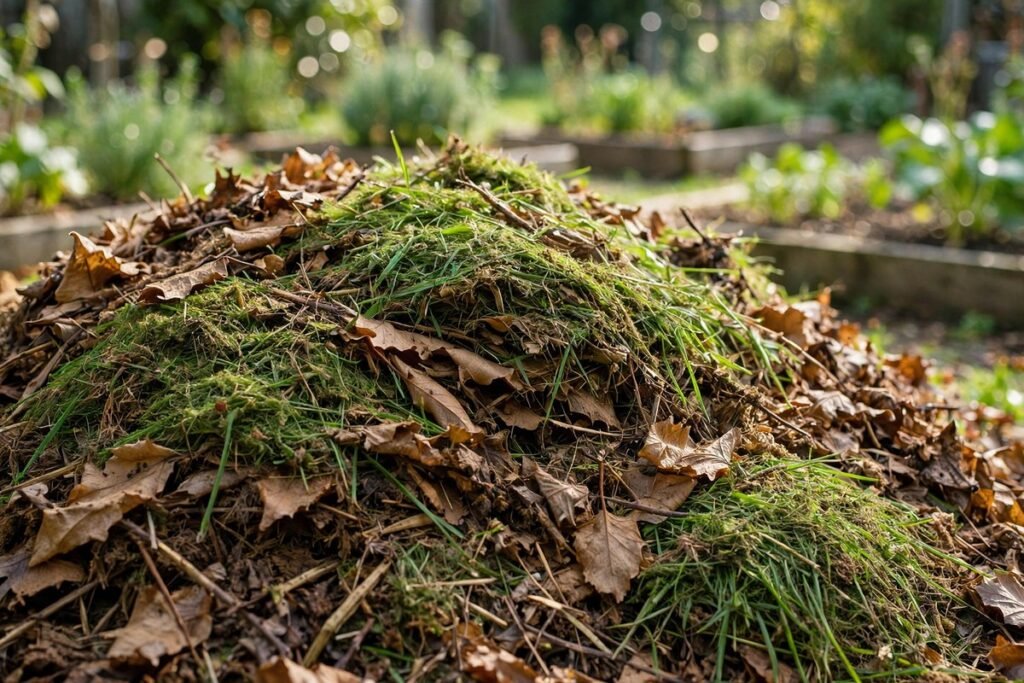
what is the best c:n ratio for compost? About 25 to 30 to 1, or 25 to 30 parts carbon for every 1 part nitrogen by weight. That balance feeds microbes carbon for energy and nitrogen for growth, so a heap heats, breaks down fast, and stays free of ammonia smell when moisture and air are also right.
That short answer only helps if you know what the number means in a real heap. A ratio measures the whole mix, not one material.
What C:N Means in Plain Language
C:N stands for carbon to nitrogen. It is written as a number to 1, so 30 to 1 means 30 parts carbon for every 1 part nitrogen by weight. Carbon is the energy source for microbes. Nitrogen is a building block for their cells, needed for the proteins and enzymes that drive growth.
A mix has a C:N value too. Add up all the carbon, add up all the nitrogen, then divide total carbon by total nitrogen. Greens are moist nitrogen rich materials such as grass and food scraps. Browns are dry carbon rich materials such as leaves, straw and cardboard.
Why 25 to 30 to 1 Works
Microbes need far more carbon than nitrogen, because they burn carbon for energy and use only part of it to build new cells. At about 25 to 30 to 1, the supply matches that need, so microbes multiply fast and the heap heats. Cornell Composting puts the ideal ratio at generally around 30 to 1 by weight.
A single fixed number is too narrow, because real materials vary. As composting proceeds, the ratio falls to 10 to 15 to 1 for finished compost.
Use the Calculator Before You Mix
Use the Compost C:N Ratio Calculator before you build a new heap or fix an old one. Choose a green and a brown material, enter how much of each you have, and the calculator gives the C:N ratio of the mix and how much brown material balances your greens.
Most heaps are mixed by volume in practice, and the calculator works by weight. A bucket of fresh grass and a bucket of dry leaves do not weigh the same. Weigh one test batch and use that result as your guide. For a full compost plan, use the Compost Calculator alongside it.
The Formulas Behind the Calculator
The calculator uses three formulas, as printed on the calculator page. First, nitrogen in each material equals weight times 1 minus moisture times N percent. Second, carbon in each material equals nitrogen times that material C:N value. Third, mix C:N equals total carbon divided by total nitrogen.
Typical moisture and nitrogen contents are built in. A wet kilogram of grass holds far less dry matter than a kilogram of dry leaves, so the calculator adjusts for water first. You cannot average two C:N values, because each material brings a different amount of nitrogen to the total.
The Grass and Leaves Worked Example
The site worked example uses fresh grass clippings and dry autumn leaves. Twenty kg of fresh grass clippings mixed with 6 kg of dry autumn leaves gives a C:N of about 31 to 1, well balanced for a hot heap. On their own, 20 kg of clippings need about 5.5 kg of dry leaves to reach 30 to 1.
Read that example carefully. It gives the C:N of the mix, not the C:N of grass on its own and not the C:N of leaves on their own. The 31 to 1 result belongs to the 20 kg plus 6 kg combination.
What the Cornell Table Shows
The calculator page does not list individual material C:N values, moisture percentages or N percentages, so this blog does not invent them. The table below comes from Cornell Waste Management Institute, Cornell Composting. The figures are Cornell figures, not calculator figures, ranges not fixed values, from Dickson, Richard and Kozlowski, 1991.
| Material | Type | C:N range from Cornell |
|---|---|---|
| Autumn leaves | Brown | 30 to 80 to 1 |
| Straw | Brown | 40 to 100 to 1 |
| Wood chips or sawdust | Brown | 100 to 500 to 1 |
| Newspaper or corrugated cardboard | Brown | 560 to 1 |
| Vegetable scraps | Green | 15 to 20 to 1 |
| Grass clippings | Green | 15 to 25 to 1 |
| Manure | Green | 5 to 25 to 1 |
The wide ranges are the point. Autumn leaves can sit at 30 to 80 to 1, straw at 40 to 100 to 1, and wood chips or sawdust at 100 to 500 to 1. Those browns are not interchangeable. Not all carbon is equally available, as lignin and particle size change how much microbes can use.
Too Much Nitrogen: Smell and Lost Nitrogen
When a heap has too much nitrogen, the ratio falls below the target range. Microbes have more nitrogen than they can use, because there is not enough carbon to pair with it. The extra nitrogen escapes as ammonia gas, which gives the sharp smell most gardeners notice first. Nitrogen lost as ammonia will not be in the finished compost. The heap often turns wet and dense too, because nitrogen rich materials hold water and pack down. The fix is to add browns and mix them through. Dry leaves, straw and shredded cardboard add carbon and open up the heap so air can move. Add them in layers, turn the heap, and check the smell again after a day or two. Do not add lime, sulfur or fertiliser. No rate is given here.
| Ratio position | What happens | What to do |
|---|---|---|
| In the target range | Heap heats, breaks down fast, smells earthy | Keep moisture and air right |
| Below the target range | Extra nitrogen escapes as ammonia, heap smells sharp, nitrogen is lost | Add browns, mix through, turn the heap |
| Above the target range | Microbes run short of nitrogen, heap stays cool, breakdown is slow | Add greens, add water if dry, turn the heap |
Too Much Carbon: A Heap That Sits Still
When a heap has too much carbon, the ratio rises above the target range. Microbes run short of nitrogen, so they cannot multiply fast enough to break down the carbon in front of them. Cornell Composting states that higher ratios mean there is not sufficient nitrogen for optimal growth, so the compost stays cool and slow.
A leaf only heap is the clearest case. Dry leaves alone have a high C:N ratio and very little nitrogen, so the heap will break down in time as leaf mould, but it will not heat. The fix is to add greens and water if the heap is dry. Fresh grass clippings and food scraps bring nitrogen and moisture together. Add them in layers, water if dry, and turn.
Weight, Volume, Moisture and Shredding
Three facts sit behind every C:N calculation. First, most heaps are mixed by volume in practice, while the calculator works by weight. A bucket of dry leaves looks like a lot but weighs little. Second, moisture changes the dry matter in every kilogram. In the heap, aim for damp, not dripping. Third, fine shredding speeds up decomposition whatever the ratio. It does not change the C:N ratio.
A Simple Way to Build a Mix
Start with the materials you have. Weigh the greens first, because they set the nitrogen in the mix. Enter that weight in the Compost C:N Ratio Calculator with a brown you have on hand, weigh the brown amount it asks for, and build the heap in thin layers, green then brown. A heap that smells sharp needs more browns. A heap that stays cool and still needs more greens and water. For wider guidance, see the Guides on this site.
Common Mistakes to Avoid
- Averaging two C:N values. Add total carbon and total nitrogen separately, then divide.
- Treating the example as the C:N of grass alone or leaves alone. The 31 to 1 result belongs to the mix only.
- Mixing by volume and assuming the ratio follows. A bucket of leaves and a bucket of grass do not weigh the same.
- Building a leaf only heap and expecting it to heat. Leaves alone are carbon heavy, so the heap will sit still without greens.
- Adding fresh grass in one thick layer. Grass packs down and turns slimy, so layer it thinly.
- Ignoring an ammonia smell. It means nitrogen is being lost as gas, so add browns and turn.
- Adding water to a heap that is already wet and dense. Water helps a dry carbon heavy heap, but it makes a wet nitrogen heavy heap worse.
- Using a material table as a lab result for your own garden. Tables give wide ranges.
Frequently Asked Questions
Q: What is the best C:N ratio for compost?
A: About 25 to 30 to 1, or 25 to 30 parts carbon for every 1 part nitrogen by weight. That range gives microbes enough carbon for energy and enough nitrogen for growth.
Q: How do I calculate the C:N ratio of my compost mix?
A: Add up all the carbon, add up all the nitrogen, then divide total carbon by total nitrogen. Nitrogen equals weight times 1 minus moisture times N percent, and carbon equals nitrogen times that material C:N value.
Q: What happens if my compost has too much nitrogen?
A: The ratio falls below the target range, extra nitrogen escapes as ammonia gas, the heap smells sharp, and nitrogen is lost. Add browns, mix them through, and turn the heap.
Q: What happens if my compost has too much carbon?
A: The ratio rises above the target range, microbes run short of nitrogen, the heap stays cool, and breakdown is slow. Add greens, add water if dry, and turn the heap.
Q: Does the grass and leaves example give the C:N of grass or leaves on their own?
A: No. Twenty kg of grass mixed with 6 kg of dry leaves gives a mix C:N of about 31 to 1. Twenty kg of grass alone need about 5.5 kg of dry leaves to reach 30 to 1.
Q: Can I mix compost by volume instead of weight?
A: Yes, most heaps are mixed by volume, but the calculator works by weight. Weigh one test batch and check it in the calculator.
More guides

How to Choose a Fertilizer Rate: Meet Nitrogen or Cap Every Nutrient
Learning how to choose a fertilizer rate starts with one choice. You either meet a chosen nutrient target, usually nitrogen, and accept…
Read guide
Too Much Phosphorus From Fertilizer: Surplus, Signs and Fixes
Too much phosphorus from fertilizer is a surplus that appears when a balanced blend meets nitrogen and supplies twice the phosphate the…
Read guide
Fertilizer NPK Numbers Explained: What N, P2O5 and K2O Mean
Fertilizer npk numbers are the three percentages on a fertilizer bag, listed in the order nitrogen, phosphate and potash. They tell you…
Read guide