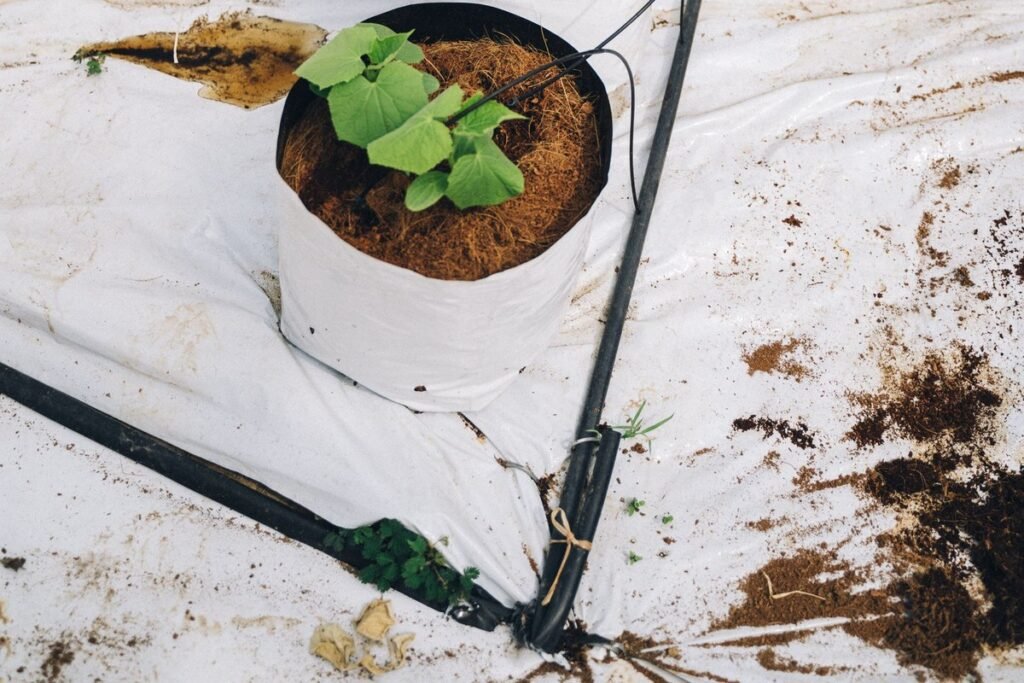
Use a 2 L/h emitter for most vegetables and a 4 L/h emitter for larger plants and clay soil. That is the short answer to what size drip emitter should i use. Size sets how fast water reaches the roots, so it also sets run time and total flow for the bed.
What emitter size means
Emitter size is the flow printed on the emitter. It tells you how much water one emitter gives in one hour at its design pressure. Emitters are rated in litres or US gallons per hour at their design pressure.
A small emitter gives water slowly. A large emitter gives the same amount of water in less time. The plant still needs the same amount of water each day. Size changes only how fast that need is met.
What Size Drip Emitter Suits Most Vegetables
The calculator gives two sizes as suitability guidance. A 2 L/h emitter, which is 0.5 GPH, suits most vegetables. A 4 L/h emitter, which is 1 GPH, suits larger plants and clay soil. No other flow value is used here.
Use 2 L/h for most vegetables because a steady slow supply suits the roots. Use 4 L/h for larger plants and clay soil because a larger plant needs more water in the same session, and the faster rate halves the run time. The choice is not about giving more water in total.
How size changes run time
Run time comes from one formula. Run time equals water per plant divided by emitters per plant times emitter flow. Divide the daily need by the total flow that plant receives each hour, and the result is the run time in hours. Multiply by 60 to turn hours into minutes. That formula is the core of the Drip Emitter Calculator.
Size sits in the lower part of that division. When size doubles, the total flow doubles if the emitter count stays the same, and the run time halves. The table below shows that trade for a tomato needing 4 L per day. One 4 L/h emitter and two 2 L/h emitters give the same combined flow and the same run time.
| Emitters per plant | Emitter size | Combined flow per plant | Run time for 4 L per day |
|---|---|---|---|
| 1 | 2 L/h | 2 L/h | 120 minutes |
| 2 | 2 L/h | 4 L/h | 60 minutes |
| 1 | 4 L/h | 4 L/h | 60 minutes |
| 2 | 4 L/h | 8 L/h | 30 minutes |
If you fit 4 L/h emitters where 2 L/h emitters were used before, and you leave the timer unchanged, the plants get twice as much water. Change size and timer together.
A tomato worked example in full
A tomato is the one crop with a daily need given on the calculator page. A tomato needs around 2 to 4 L per day in summer once established, depending on heat and plant size. The worked example on the calculator page uses the top of that range.
A tomato needing 4 L a day with two 2 L/h emitters needs 60 minutes. The maths is 4 divided by 2 times 2, which is 4 divided by 4, which is 1 hour, which is 60 minutes. The table below extends that example across the tomato range, keeping two emitters per plant, because two emitters per plant gives a backup if one clogs.
| Daily need per tomato | Emitters per plant | Emitter size | Run time |
|---|---|---|---|
| 2 L | 2 | 2 L/h | 30 minutes |
| 4 L | 2 | 2 L/h | 60 minutes |
| 2 L | 2 | 4 L/h | 15 minutes |
| 4 L | 2 | 4 L/h | 30 minutes |
In imperial units, a tomato needing 1 gallon a day from two 1 GPH emitters takes 30 minutes. The maths is 1 divided by 2 times 1, which is 0.5 hour, which is 30 minutes. The table below uses 0.5 GPH and 1 GPH, the rounded equivalents of 2 L/h and 4 L/h.
| Daily need per tomato | Emitters per plant | Emitter size | Run time |
|---|---|---|---|
| 1 gallon | 1 | 0.5 GPH | 120 minutes |
| 1 gallon | 2 | 0.5 GPH | 60 minutes |
| 1 gallon | 1 | 1 GPH | 60 minutes |
| 1 gallon | 2 | 1 GPH | 30 minutes |
Keep metric and imperial examples separate in your own notes, and treat the GPH values as rounded equivalents, not exact conversions. Do not mix the two sets in one calculation.
How size changes system flow for a 20 plant bed
Run time is only half the story. Size also changes system flow, the total flow for the whole bed in one hour. System flow equals emitters times emitter flow. Emitters equals plants times emitters per plant.
The calculator page gives the worked example for a 20 plant bed. Twenty plants need 40 emitters and 80 L/h when each plant has two 2 L/h emitters. The maths is 20 times 2, which is 40 emitters, and 40 times 2, which is 80 L/h.
| Plants | Emitters per plant | Total emitters | Emitter size | System flow |
|---|---|---|---|---|
| 20 | 1 | 20 | 2 L/h | 40 L/h |
| 20 | 2 | 40 | 2 L/h | 80 L/h |
| 20 | 1 | 20 | 4 L/h | 80 L/h |
| 20 | 2 | 40 | 4 L/h | 160 L/h |
A 20 plant bed with two 4 L/h emitters per plant draws 160 L/h, which is four times the flow of the same bed with one 2 L/h emitter per plant at 40 L/h. The Drip Irrigation Planner covers supply and zones in full. Work out system flow before you choose the larger size for every plant.
How to read the rating on an emitter
Emitters are rated in litres or US gallons per hour at their design pressure. The rating is a flow per hour, not a total per day. It may be printed in litres per hour or in US gallons per hour, so check the unit before you use the number.
Read the rating on the emitter body or on its pack. Look for L/h or GPH after the number. A 2 L/h emitter and a 2 GPH emitter are not the same. Keep one unit through the whole calculation.
Emitters per plant by plant type
Size and count work as a pair, so the count by plant type is part of the size choice. One or two emitters per plant suits vegetables. Two to four emitters per plant suits shrubs, and trees take more, spread around the root zone. Use those counts with the size guidance to set the combined flow for each plant type.
For vegetables, start with two emitters per plant where you can. Two emitters spread the water around the root zone, and give a backup if one clogs. A vegetable with two 2 L/h emitters has a combined flow of 4 L/h. For shrubs, use two to four emitters per plant. For trees, use more than for shrubs. No exact count for trees is given on the calculator page.
Checking emitters regularly for clogging
Check emitters regularly for clogging. A 2 L/h emitter has a small opening, and a small opening can block with grit, scale, or organic matter. A blocked emitter gives no water, so the plant gets less than the run time calculation assumes. A partly blocked emitter gives less water than its rating, so the run time is no longer enough.
Check by watching each emitter while the system runs. Look for a steady drip at each point. If an emitter is blocked, clean or replace it, then check again that the drip is steady.
Run time in summer and soil notes
Run drip often for 30 to 60 minutes for vegetables in summer. That range comes from the calculator page. A tomato needing 4 L with two 2 L/h emitters takes 60 minutes, at the top of the range. A tomato needing 2 L with two 2 L/h emitters takes 30 minutes, at the bottom of the range.
Plant needs vary with size, weather and soil. Run drip in one session on sandy soil only if water does not drain past the roots, and split it otherwise. For a longer run time question that covers zones and weekly time, the Irrigation Run Time Calculator gives minutes per zone from depth and flow.
Common mistakes
- Choosing size without changing the timer. A change from 2 L/h to 4 L/h halves the run time for the same daily need. Work out the new run time and set the timer to that new time.
- Judging size by one emitter alone. A plant with two 2 L/h emitters and a plant with one 4 L/h emitter have the same combined flow and the same run time. Judge the combined flow.
- Mixing litres and gallons in one calculation. A 2 L/h emitter is 0.5 GPH as a rounded equivalent, and a 4 L/h emitter is 1 GPH as a rounded equivalent. Pick one unit and keep it through to the end.
- Using one size for every plant in a mixed bed. Most vegetables suit 2 L/h, larger plants and clay soil suit 4 L/h, and shrubs take two to four emitters per plant. Group plants by size where you can.
- Forgetting system flow when you choose the larger size. A 20 plant bed with two 4 L/h emitters per plant draws 160 L/h, four times the flow of the same bed with one 2 L/h emitter per plant.
- Leaving clogged emitters in place. Check emitters regularly for clogging. A blocked emitter gives no water, and a partly blocked emitter gives less than its rating.
- Treating the tomato need as a fixed need for every crop. The calculator page gives a daily need for tomato only, around 2 to 4 L per day in summer once established.
FAQs
Q: What size drip emitter should I use for most vegetables?
A: Use a 2 L/h emitter, which is 0.5 GPH, for most vegetables. With two 2 L/h emitters, a tomato needing 4 L per day takes 60 minutes, and a tomato needing 2 L per day takes 30 minutes.
Q: When should I use a 4 L/h drip emitter?
A: Use a 4 L/h emitter, which is 1 GPH, for larger plants and clay soil. It halves the run time for the same daily need when the emitter count stays the same.
Q: How long should I run drip irrigation for vegetables in summer?
A: Often 30 to 60 minutes for vegetables in summer. A tomato needing 4 L with two 2 L/h emitters takes 60 minutes.
Q: How many emitters per plant should I use?
A: Use one or two emitters per plant for vegetables, two to four for shrubs, and more for trees, spread around the root zone. Two emitters per plant gives a backup if one clogs.
Q: How do I check if my drip emitters are clogged?
A: Check emitters regularly for clogging by watching each emitter while the system runs. Look for a steady drip at each point. If an emitter gives no water, clean or replace it.
Q: What does the rating on a drip emitter mean?
A: The rating is the flow in litres or US gallons per hour at design pressure. A 2 L/h emitter gives 2 litres in one hour at its design pressure, and a 4 L/h emitter gives 4 litres in one hour.
More guides
Hargreaves vs Penman Monteith: When the Simple Estimate Is Enough
Hargreaves vs penman monteith is a choice between a simple estimate from temperature alone and a fuller calculation from complete weather data.…
Read guide
Daily ET0 vs Monthly Average ET0: Planning vs Scheduling
Daily ET0 vs monthly ET0 is a choice between one day and a month. Use a monthly average to plan a season,…
Read guide
How Latitude and Date Change Your ET0
Latitude and ET0 are linked through Ra, the extraterrestrial radiation that reaches the top of the atmosphere. When latitude or date changes,…
Read guide