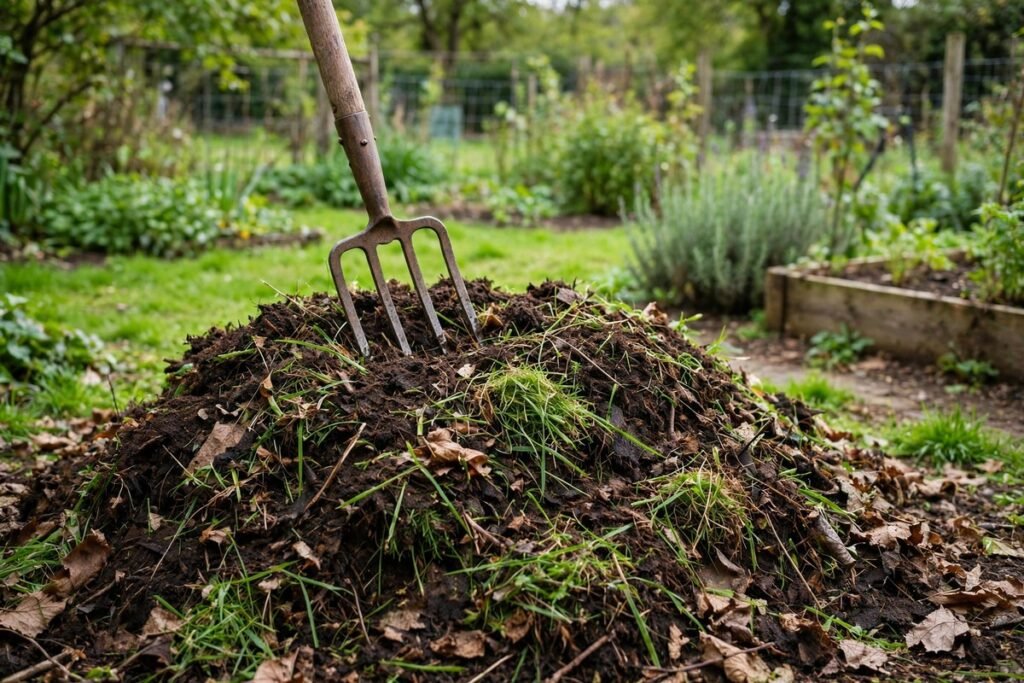
why does my compost smell of ammonia? It smells because the heap holds more nitrogen than the carbon present can balance, so microbes release the surplus as ammonia gas. Add dry browns such as dry leaves or shredded cardboard, mix them through the heap, turn it well, and check the mix with the calculator before you add more greens.
What the smell means
A sharp smell like cleaning fluid is a direct message from the heap. It does not mean the compost is ruined. It means the mix has more nitrogen than the microbes can use at that moment. When microbes have plenty of carbon for energy and enough nitrogen to build new cells, they work fast and the heap heats up with little smell. When nitrogen runs ahead of carbon, the surplus leaves as ammonia gas.
The Cornell Waste Management Institute says too much nitrogen allows rapid microbial growth, but it can create serious odor problems as oxygen is used up, and some excess nitrogen will be given off as ammonia gas while valuable nitrogen escapes. The site target is about 25 to 30 parts carbon for every 1 part nitrogen, written as 25 to 30:1. Below that range, the heap is nitrogen heavy. Above it, the heap is carbon heavy and tends to sit still.
How to confirm the cause
Look at what went into the heap in the last few days and how the heap feels. A heap that smells of ammonia often looks wet and dense, with mats of fresh grass pressed together, or with a thick layer of food scraps on top. Three causes cover most cases: a large load of fresh grass with no brown added, food scraps added day after day with only a thin sprinkle of brown, and a heap already low on carbon that then received fresh greens.
| Smell | Likely cause | First move |
|---|---|---|
| Sharp ammonia | Too much nitrogen, below 25 to 30:1 | Add browns, turn |
| Sour or rotten eggs | Too wet, too little air | Break clumps, add browns, turn |
| Sweet and sickly | Too much nitrogen, wet scraps | Add browns, bury scraps |
| No smell, heap cold | Too much carbon, too little water | Add greens, water, turn |
| Earthy | Mix is working well | Keep in balance |
How much brown fixes it
The site worked example gives a clear answer for one named case. On the calculator page, 20 kg of fresh grass clippings mixed with 6 kg of dry autumn leaves gives a C:N of about 31:1, which is well balanced for a hot heap. On their own, 20 kg of clippings need about 5.5 kg of dry leaves to reach 30:1. For 20 kg of grass, the brown needed is a little over one quarter of the green weight.
Read that example with care. It gives the result for the mix, not a C:N value for grass on its own and not a C:N value for leaves on its own. The exact brown amount for any other green depends on its own density and moisture, which the calculator holds as built in values. Food scraps, fresh grass and soft plant trimmings do not carry the same moisture or nitrogen content, so the same weight of a different green will need a different weight of brown.
| Mix | Result |
|---|---|
| 20 kg grass alone | Needs about 5.5 kg dry leaves to reach 30:1 |
| 20 kg grass plus 6 kg dry leaves | About 31:1, well balanced |
| Any other green | Do not copy grass numbers, use the calculator |
Cornell Waste Management Institute figures help explain why grass needs that much brown, and they are labelled here as Cornell figures, not as calculator values. Cornell lists grass clippings at 19:1, food wastes at 15:1, and leaves and foliage at 40 to 80:1. A green near 15:1 or 19:1 is far below the target of 25 to 30:1, while leaves sit above it. Real materials vary, so treat these as typical Cornell values.
Use the calculator before you add more greens
The fastest way to stop guessing is to check the mix before the next load goes in. Use the Compost C:N Ratio Calculator to enter the weight of the green you have and the weight of the brown you have. The calculator gives the C:N ratio of the mix and how much brown balances your greens. It uses the formulas on the page: nitrogen is weight times 1 minus moisture times N percent, carbon is nitrogen times that material C:N, and mix C:N is total carbon divided by total nitrogen.
Make the calculator part of the routine, not a check only after a smell appears. When you mow, weigh the clippings, then weigh out dry leaves or shredded cardboard to match. When you add food scraps, add browns at the same time and bury the scraps under them. Keep dry leaves or shredded cardboard beside the heap. For amount questions, the site also has a Compost Calculator and a Mulch Calculator.
The fix in order
Adding browns on top without mixing them in will not fix the centre of the heap, where the smell is coming from. The brown needs to meet the green through the whole heap.
- Put on gloves, lift the cover, and note the smell, wetness, and any mats of grass.
- Weigh the green load if you can, enter it in the calculator, and note the brown weight suggested.
- Add dry browns such as dry leaves or shredded cardboard, shredded first if pieces are large.
- Fork the heap from outside to centre, breaking mats and clumps, and mix browns through.
- Check moisture as you turn. The heap should feel damp like a wrung out sponge. Add dry brown if wet, water lightly if dry.
- Restack loosely so air can move through, and do not press it down hard.
- Check again in one or two days. The smell should be weaker and the centre warmer.
Do not add more greens until the smell has faded and the heap is heating well. Adding another load of grass or food scraps to a heap that is already nitrogen heavy will push the balance further down and bring the smell back.
Common mistakes that keep the smell coming back
- Adding greens in a thick layer with no brown at the same time.
- Laying browns on top instead of mixing them through.
- Using wet leaves or damp cardboard as the brown.
- Turning once and leaving the heap alone for weeks.
- Copying the grass example for another green, instead of using the calculator.
- Adding a chemical fix instead of carbon. This article gives no lime, sulfur or fertiliser rate.
- Covering food scraps with only a thin sprinkle of brown.
- Building the heap too small to hold heat.
The University of California Cooperative Extension Sacramento County guide gives the same short fix. It says too much green material will give off an ammonia odor, and the remedy is to add browns and turn the pile. It also says ammonia smells indicate too much nitrogen, like mats or clumps of grass.
Ammonia smell or rotten smell
Tell the two main bad smells apart, because they point to different first moves even though both improve with browns and turning. An ammonia smell is sharp, like cleaning fluid, and it points to too much nitrogen for the carbon present. A rotten smell, like rotten eggs, points to too little air and too much water. The University of California guide makes the same split, and says a rotten smell means the pile is too wet or short of air, and the remedy is to turn the pile, adding browns.
A heap that is not heating up is the opposite problem. The site says not heating up usually means too much carbon or too little moisture, and the remedy is to add greens and water. Do not add more browns to a cold heap that already smells of nothing, because that will slow it further.
When the smell should fade
A heap only a little out of balance often smells weaker within a day or two of adding browns and turning. A heap badly out of balance may need a second addition of brown and a second turn. Turning releases some ammonia gas at first, so the smell may seem stronger for a short time while you work. Once browns are mixed through, the smell should fall steadily. Finished compost should smell earthy, like forest soil.
Frequently asked questions
Q: Why does my compost smell of ammonia?
A: Why does my compost smell of ammonia? It smells because the heap holds more nitrogen than the carbon present can balance, so microbes release the surplus as ammonia gas. Add dry browns, mix them through, turn well, and check the mix with the calculator.
Q: How much brown do I need to fix an ammonia smell?
A: For the site worked example, 20 kg of grass need about 5.5 kg of dry leaves to reach 30:1, and 20 kg of grass plus 6 kg of dry leaves gives about 31:1. For any other green, do not copy those numbers. Put your own weights into the calculator.
Q: Can I just turn the heap without adding browns?
A: Turning alone helps for a short time, because it lets trapped gas escape and brings air in. It does not fix the balance, so the smell often returns. Add dry browns as you turn, mix them through, and the fix lasts.
Q: Will the ammonia smell harm my plants?
A: The smell is a sign nitrogen is leaving the heap in the air instead of staying in the compost. Finished compost should smell earthy, not sharp. Do not spread smelly compost on beds. Wait until the smell has gone.
Q: Is an ammonia smell the same as a rotten smell?
A: No. An ammonia smell is sharp and points to too much nitrogen. A rotten smell is sour or like rotten eggs and points to too little air and too much water. Both improve with dry browns and turning.
Q: How do I stop the smell coming back?
A: Add browns with every load of greens, bury food scraps under browns, mix browns through instead of laying them on top, and turn when you add a large load. Keep dry leaves or shredded cardboard beside the heap.
More guides

How to Choose a Fertilizer Rate: Meet Nitrogen or Cap Every Nutrient
Learning how to choose a fertilizer rate starts with one choice. You either meet a chosen nutrient target, usually nitrogen, and accept…
Read guide
Too Much Phosphorus From Fertilizer: Surplus, Signs and Fixes
Too much phosphorus from fertilizer is a surplus that appears when a balanced blend meets nitrogen and supplies twice the phosphate the…
Read guide
Fertilizer NPK Numbers Explained: What N, P2O5 and K2O Mean
Fertilizer npk numbers are the three percentages on a fertilizer bag, listed in the order nitrogen, phosphate and potash. They tell you…
Read guide