Can You Plant Vegetables Closer Together?
Yes, you can plant vegetables closer together, if the soil is rich and deep, the crop suits close spacing, and you accept smaller plants. Leafy greens, root crops and bush beans cope well. Tomatoes, squash and corn do not. The gain is more plants in the same bed, and the cost is more water and more disease risk.
What closer spacing really means
Seed packet spacing usually assumes rows with paths between them. It is a plan for a field, where a person or a machine needs room to walk and work. In a raised bed you do not walk between rows, so you can drop the path space and plant in a grid instead.
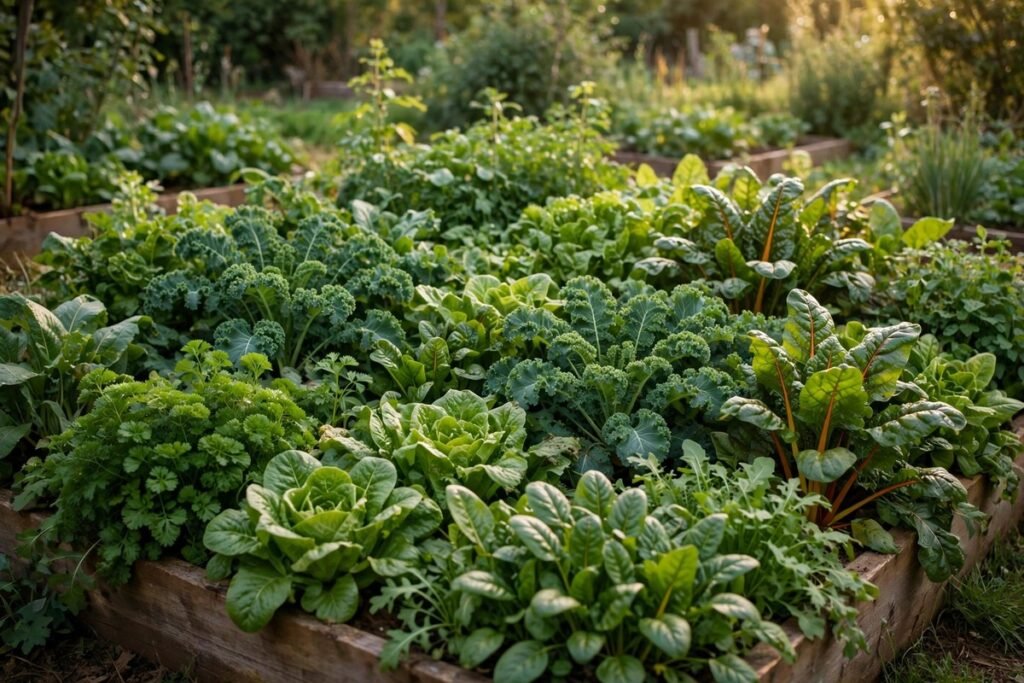
Virginia Cooperative Extension puts the test in plain terms. Space plants at equal distances from each other on all sides, such that leaves will touch at maturity. Leaves touching is close enough. Leaves piled on top of each other is too close.
There is a second test, from the same source. Do not crowd plants to the point at which disease problems arise or competition causes a loss of yield.
The maths first, so the count is honest
Use the calculator formula before you buy plants.
grid: plants = floor(length / spacing) x floor(width / row spacing)
triangular: rows = floor((width minus spacing) / (0.866 x spacing)) + 1, alternate rows shifted half a spacing
plants to buy = ceil(plants x (1 + spare %))
Floor means round down to a whole plant. Ceil means round up when you buy spares.
Take a 4 by 8 foot bed, 96 inches long and 48 inches wide. At 12 inch spacing it fits 8 by 4, which is 32 plants. At 9 inch spacing it fits 10 by 5, which is 50 plants. At 6 inch spacing it fits 16 by 8, which is 128 plants.
With 10 percent spares, buy 36 plants at 12 inch spacing, 55 at 9 inch spacing, and 141 at 6 inch spacing.
Use the Plant Spacing Calculator for your own bed size and spacing, and add spares for failures.
One honest note on the site worked example. A 2.4 by 1.2 metre bed at 30 cm spacing fits 32 plants. The site example says 35 with 10 percent spares. That is 35.2 rounded to the nearest whole plant. The formula as stated rounds up, which gives 36.
Which vegetables cope, and which do not
Close spacing works best for crops that are picked young, grow fast, and stay small. It works worst for crops that need a full season to reach full size, need air around the fruit, or spread.
The closer figures in the table are trial spacing, not a new packet rule. Try them on one row first, keep the rest of the bed at packet spacing, and use the packet spacing as the safe default if the trial row stays small or sickly.
| Crop | Packet spacing, a common guide | Trial spacing to try on one row first | Verdict |
|---|---|---|---|
| Leaf lettuce | 12 inches | 8 to 9 inches | Cope well, pick outer leaves early |
| Carrots | 3 inches | 2 to 3 inches | Cope well if soil is loose and deep |
| Radishes | 2 inches | 1 to 2 inches | Cope well, fast crop, pull early |
| Bush beans | 4 to 6 inches | 4 inches | Cope well in a block, not in a single row |
| Spinach | 4 to 6 inches | 4 inches | Cope well in cool weather, bolt risk in heat |
| Beets | 4 inches | 3 to 4 inches | Cope well, thin to the strongest plant |
| Kale | 12 to 18 inches | 12 inches | Cope at 12 inches, small leaves if closer |
| Peppers | 12 to 18 inches | 12 inches | Cope at 12 inches in warm sun, need air |
| Tomatoes, staked | 24 to 36 inches | 18 to 24 inches | Risky below 24 inches, disease and small fruit |
A packet or plant label for a specific variety can call for a different spacing, and that label should win.
Lettuce is the clearest win. At 12 inches, a 4 by 8 foot bed holds 32 lettuces. At 9 inches it holds 50. Lettuce is picked leaf by leaf, or cut young, so a smaller head is still useful.
Carrots are a different case. At 3 inches, a 4 by 8 foot bed holds 512 carrots. At 2 inches it holds 1152. That count is a trap if the soil is shallow or heavy. Carrots need loose soil to grow straight, and roots that touch each other will fork and bend. Close spacing works for carrots only in deep loose soil, with thinning once seedlings are up.
Tomatoes show the other side. At 24 inches, a 4 by 8 foot bed holds 8 staked tomatoes. At 18 inches it holds 10. That gain of two plants is small, and the cost is real. Leaves stay wet longer, disease moves faster, and fruit stays small. Keep tomatoes at 24 inches or wider unless the variety is compact and the site is sunny and breezy.
Soil, water and feeding have to rise with the plant count
Close spacing is not free. Each extra plant takes water and nutrients from the same bed. If you double the plant count and change nothing else, each plant gets half the share.
University of New Hampshire Extension states the foundation plainly. Intensive planting needs a deep, fertile, well drained soil in full sunlight. Virginia Cooperative Extension adds the practical step. Have a soil test done, add organic matter if the test shows it is low, and till the soil so the top 10 to 12 inches has a loose tilth. In an intensive bed, roots are encouraged to grow down, because there is less room to grow sideways.
Water deeply and less often, at the base of the plants in the morning. Add compost before planting, and top up with compost between crops.
Air, light and disease are the real limits
Light is the first limit. When leaves overlap heavily, lower leaves sit in shade, stop working well, and drop off. That is a sign the spacing was too close for that crop.
Air is the second limit, and it is the one that causes most failures. Cornell University, in guidance on wet seasons, notes that good air circulation lets leaves dry out, and that planting vegetables too close together makes that harder. Wet leaves and high humidity encourage more plant diseases.
Keep air moving in three ways. First, use a triangular layout where it fits. Offset rows fit more plants in a large bed, about 15 percent more with the same distance between neighbours, according to the site calculator guidance, but in a narrow bed the edges can cancel that gain. The site example shows it: a 2.4 by 1.2 metre bed at 30 cm spacing fits 32 plants in a square grid, and 30 in triangular rows. Second, prune and thin on time. Third, grow tall crops on a trellis.
Square foot gardening is close spacing with a grid
Square foot gardening is the most familiar form of close spacing. The method divides a bed into 1 foot squares, and plants each square at a fixed density: 1 large plant, 4 medium plants, 9 small plants, or 16 very small plants per square.
A 4 by 4 foot bed has 16 squares. At 4 lettuces per square, that is 64 lettuces. At 9 bush beans per square, that is 144 beans. At 16 carrots per square, that is 256 carrots. Those counts are useful as a planning tool, but they are not a promise that every square will yield at full size.
The Square Foot Garden Planner uses the same idea with a grid you can draw. Use it to lay out the bed, and use the Plant Spacing Calculator to check the count at a named spacing. This article answers the narrower question the live spacing guide leaves open: can you close the gap further, and what happens when you do.
Common mistakes
Planting by seedling size is the first mistake. Judge spacing by mature size. Skipping thinning is the second mistake. Direct sown seed needs to be thinned to the final spacing. Closing the spacing on a poor soil is the third mistake. Fix the soil first, then close the spacing. Ignoring the variety is the fourth mistake. Read the plant label, and give a vigorous variety wider spacing. Watering from above late in the day is the fifth mistake.
FAQs
Q: Can you plant vegetables closer together than the seed packet says?
A: Yes, often by one step, if the soil is deep and fertile and the crop suits it. Lettuce at 9 inches instead of 12 inches is a common example.
Q: Does planting closer together give a bigger harvest?
A: It can give more food in total from the same bed, even though each plant is smaller. If plants are pushed too close, total harvest can fall, because disease and competition take more than the extra plants add.
Q: How close can you plant lettuce?
A: Leaf lettuce copes at 8 to 9 inches in a rich bed, as a trial on one row first, against a common packet guide of 12 inches. A 4 by 8 foot bed holds 32 lettuces at 12 inches and 50 at 9 inches. At 6 inches it holds 128, but that is too close for full size heads.
Q: How close can you plant tomatoes?
A: Staked tomatoes need 24 to 36 inches, and 18 inches is the lowest to try, only for a compact variety in a sunny breezy site. At 24 inches a 4 by 8 foot bed holds 8 plants, and at 18 inches it holds 10, so the gain is small.
Q: What happens if vegetables are planted too close together?
A: Plants compete for light, water and nutrients, leaves stay wet longer, and disease spreads faster. Growth slows, fruit stays small, and some plants may fail.
Q: Is square foot gardening the same as intensive planting?
A: Square foot gardening is one form of intensive planting, with a fixed grid of 1, 4, 9 or 16 plants per square foot. Intensive planting is the wider idea: plant in a grid or in offset rows, with leaves touching at maturity, in deep fertile soil.
More guides

How to Choose a Fertilizer Rate: Meet Nitrogen or Cap Every Nutrient
Learning how to choose a fertilizer rate starts with one choice. You either meet a chosen nutrient target, usually nitrogen, and accept…
Read guide
Too Much Phosphorus From Fertilizer: Surplus, Signs and Fixes
Too much phosphorus from fertilizer is a surplus that appears when a balanced blend meets nitrogen and supplies twice the phosphate the…
Read guide
Fertilizer NPK Numbers Explained: What N, P2O5 and K2O Mean
Fertilizer npk numbers are the three percentages on a fertilizer bag, listed in the order nitrogen, phosphate and potash. They tell you…
Read guide