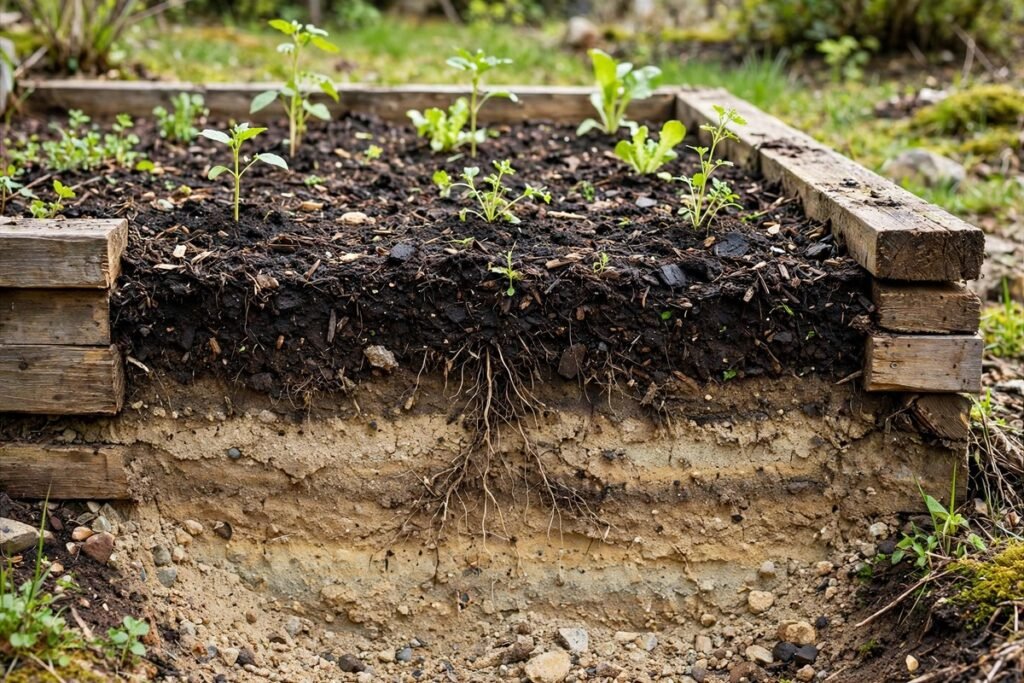
How deep should a square foot garden bed be? About 15 cm, or about 6 in, of good mix is the traditional minimum, and 30 cm, or about 12 in, gives more room for roots. That is the full depth answer on the Square Foot Garden Planner page. Choose the deeper bed when you want more root room.
What the planner page actually says
The Square Foot Garden Planner gives one short answer about depth. About 15 cm of good mix is the traditional minimum, and 30 cm gives more room for roots. There is no third depth figure on the page. There is no depth figure for one crop, no depth figure for one bed size, and no depth figure for one soil type. The page gives the minimum and the deeper option, and it leaves the choice to the gardener.
The word about matters here. The planner does not say that a bed must measure exactly 15 cm. It says about 15 cm, which means a bed built close to that depth, filled with good mix, meets the traditional minimum. The same care applies to 30 cm. Many guides say that 12 in is the minimum. That is not what the planner says. On the planner, 12 in is the deeper option, and no figure above 30 cm is given at all.
What about 15 cm means in practice
About 15 cm of good mix is the traditional minimum, and the phrase good mix does a lot of work in that sentence. A shallow bed has little room to hide poor soil. The mix must hold water without staying wet, must let roots move through it, and must give plants a steady start. The ground below the bed matters at the minimum depth. If the bed sits on open ground, roots can move down into the soil below once they pass through the mix. If the bed sits on a hard surface, roots have nowhere to go past the mix, and the minimum depth carries more risk. A bed at about 15 cm also suits crops that stay near the surface. Lettuce, basil, spinach and chard are leafy crops in general terms with roots that stay in the upper layer, so the minimum is a workable starting point for them when the mix is good.
Why 30 cm gives more room for roots
Thirty cm is twice the minimum depth, and the extra room is the whole point of the deeper option. Roots have more mix to grow through, more water to draw on, and more space to spread before they meet the ground below. That extra room is useful for larger plants, for root crops that grow down, and when the ground below the bed is poor or hard.
Tomatoes and peppers are the large plants in the planner worked example. Each takes one square, and each tomato is one indeterminate tomato per square, trained up a vertical support. A large plant like that has a larger root system in general terms than a lettuce plant, and it benefits from more room below the surface. Carrots are the clearest example of a crop that grows down, and a deeper bed gives them more room to grow straight and full. The planner does not give a depth figure for tomatoes, peppers or carrots, and this blog gives none.
Depth at a glance
| Depth | What the planner says | What it means for the gardener |
|---|---|---|
| About 15 cm | Traditional minimum of good mix | The floor for a square foot bed, works best with good mix and open ground below |
| About 30 cm | Gives more room for roots | The deeper option, gives larger plants and root crops more room below the surface |
| Above 30 cm | No figure on the planner | The planner gives no figure above 30 cm, so this blog gives none |
The table above is the whole depth rule on the planner. Build to about 15 cm when the mix is good and the ground below is open. Build to about 30 cm when you want more root room. Do not treat 30 cm as the minimum.
The worked example and root room in general terms
The planner worked example uses a classic 4 by 4 ft bed with 16 squares. Two squares of tomatoes, two of peppers, four of lettuce, three of bush beans, two of carrots and three of basil fill all 16 squares with 91 plants. The free squares are 0.
| Crop in the worked example | Squares | Plants per square | Plants | Root habit in general terms |
|---|---|---|---|---|
| Tomatoes | 2 | 1 | 2 | Deeper rooted large plant, trained up a vertical support |
| Peppers | 2 | 1 | 2 | Deeper rooted large plant |
| Lettuce | 4 | 4 | 16 | Shallow rooted leafy crop |
| Bush beans | 3 | 9 | 27 | Medium rooted bush crop |
| Carrots | 2 | 16 | 32 | Root crop that grows down |
| Basil | 3 | 4 | 12 | Shallow rooted leafy crop |
| Total | 16 | Not applicable | 91 | Mixed bed with shallow and deeper rooted crops |
The table shows why a single depth must serve a mixed bed. A bed with only lettuce and basil could stay at the minimum with little risk, because both are shallow rooted in general terms. A bed with tomatoes, peppers and carrots in it has deeper rooted crops in the same grid, and the deeper option gives those crops more room. Depth and density are separate choices. Tomatoes stay at 1 per square, lettuce at 4, bush beans at 9, and carrots at 16 at either depth. Depth changes root room. Density changes plant count.
How to choose between about 15 cm and about 30 cm
Choose about 15 cm when the bed sits on open ground, the mix is good, and the plan is mainly leafy crops like lettuce, spinach, chard and basil. Those crops are shallow rooted in general terms, and they use the upper layer well. Choose about 15 cm also when the bed must stay low and simple. Check the mix before planting. If the mix is heavy or dry, the minimum depth leaves little room for error.
Choose about 30 cm when the plan includes tomatoes, peppers or carrots, or when the bed sits on poor ground or a hard surface. Choose with the whole plan in mind, not with one crop alone. A bed is a single frame, and every square in it shares the same depth. The depth must suit the deepest rooted crop in the plan.
What the planner does not say
The planner gives no soil volume, no bag count, no weight, no yield figure, and no days to harvest. This blog gives none of those figures either, because the planner gives none, and a figure invented here would look like a planner figure when it is not. For a soil volume, use the Garden Volume Calculator on The Plant Calculator. For a raised bed soil amount, use the Raised Bed Soil Calculator on The Plant Calculator.
The planner also gives no per crop depth. It gives no depth for tomatoes, no depth for carrots, no depth for lettuce, and no depth for any other crop. This blog gives no per crop depth either. The root terms in this blog are general only. Lettuce and basil are shallow rooted in general terms. Tomatoes and peppers are deeper rooted in general terms. Carrots grow down. Bush beans sit in the middle in general terms.
Common mistakes
- Treating 30 cm as the minimum. About 15 cm is the traditional minimum.
- Treating a figure above 30 cm as a planner figure. The planner gives no figure above 30 cm.
- Giving a per crop depth with no source. The planner gives no per crop depth.
- Changing the plant count to match the depth. Depth does not change density.
- Using a shallow bed with poor mix. At about 15 cm, the mix must be good.
- Planning a mixed bed for one crop only. The depth must suit the deepest rooted crop in the plan.
- Filling the bed without checking the grid. Check that the squares add to the grid.
Frequently asked questions
Q: How deep should a square foot garden bed be?
A: About 15 cm, or about 6 in, of good mix is the traditional minimum, and 30 cm, or about 12 in, gives more room for roots. That is the full depth answer on the Square Foot Garden Planner page.
Q: Is 30 cm the minimum depth for a square foot garden bed?
A: No. The planner gives about 15 cm as the traditional minimum and 30 cm for more root room. Treating 30 cm as the minimum is a common error in competitor guides.
Q: Does a deeper bed let me plant more in each square?
A: No. Depth does not change density. Tomatoes stay at 1 per square, lettuce stays at 4 per square, bush beans stay at 9 per square, and carrots stay at 16 per square at either depth. Depth changes root room, not plant count.
Q: Which crops in the worked example need more root room in general terms?
A: Tomatoes and peppers are deeper rooted in general terms, and carrots are root crops that grow down. Lettuce and basil are shallow rooted in general terms, and bush beans sit in the middle in general terms. The planner gives no per crop depth figure.
Q: Does the planner give a soil volume or a bag count for a bed at 15 cm or 30 cm?
A: No. The planner gives no soil volume, no bag count, no weight, no yield figure, and no days to harvest. This blog gives none of those figures either.
Q: Should a mixed bed be built to the deeper depth?
A: A mixed bed shares one depth, so the depth should suit the deepest rooted crop in the plan. A bed with tomatoes, peppers and carrots has more reason to use the deeper option than a bed with only lettuce and basil.
More guides
How to Choose a Fertilizer Rate: Meet Nitrogen or Cap Every Nutrient
Learning how to choose a fertilizer rate starts with one choice. You either meet a chosen nutrient target, usually nitrogen, and accept…
Read guide
Too Much Phosphorus From Fertilizer: Surplus, Signs and Fixes
Too much phosphorus from fertilizer is a surplus that appears when a balanced blend meets nitrogen and supplies twice the phosphate the…
Read guide
Fertilizer NPK Numbers Explained: What N, P2O5 and K2O Mean
Fertilizer npk numbers are the three percentages on a fertilizer bag, listed in the order nitrogen, phosphate and potash. They tell you…
Read guide