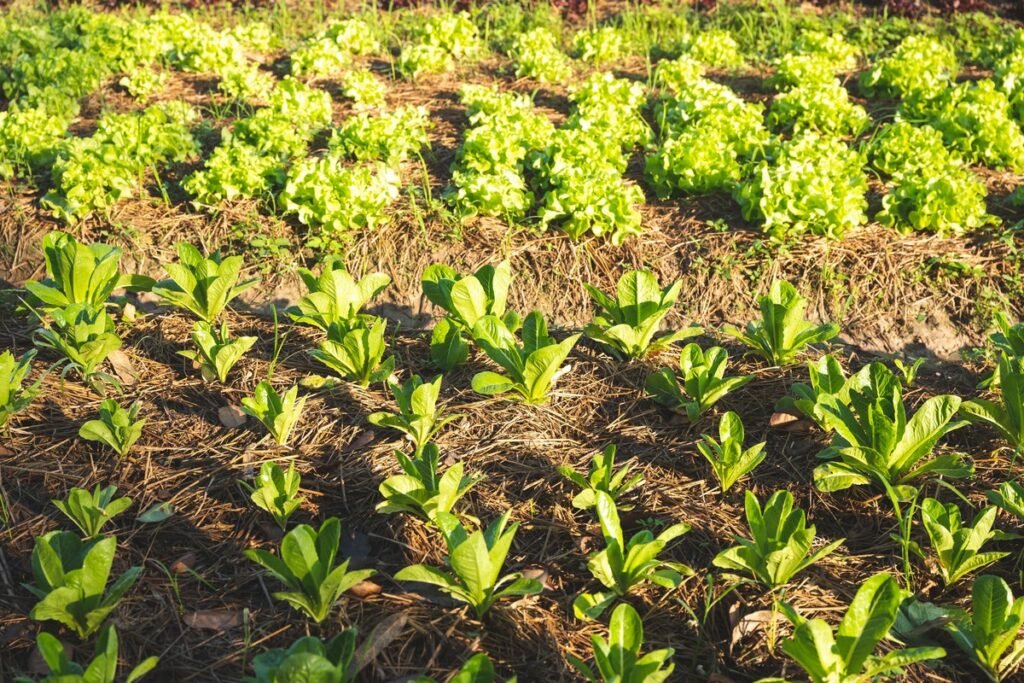
Should garden beds run north to south in most gardens, yes, because beds in that direction give plants on each side similar light through the day. Measure the plot, choose a bed width you can reach across, set path widths for walking or a wheelbarrow, and check bed count, bed length, growing area, and share planted before you dig.
Why north to south gives even light
When beds run north to south, the sun moves across the beds during the day. Plants on the east side get light in the morning, and plants on the west side get light later in the day. No side stays in shade all day. That even spread is why the Garden Bed Layout Calculator page recommends north to south in most gardens. When beds run east to west, a tall row can shade the row behind it.
How to find north in your garden
Stand in the garden with a compass and note which way is north before you mark any bed. A phone compass works for this job. Mark north on your sketch with a clear arrow, then draw the beds along that line. If you do not have a compass, note where the sun rises and where it sets. Check again on a second visit.
What the calculator measures
The Garden Bed Layout Calculator fits as many full length beds as possible into a plot, shows growing area and path area, and draws the plan to scale. Beds run along plot length, separated by paths, with a path all round. Enter plot size, bed width, and path widths, then read bed count, bed length, and growing area. Spare width is shown so you can widen paths or beds. Corner beds and curved designs are not modelled.
| Item | Formula | Result |
|---|---|---|
| Beds | Floor of plot width minus 2 x edge path plus path, divided by bed width plus path | Bed count |
| Bed length | Plot length minus 2 x edge path | Bed length |
| Growing area | Beds x bed width x bed length | Planted area |
| Share planted | Growing area divided by plot area | Share planted |
Bed width and path width
Choose a bed width you can reach across. A bed reached from both sides is often 1.2 m, or 4 ft, wide. A bed reached from one side only is often 75 to 90 cm, or 2.5 to 3 ft, wide. Walking paths are often 45 to 60 cm, or 18 to 24 in, wide. Wheelbarrow paths are often 75 to 90 cm, or 30 to 36 in, wide. Paths often take 30 to 45 percent of a vegetable garden.
| Use | Width | Notes |
|---|---|---|
| Bed reached from both sides | 1.2 m, 4 ft | Reach the middle |
| Bed reached from one side | 75 to 90 cm, 2.5 to 3 ft | Reach across |
| Walking path | 45 to 60 cm, 18 to 24 in | Walk and kneel |
| Wheelbarrow path | 75 to 90 cm, 30 to 36 in | Wheelbarrow room |
| Edge path | 45 cm, 18 in | Path all round |
Worked example 1: a 10 by 6 metre plot in metric
This is the worked example from the Garden Bed Layout Calculator page, checked by hand. The plot is 10 m long and 6 m wide, with beds 1.2 m wide, paths 45 cm wide, and an edge path of 45 cm all round. Beds are 6 minus 0.9 plus 0.45, which equals 5.55, divided by 1.65, to give 3.3636, so the floor is 3 beds. Bed length is 10 minus 0.9, which equals 9.1 m. Growing area is 3 x 1.2 x 9.1, which equals 32.76 square metres, shown as 32.8. Plot area is 60 square metres. Share planted is 32.76 divided by 60, shown as 55 percent. The beds run north to south along the 10 m length.
Worked example 2: a 32 by 20 foot plot in imperial
Use the same method in feet. The plot is 32 ft long and 20 ft wide, with beds 4 ft wide, paths 1.5 ft wide, and an edge path of 1.5 ft all round. Beds are 20 minus 3 plus 1.5, which equals 18.5, divided by 5.5, to give 3.3636, so the floor is 3 beds. Bed length is 32 minus 3, which equals 29 ft. Growing area is 3 x 4 x 29, which equals 348 square feet. Plot area is 640 square feet. Share planted is 348 divided by 640, shown as 54 percent. To convert to square metres, divide by 10.764. 348 divided by 10.764 equals 32.33 square metres. The beds run north to south along the 32 ft length.
Worked example 3: when north to south does not give the most growing area
Direction also changes how many beds fit, because the floor can leave different spare width in each direction. Take a plot 9 m east to west and 6 m north to south, with beds 1.2 m wide and paths 60 cm wide, including a 60 cm edge path. Plot area is 54 square metres. North to south: length is 6 m and width is 9 m. Beds are 9 minus 1.2 plus 0.6, which equals 8.4, divided by 1.8, to give 4.666, so the floor is 4 beds. Bed length is 4.8 m. Growing area is 4 x 1.2 x 4.8, which equals 23.04 square metres. Share planted is 23.04 divided by 54, shown as 43 percent. East to west: length is 9 m and width is 6 m. Beds are 6 minus 1.2 plus 0.6, which equals 5.4, divided by 1.8, to give 3 beds exactly. Bed length is 7.8 m. Growing area is 3 x 1.2 x 7.8, which equals 28.08 square metres. Share planted is 28.08 divided by 54, shown as 52 percent. East to west gives about 302 square feet, against about 248 for north to south. East to west grows more here, so light alone should not decide direction.
| Example | Beds | Growing area | Share planted |
|---|---|---|---|
| 10 by 6 m, north to south | 3 beds, 9.1 m | 32.8 square metres | 55 percent |
| 32 by 20 ft, north to south | 3 beds, 29 ft | 348 square feet | 54 percent |
| 9 by 6 m, east to west | 3 beds, 7.8 m | 28.1 square metres | 52 percent |
| 9 by 6 m, north to south | 4 beds, 4.8 m | 23.0 square metres | 43 percent |
How to place tall crops at the north end
In the northern hemisphere, put tall crops at the north end of each north to south bed, so they stand behind the shorter crops when viewed from the south. Reverse the rule in the southern hemisphere. Keep the tallest plants in one group at the north end, so their shade falls on the path, not on low crops. If you run beds east to west instead, put tall crops along the north side, in the north bed. The northern hemisphere rule stays the same: tall plants go north, short plants go south.
How to handle a plot where north to south does not fit
North to south may not fit a plot long east to west and short north to south, a plot with a gate that cuts across the line, or a plot with a slope, fence, or tree at one end. In that case, in the northern hemisphere, run the beds east to west, put tall crops along the north side, and check the growing area by swapping plot length and width. Run the numbers both ways, compare bed count, growing area, and share planted, and choose the layout with a good growing area and a clear path round the beds.
How to lay out the beds on the ground
Start with the sketch and the calculator result, then mark the first bed on the ground. Peg each corner, run string between the pegs, and check the sides are straight and the corners are square. Measure the path beside it, put pegs for the next bed, and repeat the steps across the plot. Leave the edge path all round. Walk the paths before you plant, and check that you can kneel beside each bed and reach the middle. If a path feels too narrow, widen it and run the calculator again.
Common mistakes to avoid
The first mistake is guessing north and marking beds at an angle. The second is making beds too wide to reach the middle, so you step on the soil. The third is making paths too narrow for a wheelbarrow. The fourth is putting tall crops at the south end, where they shade the rest of the bed. The fifth is forgetting the edge path, so the beds touch the fence. Check each point before you plant.
Using your layout in the next step
Use the layout as the starting point for the next job. The Garden Area Calculator can check the total area of the plot. The Plant Spacing Calculator uses area and spacing to work out plant counts for a bed, and the Square Foot Garden Planner uses a grid to plan crops by square. The Raised Bed Soil Calculator can help with the next step for raised beds. Keep the layout sketch with bed count and growing area.
Frequently Asked Questions
Q: Should garden beds run north to south?
A: In most gardens, yes. Beds in that direction give each side similar light through the day.
Q: How wide should garden beds be?
A: About 1.2 m, or 4 ft, from both sides, or 75 to 90 cm, or 2.5 to 3 ft, from one side only.
Q: How wide should paths be between garden beds?
A: 45 to 60 cm, or 18 to 24 in, for walking, and 75 to 90 cm, or 30 to 36 in, for a wheelbarrow.
Q: Where should tall crops go in a north to south bed?
A: Put tall crops at the north end in the northern hemisphere, so they do not shade shorter crops to the south.
Q: What should I do if north to south does not fit my plot?
A: Run the beds east to west in the northern hemisphere, put tall crops along the north side, and check the layout with the calculator by swapping plot length and width.
Q: What percentage of a vegetable garden is paths?
A: Often 30 to 45 percent.
More guides

How to Choose a Fertilizer Rate: Meet Nitrogen or Cap Every Nutrient
Learning how to choose a fertilizer rate starts with one choice. You either meet a chosen nutrient target, usually nitrogen, and accept…
Read guide
Too Much Phosphorus From Fertilizer: Surplus, Signs and Fixes
Too much phosphorus from fertilizer is a surplus that appears when a balanced blend meets nitrogen and supplies twice the phosphate the…
Read guide
Fertilizer NPK Numbers Explained: What N, P2O5 and K2O Mean
Fertilizer npk numbers are the three percentages on a fertilizer bag, listed in the order nitrogen, phosphate and potash. They tell you…
Read guide