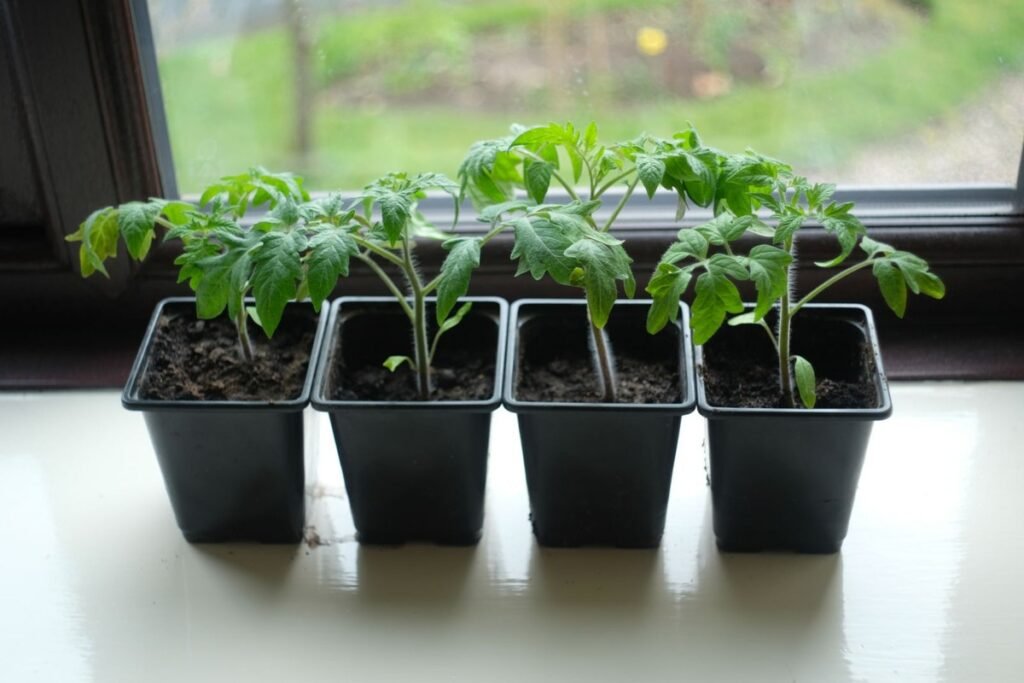
This guide answers when to start seeds indoors before the last frost.
When to start seeds indoors before the last frost is a count back question, not a calendar date question. You start from the average last frost date, count back the weeks your crop needs indoors, and the date you land on is your sowing date. For tomatoes that count back is 6 to 8 weeks before the average last frost. For peppers it is 8 to 10 weeks before the average last frost. In Zone 6 the average last frost is 11 April, so tomatoes go indoors between 14 and 28 February, and peppers go indoors earlier still. This guide works that count back in full, shows how to check it against the seed packet, and explains why starting too early can do more harm than starting on time.
Count back in plain words
Count back means you take the average last frost date and move backwards by the number of weeks a seedling needs indoors. The seedling grows inside while the weather outside is still too cold, and it is ready to go out when the frost risk has passed and the nights are warm enough. The number of weeks is not the same for every crop, because crops grow at different speeds and need different amounts of time to reach a size that can survive outside.
Tomatoes need 6 to 8 weeks indoors. Peppers need 8 to 10 weeks indoors, because they grow more slowly at the start and need the extra time to reach the same stage. That difference of two weeks matters in February, when light is still weak and space on a windowsill is limited. A tomato sown at the same time as a pepper will often be ready sooner, and a pepper sown at the tomato date will often be too small at plant out time. The count back keeps each crop on its own clock, even when the frost date they share is the same.
The Zone 6 example counted back in full
Start with tomatoes. Six weeks before 11 April is 28 February. Eight weeks before 11 April is 14 February. So the tomato sowing window is 14 to 28 February, with the earlier date giving the longest indoor growing time and the later date giving the shortest. A tomato sown on 14 February has eight weeks indoors before the average frost date. A tomato sown on 28 February has six weeks indoors. Both are inside the range the calculator gives, and the choice between them depends on your light, your space and how large you want the seedling to be at plant out time.
Now count back for peppers. Eight weeks before 11 April is 14 February. Ten weeks before 11 April is 31 January. So the pepper sowing window is 31 January to 14 February, which is two weeks earlier than the tomato window. A pepper sown on 31 January has ten weeks indoors before the average frost date. A pepper sown on 14 February has eight weeks indoors. That earlier start is not a sign that peppers are hardier. It is a sign that they need more time indoors to reach plant out size, and the count back gives them that time.
| Crop | Weeks indoors before average last frost | Indoor sowing window for an 11 April average |
|---|---|---|
| Tomatoes | 6 to 8 weeks | 14 to 28 February |
| Peppers | 8 to 10 weeks | 31 January to 14 February |
Use the calculator timeline, not a fixed month
A fixed month is a poor guide to sowing, because February in one zone is not February in another zone. The calculator timeline avoids that problem by counting in weeks from the average date, so the sowing date moves when the frost date moves. Use the Last Frost Date Calculator to find your average, either from your zone or from a local date you enter, add the safety margin to find the safe plant out date, and read the indoor sowing dates from the timeline it gives. That timeline is the plan for the whole spring, and it keeps the sowing date, the plant out date and the margin in one place.
Check the seed packet before you sow
The count back gives the range for the crop. The seed packet gives the range for the variety, and the variety can sit at one end of the crop range or the other. Some tomato varieties are listed at six weeks, some at eight weeks, and the packet is the only place that names the figure for the seed in your hand. Read the packet before you sow, and use its weeks to narrow the count back window to a single date that fits your variety, your light and your space.
For the full lesson on reading a packet, use the live blog How to Read Plant Spacing on a Seed Packet. That blog explains the packet wording in full, including spacing, and this blog does not repeat that lesson. The point here is narrower: use the packet weeks to set your sowing date, and use the spacing lesson in that blog to set the space each seedling will need once it goes out. The two lessons belong together, but they are not the same lesson, and keeping them separate keeps both of them clear.
Why starting too early can do more harm than good
Starting too early is one of the most common seed starting mistakes, and it is easy to make, because sowing feels like progress and an early sowing feels like a head start. In practice an early sowing often gives a weak seedling, not a strong one, because the seedling grows in poor light for longer than it should, and it grows tall and thin as it reaches for the light. That tall thin growth is called leggy growth, and it is a sign that the seedling has spent too long indoors in light that is too weak for its size.
Light is the limiting factor in late winter. Days are short, the sun is low, and a windowsill that feels bright to a person can still be dim for a seedling that needs strong light for most of the day. A seedling sown in January in Zone 6 will spend its first weeks in the weakest light of the year, while a seedling sown in late February will spend its first weeks as the days are lengthening. That difference in light is often worth more than the extra two weeks of growing time, and it is why the count back window has a late end as well as an early end. Sow inside the window, not before it, and give the seedling the light it needs once it is up.
The plant out check: soil warmth and night temperature
The count back gives the sowing date. The plant out date needs a second check, and that check is about warmth at plant out time, not about the calendar. Tomatoes go outside after all danger of frost has passed and nights stay above about 10 C (50 F), which usually happens 1 to 2 weeks after the average last frost. In the Zone 6 example that check agrees with the safe date of about 25 April, which is the average plus two weeks, and the two checks together give a plant out date that respects both the record and the weather.
What comes after the sowing date
This blog stops at the sowing date, and that stop is deliberate. The next steps in the chain belong to other tools and other guides, and they are linked here so you can follow them when the seedlings are up, without this blog trying to cover them in brief. The Transplant Date Calculator gives the transplant timing for the seedlings once they are ready to go out, and it is the right place to look for the date to move them, rather than a short hardening off note here. Hardening off and potting on belong to the transplant guide, and they are not covered in this blog, so that this blog can stay focused on the count back itself.
The Seed Calculator is the tool for seed quantities, and it is linked here as a tool only. This blog does no seed quantity maths, because that maths belongs to the seed calculator guide, and doing it here would duplicate that work and blur the count back lesson. Use the seed calculator when you need to work out how much seed to buy or sow, and use this blog when you need to work out when to sow it.
The Square Foot Garden Planner is the tool for the next step after transplanting, which is spacing the seedlings in the bed. Once the sowing date and the transplant date are settled, the planner helps you work out how many plants fit in the space you have, and how to lay them out so each plant has room to grow. That spacing step is not part of the count back, but it is part of the same spring plan, and linking it here keeps the chain from sowing to spacing in one place.
Frequently asked questions
Q: When should I start tomato seeds indoors before the last frost?
A: Start tomatoes indoors 6 to 8 weeks before your average last frost date. For an 11 April average in Zone 6, that is 14 to 28 February.
Q: When should I start pepper seeds indoors before the last frost?
A: Start peppers indoors 8 to 10 weeks before your average last frost date. For an 11 April average in Zone 6, that is 31 January to 14 February.
Q: What happens if I start seeds too early indoors?
A: Seedlings started too early often grow tall and thin in poor winter light, a problem called leggy growth. They flop when moved, need support, and start the season behind seedlings sown on time in good light.
Q: Should I use the seed packet or the count back to choose my sowing date?
A: Use both. The count back gives the range for the crop, and the seed packet gives the weeks for your named variety. Read the packet to narrow the range to a single date that fits your variety.
Q: When can I plant tomatoes outside after starting them indoors?
A: Plant tomatoes outside from the safe date, which is the average plus a two week margin, once nights stay above about 10 C (50 F). In Zone 6 that is from about 25 April.
Q: Does this blog cover hardening off and potting on?
A: No. This blog stops at sowing dates. Use the Transplant Date calculator for transplant timing, and look to the transplant guide for hardening off and potting on.
More guides

How to Choose a Fertilizer Rate: Meet Nitrogen or Cap Every Nutrient
Learning how to choose a fertilizer rate starts with one choice. You either meet a chosen nutrient target, usually nitrogen, and accept…
Read guide
Too Much Phosphorus From Fertilizer: Surplus, Signs and Fixes
Too much phosphorus from fertilizer is a surplus that appears when a balanced blend meets nitrogen and supplies twice the phosphate the…
Read guide
Fertilizer NPK Numbers Explained: What N, P2O5 and K2O Mean
Fertilizer npk numbers are the three percentages on a fertilizer bag, listed in the order nitrogen, phosphate and potash. They tell you…
Read guide