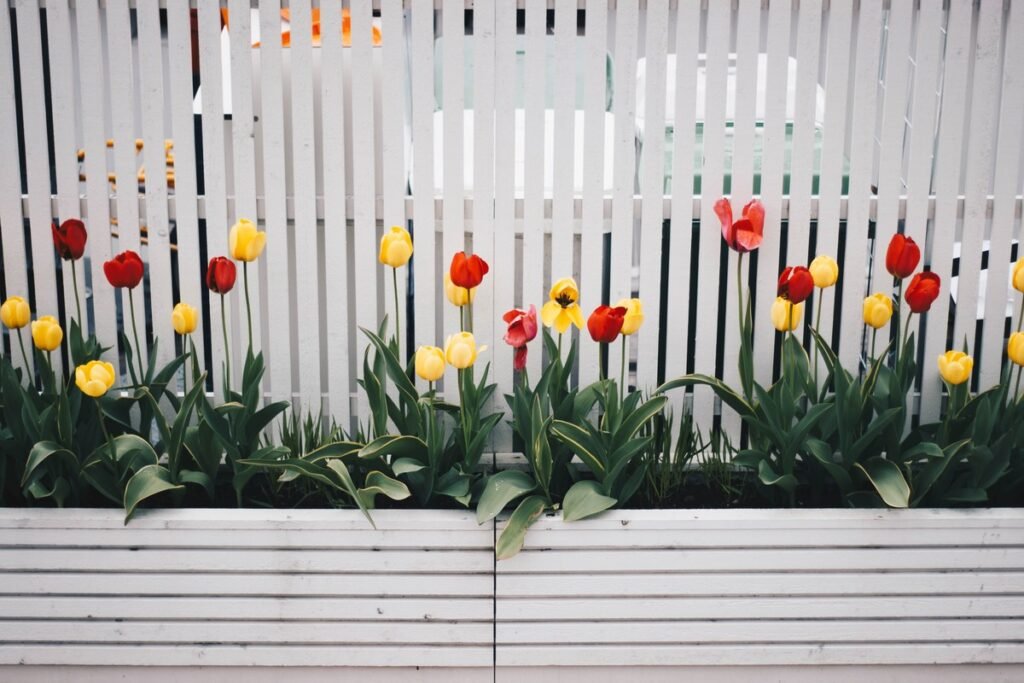
This flower bed spacing guide shows you how to space tall, medium and edging plants in one bed, using a different spacing for each zone. A 4 by 1.5 metre border split 30 to 40 to 30 needs 9 tall plants at 45 cm, 27 medium plants at 30 cm and 80 edging plants at 15 cm, 116 plants.
Why one spacing cannot fit a whole bed
A flower bed is three plantings in one strip: tall at the back, medium in the middle and low edging at the front. Each layer has a different mature spread, so each needs a different spacing, measured from plant centre to plant centre. When spacing grows, the room each plant takes grows with the square of the spacing. Double the spacing and each plant takes four times the room, so you need one quarter as many plants. The calculator treats each zone as a block at square spacing. For an island bed, put the tall zone in the middle.
How the calculator works
The Flower Bed Calculator asks for bed length and depth, then the share of the depth for tall, medium and edging plants, with a spacing for each zone. The shares must total 100 percent. Bed area equals bed length times bed depth. Zone area equals bed area times zone share. Plants in a zone equals zone area divided by spacing squared, rounded up. Total plants equals the sum of the three zone counts. Show the unrounded figure before rounding. Spacing guides assume plants at their mature spread, so young plants look sparse at first.
Plants per square metre by spacing
Plants per square metre at square spacing equals 1 divided by spacing squared, with spacing in metres. At 45 cm, 1 divided by 0.2025 is 4.94. At 30 cm, 1 divided by 0.09 is 11.11. At 25 cm, 1 divided by 0.0625 is 16. At 15 cm, 1 divided by 0.0225 is 44.44. Plants per square foot equals plants per square metre divided by 10.7639.
| Spacing | Plants per square metre | Plants per square foot |
|---|---|---|
| 45 cm, 18 in | 4.94 | 0.46 |
| 30 cm, 12 in | 11.11 | 1.03 |
| 25 cm, 10 in | 16 | 1.49 |
| 15 cm, 6 in | 44.44 | 4.13 |
Edging at 15 cm needs 44.44 plants per square metre, which is 4 times the medium density of 11.11 and 9 times the tall density of 4.94. A small edging zone can therefore hold more plants than the tall and medium zones put together. To check any bed, multiply zone area by the plants per square metre figure for that zone spacing, then round up. That table matches the GardenCalc UK table, which gives 16 to 44 plants per square metre at 15 to 25 cm. The Plants per Square Foot Calculator gives the same density idea for any spacing.
Worked example 1: the calculator border, 4 by 1.5 metres
The calculator worked example is a border 4 metres long and 1.5 metres deep, split 30 to 40 to 30 between tall, medium and edging zones. In imperial units, 4 metres equals 13.12 feet and 1.5 metres equals 4.92 feet. Bed area is 4 times 1.5, which equals 6 square metres, or 64.58 square feet, since 6 times 10.7639 equals 64.58.
Tall zone: 6 times 0.30 equals 1.8 square metres. 1.8 divided by 0.2025 equals 8.888, rounded up to 9. Medium zone: 6 times 0.40 equals 2.4 square metres. 2.4 divided by 0.09 equals 26.666, rounded up to 27. Edging zone: 6 times 0.30 equals 1.8 square metres. 1.8 divided by 0.0225 equals 80 exactly. Total is 9 plus 27 plus 80, which equals 116 plants.
| Zone | Share | Zone area | Spacing | Plants |
|---|---|---|---|---|
| Tall, back | 30 percent | 1.8 sq m | 45 cm, 18 in | 9 |
| Medium, middle | 40 percent | 2.4 sq m | 30 cm, 12 in | 27 |
| Edging, front | 30 percent | 1.8 sq m | 15 cm, 6 in | 80 |
| Total | 100 percent | 6 sq m | Not one spacing | 116 |
Edging gives 80 of the 116 plants, which is 69 percent of the total, from only 30 percent of the bed area. Change only the edging spacing, from 15 cm to 25 cm, and the edging count falls to 29, since 1.8 divided by 0.0625 equals 28.8, rounded up to 29, and the total falls to 65.
Worked example 2: a smaller border, 3 by 1.2 metres
Take a border 3 metres long and 1.2 metres deep, split 25 to 35 to 40 between tall, medium and edging zones. In imperial units, 3 metres equals 9.84 feet and 1.2 metres equals 3.94 feet. Bed area is 3 times 1.2, which equals 3.6 square metres, or 38.75 square feet, since 3.6 times 10.7639 equals 38.75.
Tall zone: 3.6 times 0.25 equals 0.9 square metres. 0.9 divided by 0.2025 equals 4.444, rounded up to 5. Medium zone: 3.6 times 0.35 equals 1.26 square metres. 1.26 divided by 0.09 equals 14 exactly. Edging zone: 3.6 times 0.40 equals 1.44 square metres. 1.44 divided by 0.0225 equals 64 exactly. Total is 5 plus 14 plus 64, which equals 83 plants. Here edging gives 64 of the 83 plants, which is 77 percent of the total.
Worked example 3: a border in feet, 12 by 5 feet
Take a border 12 feet long and 5 feet deep, split 20 to 30 to 50 between tall, medium and edging zones. In metric units, 12 feet equals 3.66 metres and 5 feet equals 1.52 metres. Bed area is 12 times 5, which equals 60 square feet, or 5.57 square metres, since 60 divided by 10.7639 equals 5.57.
Tall zone: 60 times 0.20 equals 12 square feet. 12 divided by 2.25 equals 5.333, rounded up to 6. Spacing here is 1.5 feet, and spacing squared is 2.25 square feet. Medium zone: 60 times 0.30 equals 18 square feet. 18 divided by 1 equals 18 exactly. Edging zone: 60 times 0.50 equals 30 square feet. 30 divided by 0.25 equals 120 exactly. Total is 6 plus 18 plus 120, which equals 144 plants. Edging alone needs 120 plants, which is 83 percent of the total. Move the edging share from 50 percent to 30 percent and the edging count falls to 72 plants, and the total falls by 48 plants.
How to choose spacing for each zone
Start with the plant label, not with the table. The label gives mature spread, and spacing should match that spread. Many bedding plants are spaced 15 to 25 cm, or 6 to 10 inches, apart. A plant with a mature spread near 45 cm belongs in the tall zone, near 30 cm in the medium zone, and near 15 cm in the edging zone. A cross check is the rule of thumb that annuals be planted one half of their mature height apart: a 30 cm tall plant gives 15 cm spacing, and a 90 cm tall plant gives 45 cm spacing. If the label and the rule disagree, follow the label. The Plant Spacing Calculator can check a single spacing count for a bed, and it also shows triangular spacing.
Dense planting, triangular spacing and edge margins
Dense colour needs closer spacing, not wider spacing. A dense block benefits from the lower end of a spacing range, plants closer together, which gives more plants per square metre. The upper end means plants further apart and a looser effect. Plant edging at 15 cm for an instant full edge, not at 25 cm. Triangular spacing gives more plants than square spacing, not fewer. At 30 cm, square spacing gives 11.11 plants per square metre, and triangular gives 12.8, a gain of about 15.5 percent. Do not add that gain to a zone total from this calculator, which uses square spacing. The calculator treats each zone as a full block with no edge margin. If you leave 6 to 12 inches from borders for access, measure the planted area after you take off the margin, then work the zone areas from that smaller area. Bulb counts are not plant counts. The calculator gives plant count per zone and total only, with no soil volume, bag count, plant cost, seed weight, fertiliser rate, bulb count, or cost.
Common mistakes to avoid
Do not use a density far below the calculator ceilings. A figure of 6 to 9 small annuals per square metre implies a spacing of 33 to 41 cm, far wider than the bedding spacing of 15 to 25 cm. At 15 cm the correct density is 44.44, and at 25 cm it is 16. Give one spacing per zone, with a bed size for every count. Do not mix counting methods in one table: the calculator rounds up per zone, while other tools round down, or round the final total, or add one plant at each edge. For an irregular bed, work the true area first with the Garden Area Calculator, then split that area by zone share. A fixed grid plan, such as the Square Foot Garden Planner, uses a fixed 30 cm square grid, and it does not split a flower bed into zones. Do not make the bed total odd for its own sake: the worked example total of 116 plants is even, and it is correct. The odd rule applies to each group, not to the bed total.
Frequently Asked Questions
Q: How far apart should flower bed plants be?
A: Use 45 cm for tall plants at the back, 30 cm for medium plants in the middle and 15 cm for low edging plants at the front, and check the plant label for each plant.
Q: How many plants per square metre do I need at 15 cm spacing?
A: 44.44 plants per square metre at square spacing, which is 4.13 plants per square foot.
Q: Why does edging need so many plants?
A: Edging at 15 cm needs 44.44 plants per square metre, which is 4 times the medium density and 9 times the tall density, so a small edging zone can hold most of the plants in the bed.
Q: How do I work out plants for a flower bed by zone?
A: Work out bed area, multiply by each zone share to get zone area, divide zone area by spacing squared, round up per zone, then add the three zone counts.
Q: Does triangular spacing give more plants than square spacing?
A: Yes, triangular spacing gives about 15.5 percent more plants at the same spacing, with 12.8 plants per square metre at 30 cm against 11.11 plants per square metre on a square grid.
Q: What does the Flower Bed Calculator give?
A: It gives plant count per zone and total only, plus a plan view drawing, with no soil volume, bag count, plant cost, seed weight, fertiliser rate, bulb count, or cost.
More guides

Head to Head Coverage Explained: Spacing, Corners, Edges and Middle
Head to head coverage means each sprinkler head sprays far enough to reach the head next to it, so the distance between…
Read guide
How Many Sprinkler Heads Do I Need
How many sprinkler heads do I need depends on lawn size and throw radius. A 10 by 6 metre lawn with 4…
Read guide
Sprinkler Calculator: A Worked Guide
A sprinkler calculator gives a head count and a zone count from lawn size and spray distance. For a 10 by 6…
Read guide