A ground cover calculator turns an area and a spacing into a plant order. You enter how much ground to cover and how far apart to set the plants, and it gives the plants to buy, the flats to buy, and the mulch to spread while the plants fill in. This guide works the page formula step by step, with the page metric example and the page imperial example worked in full.
What ground cover means
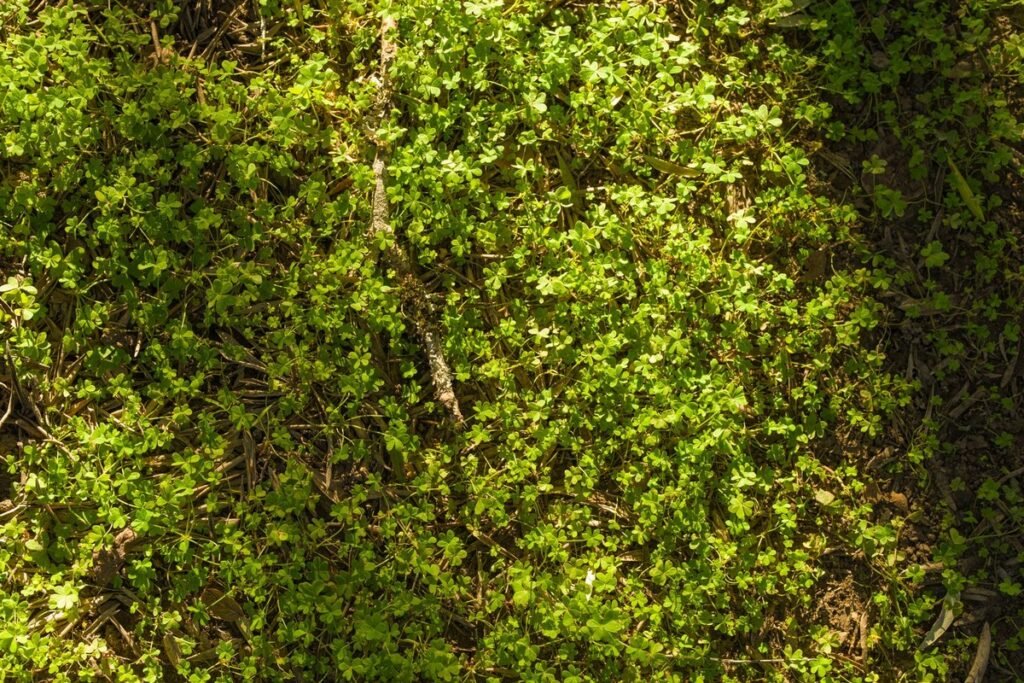
Ground cover is a low plant that spreads across the soil and fills a bed with leaves, so bare soil is covered and weeds have less room to start. You plant it on a grid, with the same spacing in each direction.
The page formula step by step
The formula has four steps: plants per unit area, plants, flats, mulch.
Step 1: plants per unit area. In metric, plants per square metre equals 1 divided by spacing squared, with spacing in metres. In imperial, plants per square foot equals 144 divided by spacing squared, with spacing in inches.
Step 2: plants. Plants equals area times plants per unit area times 1 plus the extra percentage. The extra percentage is an allowance for losses, and the default is 5 percent. Plants always round up with ceil, never round to nearest, because you cannot buy part of a plant.
Step 3: flats. Flats equals ceil of plants divided by plants per flat. Flats always round up with ceil, because you cannot buy part of a flat. The default is 18 plants per flat.
Step 4: mulch. Mulch equals area times 5 cm depth. The calculator shopping list gives mulch at 5 cm deep, shown as 2 in in imperial. 5 cm is 1.97 in, not exactly 2 in.
Worked example 1: metric, 10 square metres at 30 cm
The page metric example is 10 square metres at 30 cm in a square grid, with 5 percent extra. 30 cm is 0.3 m. Plants per square metre equals 1 divided by 0.09, which is 11.11. Plants equals 10 times 11.11 times 1.05, which is 116.667, rounded up to 117 plants. Flats equals ceil of 117 divided by 18, which is 7 flats of 18. Mulch equals 10 square metres times 5 cm depth, which is 0.5 cubic metres, or 500 litres.
Worked example 2: imperial, 100 square feet at 12 in
The page imperial example is 100 square feet at 12 in, with the 5 percent default extra. Plants per square foot equals 144 divided by 144, which is 1 plant per square foot. Plants equals 100 times 1 times 1.05, which is 105 plants. The 5 percent extra is part of this result, because without extra the count would be 100 plants. Flats equals ceil of 105 divided by 18, which is 6 flats of 18. Mulch equals 100 square feet times the 5 cm depth, which is 16.4 cubic feet.
The defaults are rounded equivalents, not exact conversions. 10 square metres is 107.64 square feet, not 100 square feet, and 100 square feet is 9.29 square metres, not 10 square metres. 30 cm is 11.81 in, not 12 in, and 12 in is 30.48 cm, not 30 cm.
Metric areas at 30 cm spacing
The table below works metric areas at 30 cm spacing in a square grid, with 5 percent extra and flats of 18.
| Area | Plants | Flats of 18 |
|---|---|---|
| 5 m² | 59 | 4 |
| 10 m² | 117 | 7 |
| 25 m² | 292 | 17 |
| 50 m² | 584 | 33 |
Imperial areas at 12 in spacing
The table below works imperial areas at 12 in spacing in a square grid, with 5 percent extra and flats of 18.
| Area | Plants | Flats of 18 |
|---|---|---|
| 50 sq ft | 53 | 3 |
| 100 sq ft | 105 | 6 |
| 250 sq ft | 263 | 15 |
| 500 sq ft | 525 | 30 |
A second area in metric: 25 square metres at 30 cm
Plants per square metre is 11.11, as in the page example. Plants equals 25 times 11.11 times 1.05, which is 291.667, rounded up to 292 plants. Flats equals ceil of 292 divided by 18, which is 17 flats of 18. Mulch is 1.25 cubic metres.
A second area in imperial: 250 square feet at 12 in
Plants per square foot is 1, as in the page example. Plants equals 250 times 1 times 1.05, which is 262.5, rounded up to 263 plants. Flats equals ceil of 263 divided by 18, which is 15 flats of 18. Mulch is 41.0 cubic feet, or 1.52 cubic yards.
How to use the calculator
First measure the area to plant. The Garden Area Calculator covers measuring a garden area, and the Square Foot Garden Planner covers planning a bed by square feet. Second choose a ground cover or enter its spacing. Third choose a square or staggered layout. Fourth enter plants per flat, or 1 for individual pots. Fifth mulch between plants until they spread.
The Ground Cover Calculator shows the plants, the flats, and the mulch from those entries. Enter the area first and the spacing next, because the spacing sets plants per unit area. Choose the layout before you read the plant count, because a staggered layout needs about 15 percent more plants than a square grid.
Calculator defaults and limits
Area defaults to 10 square metres, or 100 square feet in imperial; spacing to 30 cm, or 12 in; layout to square; plants per flat to 18; extra for losses to 5 percent. Area runs from 0.1 to 1,000,000, spacing from 2 to 300, plants per flat from 1 to 200, and extra from 0 to 50 percent in steps of 0.1 percent.
The extra percentage changes the plant count but not always the flat count. On 10 square metres at 30 cm, 0 percent extra gives 112 plants, 5 percent gives 117, 10 percent gives 123, and 20 percent gives 134, yet 112, 117 and 123 plants all need 7 flats of 18, and only 134 needs 8 flats.
Ground cover presets
Each preset sets the spacing only, not the area, layout, plants per flat, or extra percentage. Creeping thyme, ajuga, liriope and sedum set 30 cm, or 12 in. Pachysandra sets 20 cm, or 8 in. Vinca, also called periwinkle, sets 40 cm, or 15 in. Creeping phlox sets 45 cm, or 18 in. Clover lawn plugs set 15 cm, or 6 in.
Spacing is usually 15 to 45 cm, or 6 to 18 in, depending on the plant and how fast you want cover. The Plant Spacing Calculator covers a single spacing in a bed, and the Plants per Square Foot Calculator covers plants per square foot from one spacing.
Square and staggered layouts
A square grid sets plants in straight rows and columns, with the same spacing in each direction. A staggered layout, also called a triangular layout, offsets each row by half a spacing, so plants sit in a diamond pattern. The page states staggered planting needs about 15 percent more plants, and the exact uplift from the 0.8660254 factor is 15.47 percent.
At 30 cm on 10 square metres, square gives 117 plants and 7 flats, while triangular gives 135 plants and 8 flats, 18 more plants, or 15.4 percent more after the round up in each count. At 12 in on 100 square feet, square gives 105 plants and 6 flats, while triangular gives 122 plants and 7 flats, 17 more plants, or 16.2 percent more before rounding.
Mulch from the calculator
The depth is always 5 cm, shown as 2 in in imperial, and the volume is area times that depth. In metric, 10 square metres gives 0.5 cubic metres, 25 gives 1.25, 50 gives 2.5, and 100 gives 5. In imperial, 100 square feet gives 16.4 cubic feet, 250 gives 41.0, or 1.52 cubic yards, 500 gives 82.0, or 3.04 cubic yards, and 1000 gives 164.0, or 6.08 cubic yards.
What the calculator does not give
The calculator gives plant counts, flats, densities, and a mulch volume at 5 cm depth only. It gives no plant cost, no seed count, no yield figure, no fertiliser rate, no watering figure, no soil volume, no coverage time in days or weeks, no spacing from a plant name beyond the preset values, no mature spread figure, and no ground cover versus lawn comparison.
The page FAQ gives 1 plant per square foot at 12 in, 4 at 6 in, and about 0.44 at 18 in, all in a square grid.
The page assumptions
Spread rate varies with soil, light and variety. Closer spacing gives faster cover at higher cost. Remove perennial weeds before planting. Ground cover takes typically one to three growing seasons to fill in, and flats commonly hold 18, 32 or 36 plants depending on cell size, so check with your nursery.
Frequently asked questions
Q: How many ground cover plants do I need for 10 m² at 30 cm spacing?
A: 117 plants and 7 flats of 18, including 5% extra.
Q: How many ground cover plants do I need for 100 sq ft at 12 in spacing?
A: 105 plants and 6 flats of 18, including 5% extra.
Q: How many ground cover plants are there per square foot at 12 in spacing?
A: One plant per square foot in a square grid.
Q: How many plants are in a flat of ground cover?
A: Commonly 18, 32 or 36 depending on cell size. The calculator default is 18.
Q: Why does the calculator round plant counts up?
A: Because you cannot buy part of a plant.
Q: How long does ground cover take to fill in?
A: Typically one to three growing seasons.
More guides

Head to Head Coverage Explained: Spacing, Corners, Edges and Middle
Head to head coverage means each sprinkler head sprays far enough to reach the head next to it, so the distance between…
Read guide
How Many Sprinkler Heads Do I Need
How many sprinkler heads do I need depends on lawn size and throw radius. A 10 by 6 metre lawn with 4…
Read guide
Sprinkler Calculator: A Worked Guide
A sprinkler calculator gives a head count and a zone count from lawn size and spray distance. For a 10 by 6…
Read guide