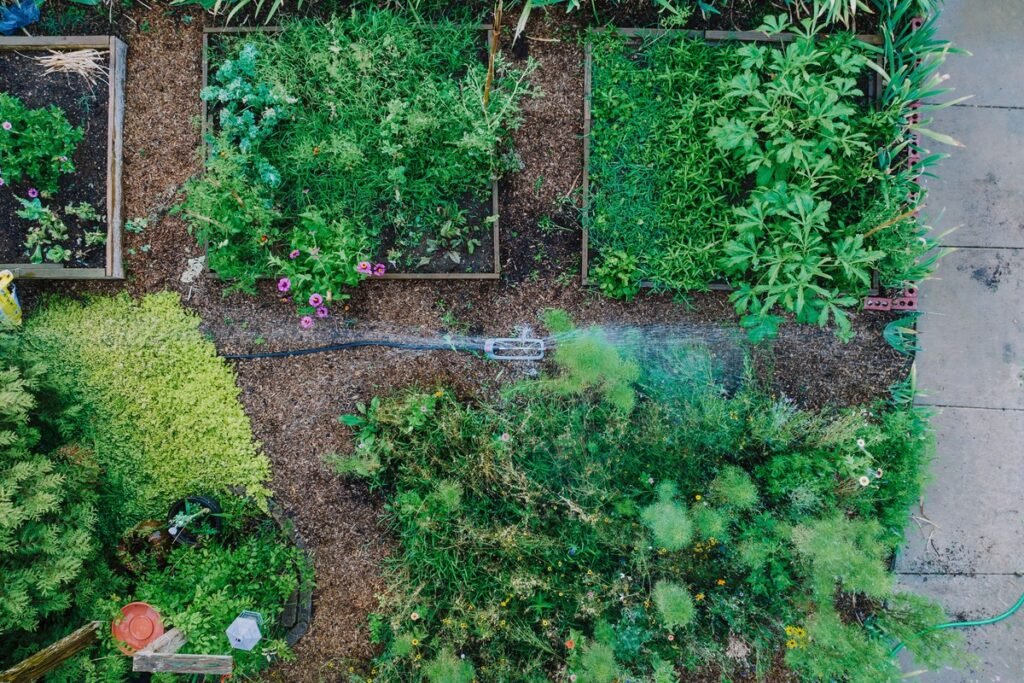
how many raised beds fit in a garden depends on plot width, bed width and path width. A 10 by 6 metre plot with 1.2 metre beds and 45 centimetre paths fits 3 beds, each 9.1 by 1.2 metres, giving 32.8 square metres of growing space, which is 55 percent of the plot.
Why area alone does not give the count
Dividing plot area by the area of one bed ignores paths, and paths take a real share of a vegetable garden. A bed needs a path beside it so you can reach it without stepping on the soil, plus a path around the edge so you can walk around the beds. Count only bed area and you will plan more beds than the plot can hold.
Shape matters too. Beds run along the plot length, with a path all round. Bed count depends mainly on plot width, because beds sit side by side across it. Plot length sets bed length. A long narrow plot and a short wide plot can have the same area and fit a very different number of beds.
The bed count formula
The Garden Bed Layout Calculator fits as many full length beds as possible. Bed count is floor of plot width minus 2 edge paths plus path, divided by bed width plus path. Round down, because a part bed is not usable. Bed length is plot length minus 2 edge paths. Growing area is beds times bed width times bed length. Share planted is growing area divided by plot area, and the rest is paths. It also shows width left over.
| Step | What it gives | Formula in words |
|---|---|---|
| Bed count | Number of beds | Floor of plot width minus 2 edge paths plus path, divided by bed width plus path |
| Bed length | Length of each bed | Plot length minus 2 edge paths |
| Growing area | Planted area | Beds times bed width times bed length |
| Share planted | Planted share | Growing area divided by plot area |
What to measure first
Measure plot length and width in straight lines, from edge to edge. Use metres or feet, and stay with one unit. Write each measurement down. If the plot is not a neat rectangle, measure the main rectangle first. The Garden Area Calculator can help with a plot that is not a simple rectangle.
Choose a bed width you can reach across. A typical width is 1.2 metres, about 4 feet, if you can reach from both sides. If you can reach from one side only, use 75 to 90 centimetres. For paths, 45 to 60 centimetres, 18 to 24 inches, suits walking and kneeling. Allow 75 to 90 centimetres for a wheelbarrow. Paths often take 30 to 45 percent of a vegetable garden, so a share planted near 55 percent is normal.
| Choice | Usual width |
|---|---|
| Bed, both sides | 1.2 metres, about 4 feet |
| Bed, one side only | 75 to 90 centimetres, about 2.5 to 3 feet |
| Walking path | 45 to 60 centimetres, 18 to 24 inches |
| Wheelbarrow path | 75 to 90 centimetres, 30 to 36 inches |
Worked example 1: 10 by 6 metre plot
This worked example is from the Garden Bed Layout Calculator page. Plot 10 by 6 metres, beds 1.2 metres wide, paths 45 centimetres, edge path 45 centimetres. Imperial: plot about 32.81 by 19.69 feet, beds about 3.94 feet wide, paths about 17.7 inches.
Bed count: 6 minus 0.9 plus 0.45 equals 5.55, and 1.2 plus 0.45 equals 1.65. Then 5.55 divided by 1.65 equals 3.3636, and floor gives 3 beds. Bed length: 10 minus 0.9 equals 9.1 metres, about 29.86 feet. Growing area: 3 times 1.2 times 9.1 equals 32.76 square metres, shown as 32.8, about 352.6 square feet. Plot area: 10 times 6 equals 60 square metres, about 645.8 square feet. Share planted: 32.76 divided by 60 equals 0.546, shown as 55 percent.
Leftover width: width used is 0.9 plus 3.6 plus 0.9, which equals 5.4 metres. The plot is 6 metres wide, so 0.6 metres, 60 centimetres, is left over. Widen the paths or beds a little, then run the count again.
Worked example 2: 8 by 4 metre plot
Plot 8 by 4 metres, beds 1.2 metres wide, paths 60 centimetres, edge path 45 centimetres. In imperial units, the plot is about 26.25 by 13.12 feet, beds about 3.94 feet wide, paths about 23.6 inches wide.
Bed count: 4 minus 0.9 plus 0.6 equals 3.7, and 1.2 plus 0.6 equals 1.8. Then 3.7 divided by 1.8 equals 2.0556, and floor gives 2 beds. Bed length: 8 minus 0.9 equals 7.1 metres, about 23.29 feet. Growing area: 2 times 1.2 times 7.1 equals 17.04 square metres, about 183.4 square feet. Plot area: 8 times 4 equals 32 square metres, about 344.4 square feet. Share planted: 17.04 divided by 32 equals 0.5325, shown as 53 percent.
Leftover width: width used is 0.9 plus 2.4 plus 0.6, which equals 3.9 metres. The plot is 4 metres wide, so only 0.1 metres, 10 centimetres, is left over. Leave it as a wider edge path. A third bed would need a full bed width plus a path, which the plot does not have.
Worked example 3: 12 by 8 metre plot
Plot 12 by 8 metres, beds 1.2 metres wide, paths 60 centimetres, edge path 45 centimetres. Imperial: plot about 39.37 by 26.25 feet, beds about 3.94 feet wide, paths about 23.6 inches.
Bed count: 8 minus 0.9 plus 0.6 equals 7.7, and 1.2 plus 0.6 equals 1.8. Then 7.7 divided by 1.8 equals 4.2778, and floor gives 4 beds. Bed length: 12 minus 0.9 equals 11.1 metres, about 36.42 feet. Growing area: 4 times 1.2 times 11.1 equals 53.28 square metres, about 573.5 square feet. Plot area: 12 times 8 equals 96 square metres, about 1033.3 square feet. Share planted: 53.28 divided by 96 equals 0.555, shown as 55.5 percent.
Leftover width: width used is 0.9 plus 4.8 plus 1.8, which equals 7.5 metres. The plot is 8 metres wide, so 0.5 metres, 50 centimetres, is left over. Add about 10 centimetres to each path and edge path. Or widen each bed by about 12.5 centimetres, if you can still reach across it.
| Example | Beds | Growing area | Leftover |
|---|---|---|---|
| 10 by 6 m, 45 cm paths | 3 beds, 9.1 by 1.2 m | 32.8 sq m, 55 percent | 0.6 m |
| 8 by 4 m, 60 cm paths | 2 beds, 7.1 by 1.2 m | 17.04 sq m, 53 percent | 0.1 m |
| 12 by 8 m, 60 cm paths | 4 beds, 11.1 by 1.2 m | 53.28 sq m, 55.5 percent | 0.5 m |
What to do with leftover width
Leftover width is normal, not wasted space. It is the width that remains after full beds, full paths, and the edge path are placed. Small amounts, such as 10 centimetres, are best left as a slightly wider edge path. Medium amounts, such as 50 or 60 centimetres, can be shared across the paths. Large amounts may mean you can widen the beds, but only if you can still reach the middle. Try 45 centimetre paths, then 60 centimetre paths, and compare the bed count and share planted. If a change in path width changes the bed count, growing area will change by a whole bed, so check the floor step each time.
Bed direction and path share
In most gardens, beds should run north to south, because plants on each side get similar sunlight through the day. If your plot runs east to west, think about which way the sun moves across your garden before you fix the layout. Very narrow paths may give a higher share planted, but they make the garden harder to walk and work in. Wide wheelbarrow paths give a lower share planted, but they are easier to use. Choose path width for how you use the garden, not only for the highest growing area.
Common mistakes to avoid
First, counting a part bed as a whole bed. If the formula gives 3.36, the answer is 3 beds, not 4. Second, forgetting the edge path. Without it, beds sit against the fence or lawn edge, with no room to walk around them. Third, mixing units. Pick metres or feet at the start, convert before you divide, and convert only the final total if you need the other unit. Fourth, using bed area alone. Always include paths and the edge path, and check leftover width. Corner beds and curved designs are not modelled. If your plot has a curved edge, use the calculator for the main rectangle first, then plan the rest as a separate area.
Using your bed count next
Once you know how many beds fit and how long each is, you can plan what goes in each bed. The Plant Spacing Calculator uses bed size and spacing to work out plant counts, and the Square Foot Garden Planner uses a grid to plan crops by square. If you need soil amounts, use the Raised Bed Soil Calculator as a separate step, because the bed layout calculator gives bed count, bed length, growing area, path area and share planted only.
Frequently Asked Questions
Q: How many raised beds fit in a garden?
A: It depends on plot width, bed width and path width. Use the formula, round down, and check the worked examples.
Q: How wide should a raised bed be?
A: About 1.2 metres, about 4 feet, if you can reach from both sides, or 75 to 90 centimetres if you can reach from one side only.
Q: How wide should paths be between raised beds?
A: Paths of 45 to 60 centimetres suit walking and kneeling, and paths of 75 to 90 centimetres suit a wheelbarrow.
Q: What percentage of a vegetable garden is paths?
A: Paths often take 30 to 45 percent, so a share planted near 55 percent is normal.
Q: Should raised beds run north to south?
A: In most gardens, yes, because plants on each side get similar sunlight.
Q: What do I do with leftover width in a bed layout?
A: Share a medium amount across the paths, widen beds only if you can still reach across them, and leave a small amount as a wider edge path.
More guides

How Many Zones Does My Supply Need
If you are asking how many zones does my supply need, the answer comes from two numbers. Add up the flow of…
Read guide
Head to Head Coverage Explained: Spacing, Corners, Edges and Middle
Head to head coverage means each sprinkler head sprays far enough to reach the head next to it, so the distance between…
Read guide
How Many Sprinkler Heads Do I Need
How many sprinkler heads do I need depends on lawn size and throw radius. A 10 by 6 metre lawn with 4…
Read guide