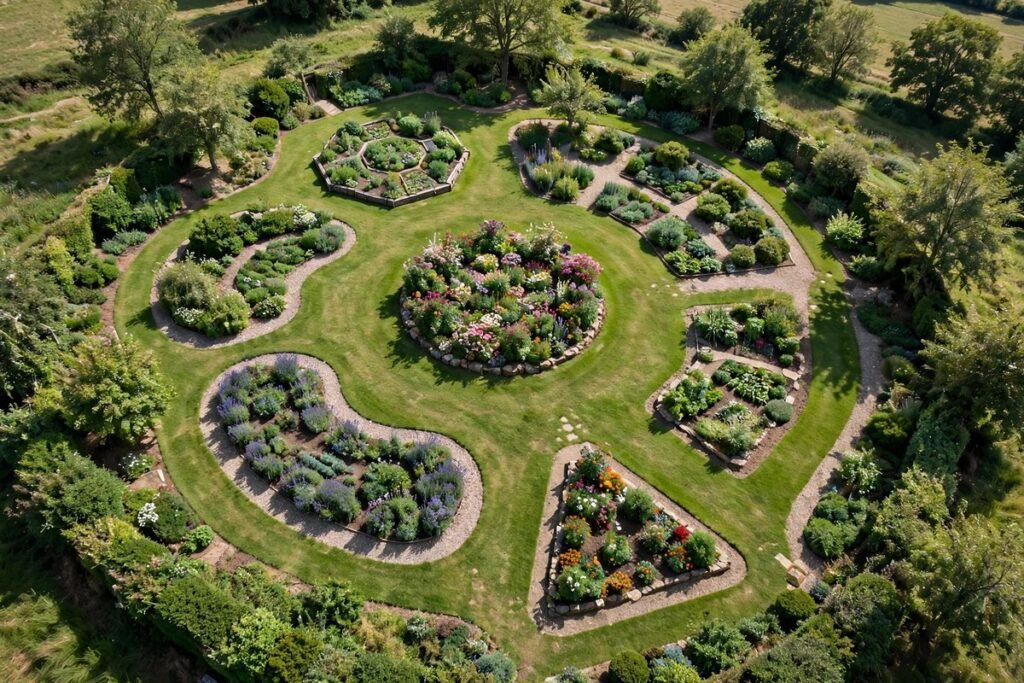
To learn how to calculate the area of an irregular garden, sketch the garden, split it into simple shapes, measure each shape, work out each area with the matching formula, and add the results together. Use rectangles, circles, triangles, and ovals for the sections, then read the total in square metres, square feet, acres, or hectares.
Why most gardens are not one rectangle
A garden that looks simple from the door often turns out to be a mix of shapes when you walk it. A straight lawn may meet a round flower bed, a path may cut a corner, a patio may sit inside the lawn, and a back corner may run at an angle. The trouble starts when you try to force the whole garden into one rectangle. People take the longest length and the widest width, multiply them, and treat the result as the area. If the garden is L shaped, that counts the missing corner as if it were lawn. If it has a round bed, it counts the corners around the circle as if they were planted.
What you need before you start
You need a tape measure, a notebook, and a pencil. A long tape helps for lawns, a short tape helps for small beds. Measure in metres or in feet, and stay with one unit through the whole job. Do not mix metres for one section and feet for another, because the total will be wrong. Write each measurement beside the right part of the sketch as soon as you take it. Measure along the ground, in straight lines, from edge to edge. For a rectangle, measure length and width. For a circle, measure straight across the middle to get the diameter. For a triangle, measure the base and the height at a right angle. For an oval, measure the full length and width. Write the unit after every number.
Sketch the garden and split it into shapes
Start with a rough sketch. It does not need to be neat or to scale. It needs to show the outline, the main parts, and the measurements. Draw the fence line first, then add the lawn, beds, path, and patio, and label each part, such as Lawn, Round Bed, and Corner. Next, split the sketch into simple shapes. Look for straight edges that can form a rectangle, round parts that can form a circle or an oval, and corners that can form a triangle. A garden that looks irregular at first often splits into two or three clear shapes. The Garden Area Calculator takes up to three sections, so plan for three at most. Set unused sections to Not used, so it adds only the sections you measured. Small gaps and overlaps rarely matter.
The four shapes and their formulas
Four formulas cover almost every garden section. A rectangle uses length times width. A circle uses pi times diameter squared divided by 4. A triangle uses base times height divided by 2. An oval uses pi times length times width divided by 4. The total area is the sum of the sections. Use pi as 3.1416 for hand work, round each section to two decimal places before you add, and round the final total to two decimal places.
| Shape | What to measure | Formula | Result |
|---|---|---|---|
| Rectangle | Length and width | Length x width | Area of the section |
| Circle | Diameter across the middle | Pi x diameter squared / 4 | Area of the section |
| Triangle | Base and height at a right angle | Base x height / 2 | Area of the section |
| Oval | Full length and full width | Pi x length x width / 4 | Area of the section |
Worked example 1: lawn, round bed, and triangular corner
This is the worked example from the Garden Area Calculator page, checked by hand. A garden has a lawn 10 metres long and 5 metres wide, a round bed 3 metres across, and a triangular corner with a base of 4 metres and a height of 3 metres. The lawn is 10 times 5, which equals 50 square metres. The round bed is 3.1416 times 9 divided by 4, which equals 7.0686, rounded to 7.07 square metres. The corner is 4 times 3 divided by 2, which equals 6 square metres. Add the sections. 50 plus 7.07 plus 6 equals 63.07 square metres. To convert to square feet, multiply by 10.764. 63.07 times 10.764 equals 678.89, which rounds to about 679 square feet.
Worked example 2: an L shaped garden in two rectangles
Many gardens are L shaped, and the shape looks hard until you split it into two rectangles. Imagine a main lawn 8 metres long and 6 metres wide, and a side strip 4 metres long and 3 metres wide, with no overlap and no gap. The main lawn is 8 times 6, which equals 48 square metres. The side strip is 4 times 3, which equals 12 square metres. Add them. 48 plus 12 equals 60 square metres. Convert to square feet by multiplying by 10.764. 60 times 10.764 equals 645.84, which rounds to about 646 square feet. If you had measured this garden as one rectangle, using the longest length and the widest width, you would have counted the empty corner of the L as if it were garden.
Worked example 3: a rectangle lawn with an oval bed
Some gardens mix straight edges and soft curves. Imagine a rectangle lawn 12 metres long and 4 metres wide, plus an oval bed 6 metres long and 4 metres wide. The lawn is 12 times 4, which equals 48 square metres. The oval bed is 3.1416 times 6 times 4 divided by 4, which equals 18.8496, rounded to 18.85 square metres. Add the sections. 48 plus 18.85 equals 66.85 square metres. Convert to square feet by multiplying by 10.764. 66.85 times 10.764 equals 719.57, which rounds to about 720 square feet.
| Worked example | Sections | Section areas | Total |
|---|---|---|---|
| Lawn, round bed, and triangular corner | 10 x 5 m rectangle, 3 m circle, 4 m by 3 m triangle | 50, 7.07, and 6 square metres | 63.07 square metres, about 679 square feet |
| L shaped garden | 8 x 6 m rectangle and 4 x 3 m rectangle | 48 and 12 square metres | 60 square metres, about 646 square feet |
| Rectangle lawn and oval bed | 12 x 4 m rectangle and 6 x 4 m oval | 48 and 18.85 square metres | 66.85 square metres, about 720 square feet |
Subtracting a patio, a path, or a building
Some gardens include ground you do not want to count. A patio, shed, path, or part of a building may sit inside the garden outline. If you measure the whole outline as one area, you will count that hard surface as if it were garden. Measure the patio or building as a separate section, work out its area, and subtract it from the total. Imagine an outline 10 metres by 8 metres, which is 80 square metres, with a patio 3 metres by 2 metres inside it. The patio is 6 square metres. Subtract 6 from 80 to get 74 square metres. Convert if you need square feet. 74 times 10.764 equals 796.54, which rounds to about 797 square feet. Use the same method for a path through a lawn.
Measuring curved edges, slopes, and very irregular outlines
A curved bed can be treated as part of a circle or an oval, or it can be split into several smaller sections with straight edges. For a half circle bed, use the circle formula, then take half the result. A full circle with a diameter of 4 metres is 3.1416 times 16 divided by 4, which equals 12.5664, rounded to 12.57 square metres. Half of the unrounded value is 6.2832, rounded to 6.28 square metres. Measure in straight lines along the ground, not up and down a slope, and not in a curve around a bed. Slopes add a little extra area, but the flat measurement is the right one for most planning.
Common mistakes to avoid
The first mistake is mixing units. Pick one unit at the start and use it for every section, then convert only the final total. The second mistake is using the wrong shape. A triangle measured as a rectangle is double the true area, and a circle measured as a square is more than a quarter larger. The third mistake is counting a section twice, when two sections overlap and both include the same strip of ground. Check that each part sits in exactly one section. The fourth mistake is rounding too early. Keep two decimal places for each section, add them, and round only the final total.
Using your total in the next step
Once you have the total area, you can use it as the starting point for the next job. The Plant Spacing Calculator uses area and spacing to work out plant counts for a bed, and the Square Foot Garden Planner uses a grid to plan crops by square. The Plants per Square Foot Calculator helps when you need a density figure for a square foot. Each tool needs a sound area total first. The Guides on The Plant Calculator give further reading on garden planning.
FAQs
Q: How do I calculate the area of an irregular garden?
A: Sketch it, split it into rectangles, circles, triangles and ovals, measure each section, work out each area, and add the sections together.
Q: How many square feet are in an acre?
A: One acre is 43,560 square feet, which is about 4,047 square metres.
Q: How do I convert square metres to square feet?
A: Multiply square metres by 10.764 to get square feet.
Q: How do I measure a curved garden bed?
A: Treat it as part of a circle or oval, or split it into several smaller sections with straight edges.
Q: What if part of my garden is a patio or a building?
A: Measure the patio or building as a separate section and subtract its area from the total garden area.
Q: Do small gaps or overlaps between sections matter?
A: Small gaps and overlaps rarely matter for buying materials, because the total stays close enough for planning.
More guides

How to Choose a Fertilizer Rate: Meet Nitrogen or Cap Every Nutrient
Learning how to choose a fertilizer rate starts with one choice. You either meet a chosen nutrient target, usually nitrogen, and accept…
Read guide
Too Much Phosphorus From Fertilizer: Surplus, Signs and Fixes
Too much phosphorus from fertilizer is a surplus that appears when a balanced blend meets nitrogen and supplies twice the phosphate the…
Read guide
Fertilizer NPK Numbers Explained: What N, P2O5 and K2O Mean
Fertilizer npk numbers are the three percentages on a fertilizer bag, listed in the order nitrogen, phosphate and potash. They tell you…
Read guide