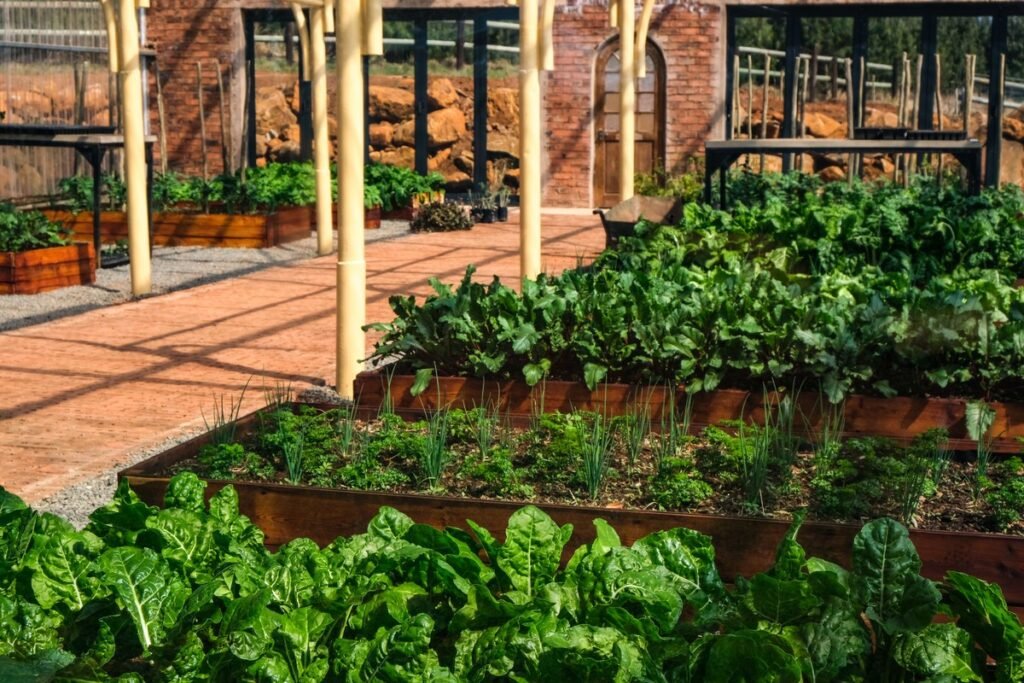
how wide should garden beds be if you want to reach, tend, and harvest without stepping on the soil? Make beds about 1.2 metres, or 4 feet, wide if you can reach them from both sides, or 75 to 90 centimetres wide if you can reach them from one side only. Keep paths 45 to 60 centimetres wide for walking.
Why bed width is a reach question
Bed width is decided by your arms, not by the size of the plot. A bed that is too wide forces you to step into it to reach the middle, and that step presses the soil down. A bed that is too narrow wastes path space. The right width lets you reach the centre from the path and tend crops while you stay on firm ground.
Stand beside a bed and reach across it with a comfortable bend at the waist. If you can walk round both sides, the bed can be about twice your comfortable reach. If a fence, wall, or hedge blocks one side, the bed must be narrower. Raised beds follow the same rule, because the edge does not add much reach.
Bed width by reach
Use the table as a starting point, then adjust it to your own reach. Shorter gardeners, children, and seated workers may need narrower beds.
| Reach | Bed width | Best for |
|---|---|---|
| Both sides | About 1.2 metres, or 4 feet | Most vegetable beds |
| One side only | 75 to 90 centimetres, or 2.5 to 3 feet | Beds beside a fence or wall |
| Short reach | 60 to 75 centimetres, or 2 to 2.5 feet | Children and seated work |
| Wide beds | More than 1.2 metres, or 4 feet | Only if you can step in safely |
Path width by use
Paths decide how pleasant the garden is to use. A path that is too narrow makes you step into a bed to pass someone. A path that is too wide takes ground that could have grown food. Choose the path by what must travel along it.
| Use | Path width | Notes |
|---|---|---|
| Walking and kneeling | 45 to 60 centimetres, or 18 to 24 inches | Enough for one person |
| Wheelbarrow | 75 to 90 centimetres, or 30 to 36 inches | Enough to push and turn |
| Two people passing | 90 centimetres or more, or 36 inches or more | Useful on a main path |
| Edge path | 45 centimetres, or 18 inches | A path all round the beds |
How the calculator fits beds into a plot
The Garden Bed Layout Calculator fits as many full length beds as possible into a plot, shows the growing area and path area, and draws the plan to scale. Beds run along the plot length, separated by paths, with a path all round.
The calculator uses four steps: bed count, bed length, growing area, then share planted by dividing growing area by plot area.
Beds equal floor of plot width minus 2 times edge path plus path, divided by bed width plus path. Floor means round down to a whole bed. Bed length equals plot length minus 2 times edge path. Growing area equals beds times bed width times bed length. Share planted equals growing area divided by plot area.
Worked example 1: a 10 by 6 metre plot
This is the worked example from the calculator page, checked by hand. The plot is 10 metres long and 6 metres wide. Beds are 1.2 metres wide. Paths and the edge path are 45 centimetres, which is 0.45 metres.
Plot width minus 2 times edge path plus path equals 6 minus 0.9 plus 0.45, which equals 5.55. Bed width plus path equals 1.2 plus 0.45, which equals 1.65. Divide 5.55 by 1.65 to get 3.3636. Floor gives 3 beds. Bed length equals 10 minus 0.9, which equals 9.1 metres, so each bed is 9.1 metres long and 1.2 metres wide.
Growing area equals 3 times 1.2 times 9.1, which equals 32.76 square metres, shown as 32.8 square metres. Plot area equals 10 times 6, which equals 60 square metres. Share planted equals 32.76 divided by 60, which equals 0.546, shown as 55 percent. Path area is 60 minus 32.76, which equals 27.24 square metres.
Worked example 2: the same idea in feet and inches
Use the same method in imperial units. The plot is 30 feet long and 20 feet wide. Beds are 4 feet wide. Paths and the edge path are 18 inches, which is 1.5 feet.
Plot width minus 2 times edge path plus path equals 20 minus 3 plus 1.5, which equals 18.5. Bed width plus path equals 4 plus 1.5, which equals 5.5. Divide 18.5 by 5.5 to get 3.3636. Floor gives 3 beds. Bed length equals 30 minus 3, which equals 27 feet, so each bed is 27 feet long and 4 feet wide.
Growing area equals 3 times 4 times 27, which equals 324 square feet. Plot area equals 30 times 20, which equals 600 square feet. Share planted equals 324 divided by 600, which equals 0.54, shown as 54 percent. Use 1 metre equals 3.28084 feet and 1 square metre equals 10.764 square feet to compare the examples. The metric plot is about 32.8 by 19.7 feet, so the imperial plot is a little smaller.
Worked example 3: what happens when you change the widths
Change one width at a time on the 10 by 6 metre plot. Plot area stays at 60 square metres, and the edge path stays at 45 centimetres unless stated otherwise.
First, use narrower beds of 0.9 metres with paths of 0.45 metres. Bed count equals 5.55 divided by 1.35, which equals 4.111, so floor gives 4 beds. Growing area equals 4 times 0.9 times 9.1, which equals 32.76 square metres, shown as 32.8 square metres. Share planted stays at 55 percent, because 4 times 0.9 metres equals 3.6 metres, just as 3 times 1.2 metres equals 3.6 metres.
Next, use one side beds of 0.75 metres with paths of 0.45 metres. Bed count equals 5.55 divided by 1.2, which equals 4.625, so floor gives 4 beds. Growing area equals 4 times 0.75 times 9.1, which equals 27.3 square metres. Share planted equals 27.3 divided by 60, which equals 0.455, shown as 46 percent.
Next, widen paths to 0.9 metres for a wheelbarrow, with beds of 1.2 metres and an edge path of 0.9 metres. Bed count equals 6 minus 1.8 plus 0.9, which equals 5.1, divided by 2.1, which equals 2.428, so floor gives 2 beds. Bed length equals 10 minus 1.8, which equals 8.2 metres. Growing area equals 2 times 1.2 times 8.2, which equals 19.68 square metres. Share planted equals 19.68 divided by 60, which equals 0.328, shown as 33 percent.
| Change | Beds | Growing area | Share planted |
|---|---|---|---|
| 1.2 metre beds, 0.45 metre paths | 3 | 32.8 square metres | 55 percent |
| 0.9 metre beds, 0.45 metre paths | 4 | 32.8 square metres | 55 percent |
| 0.75 metre beds, 0.45 metre paths | 4 | 27.3 square metres | 46 percent |
| 1.2 metre beds, 0.9 metre paths | 2 | 19.7 square metres | 33 percent |
The lesson is clear. Bed width changes the number of beds, but path width changes the growing share much more. Wide paths are worth it when you need a wheelbarrow every week. If you need wide access in one place only, keep the main path wide and the paths between beds narrow. Share planted is the part of the plot that is bed. Paths often take 30 to 45 percent of a vegetable garden, so a high share is not always better if the paths are too narrow to use well.
Direction, spare width, and curved designs
Run beds north to south in most gardens, so plants on each side get similar sunlight through the day. Note where shade falls before you fix the layout, because fences, walls, trees, and buildings can shade one side whatever direction you choose.
Spare width is the width left over after whole beds are fitted. The calculator shows it, so you can widen paths or beds a little. Do not try to squeeze in a part bed. Corner beds and curved designs are not modelled, so plan any odd shape by hand and check that you can reach every part of it from a path.
Common mistakes to avoid
The first mistake is choosing bed width from the plot size alone, without testing reach. The second mistake is forgetting the edge path. The third mistake is widening every path for one wide tool. Keep wheelbarrow width on the main route only. The fourth mistake is rounding up the bed count. Floor means round down, so 3.9 beds is 3 beds, not 4. The fifth mistake is mixing units. Pick metres or feet at the start.
Using your layout in the next step
Once you have bed count, bed length, and growing area, use those numbers for the next job. The Garden Area Calculator helps when you need the total area of the plot. The Plant Spacing Calculator uses spacing to work out plant counts for a bed, and the Square Foot Garden Planner uses a grid to plan crops by square. The Raised Bed Soil Calculator helps when you move from bed size to soil planning.
Frequently Asked Questions
Q: How wide should garden beds be?
A: About 1.2 metres, or 4 feet, from both sides, or 75 to 90 centimetres, or 2.5 to 3 feet, from one side only.
Q: How wide should paths be between garden beds?
A: 45 to 60 centimetres, or 18 to 24 inches, for walking, and 75 to 90 centimetres, or 30 to 36 inches, for a wheelbarrow.
Q: What percentage of a vegetable garden is paths?
A: Paths often take 30 to 45 percent, so a share planted of 55 to 70 percent is common.
Q: Should garden beds run north to south?
A: In most gardens, yes, because plants on each side get similar sunlight through the day.
Q: How many beds will fit in my plot?
A: Use the bed count formula with plot width, bed width, path width, and edge path, and round down, because a part bed does not count.
Q: What does the Garden Bed Layout Calculator give?
A: Bed count, bed length, growing area, path area, and share planted only, with a plan drawn to scale.
More guides

How to Choose a Fertilizer Rate: Meet Nitrogen or Cap Every Nutrient
Learning how to choose a fertilizer rate starts with one choice. You either meet a chosen nutrient target, usually nitrogen, and accept…
Read guide
Too Much Phosphorus From Fertilizer: Surplus, Signs and Fixes
Too much phosphorus from fertilizer is a surplus that appears when a balanced blend meets nitrogen and supplies twice the phosphate the…
Read guide
Fertilizer NPK Numbers Explained: What N, P2O5 and K2O Mean
Fertilizer npk numbers are the three percentages on a fertilizer bag, listed in the order nitrogen, phosphate and potash. They tell you…
Read guide