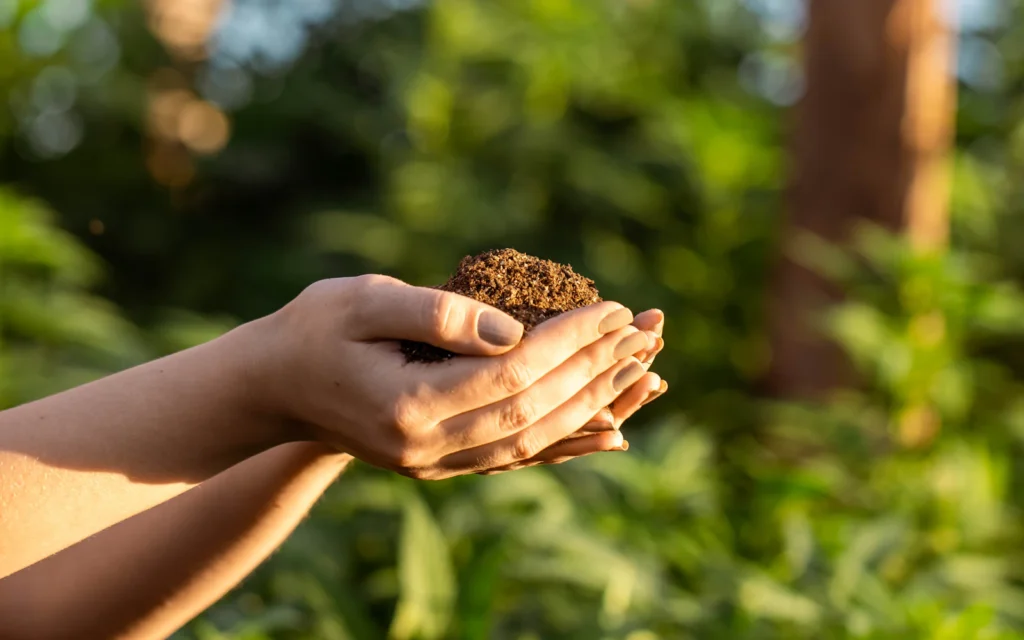
Garden centres stack them side by side in similar bags, but mulch, compost and topsoil do very different jobs. Using the right one, at the right depth, saves money and gives better results.
Topsoil: building or levelling ground
Topsoil is the mineral base of a garden. Use it to raise levels, fill new beds, level a lawn before seeding or replace poor ground. It is heavy and sold by the bag, by the tonne or by the cubic metre or yard.
Typical depths: 10–15 cm (4–6 in) under a new lawn; 20 cm (8 in) or more for a new bed; a thin 1 cm (½ in) top-dressing to smooth an uneven lawn.
Compost: feeding the soil
Compost is decomposed organic matter. It feeds soil life, improves structure and helps sandy soils hold water and clay soils drain. Use it to top-dress beds every year, build no-dig beds or mix into new borders.
Typical depths: 2.5–5 cm (1–2 in) as an annual top-dressing; 10 cm (4 in) to start a no-dig bed; a thin 6 mm (¼ in) layer brushed into a lawn.
See the Compost Calculator. To mix compost into existing soil to a target percentage, use the Soil Amendment Calculator.
Mulch: protecting the surface
Mulch is a covering on top of the soil. Bark, wood chip, straw and leaf mould suppress weeds, hold moisture and keep soil temperature even. As organic mulches break down they also add organic matter.
Typical depth: 5–8 cm (2–3 in). Deeper than about 10 cm can starve roots of air, and mulch piled against stems and trunks invites rot.
The Mulch Calculator works out bags or bulk for your beds.
Quick comparison
| Topsoil | Compost | Mulch | |
|---|---|---|---|
| Main job | Build or level ground | Feed and improve soil | Cover and protect |
| Where it goes | Below or as the bed | On top or mixed in | On top only |
| Typical depth | 10–20 cm (4–8 in) | 2.5–5 cm (1–2 in) | 5–8 cm (2–3 in) |
| Sold by | Bag, tonne, m³ / yd³ | Bag, m³ / yd³ | Bag, m³ / yd³ |
How much to buy: the one formula
All three come down to area × depth. Measure the area in square metres and the depth in metres to get cubic metres, or square feet × depth in feet to get cubic feet (divide by 27 for cubic yards). Add 10–15% for topsoil to cover settling. Above about one cubic metre, bulk is usually much cheaper than bags.
More guides
Watering in Litres and Gallons: Imperial Tables
Watering in litres and gallons starts with one figure. A garden that needs 1 in of water a week needs 0.62 US…
Read guide
How Long to Water: Hose Flow and Minutes Per Session
How long to water depends on hose flow and litres in one session. At the verified flow of 12 litres per minute,…
Read guide
Watering Sessions by Soil Type: Sand, Loam and Clay
Watering sessions by soil type split one weekly water total into 3 sessions for sand, 2 sessions for loam and 1 session…
Read guide